Protagonist's Imagined Campaign Exposing Police Corruption and Spurring a State Legislature Investigation
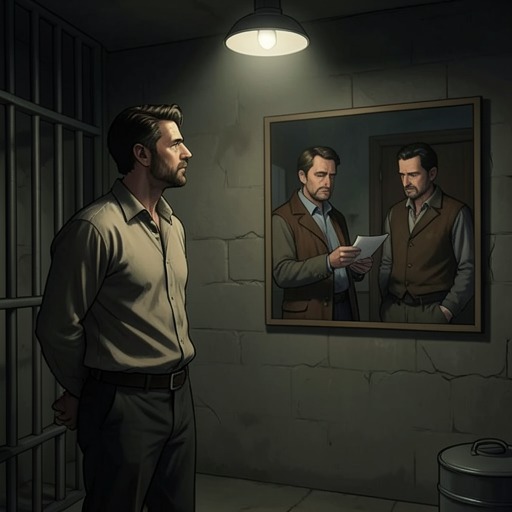
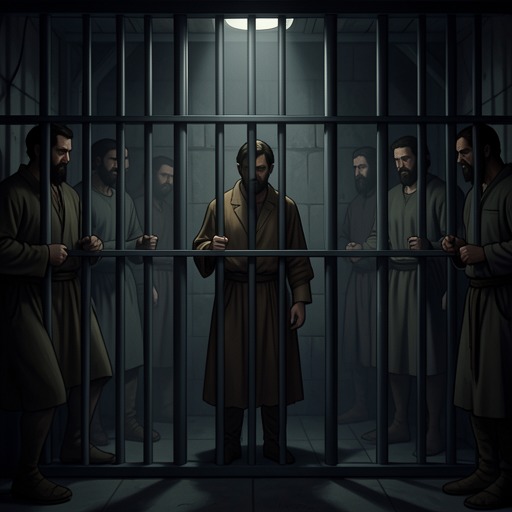
The RoomThe Unnamed protagonist’s imagined campaign to expose police corruption and provoke a State Legislature investigation transforms the helplessness of confinement into a public crusade. Its imagined victories are carefully assembled from his own grievances: he supplies the injury and testimony, while Donald Preston and Stacey Lowry provide the press, documentation, and political machinery. The campaign’s apparent progress is therefore both a fantasy of institutional redress and a portrait of how thoroughly he wants to reverse the powerlessness he associates with the justice system.
Causes and Premise
The vision grows from a letter the Unnamed protagonist has sent about what he describes as a Police State. He argues that the State’s police presence makes citizens feel watched wherever they go, and that obscure, antiquated laws give officers opportunities to harass people. Even an ordinary act such as spitting on a sidewalk, he contends, could be used against someone; minor conduct and a police officer’s personal grievance can become occasions for punishment. These are the protagonist’s accusations, not an independent account verifying each charge, and the fantasy makes them the starting point for a campaign rather than leaving them as private complaint.
Donald Preston and Stacey Lowry tell him that simply publishing his letter would accomplish little. Outrage, they warn, would fade as readers returned to everyday responsibilities unless someone pursued the issue vigorously. They say they have been looking for a person with his experience and propose using it as the campaign’s springboard. The distinction between a personal grievance and a public cause is central to the plan: his case is meant to reveal a wider pattern, including harms that could affect citizens’ children and future generations.
The proposed strategy combines public speaking, newspaper coverage, and the recovery of documentary material. Stacey Lowry is to address professional, civic, and other willing groups, while Donald Preston continues a daily series in the paper. They will search old files for statements, letters, depositions, photographs, and even rumors that could attract public attention and press the legislature to investigate. The plan openly allows for any available means, however devious, in pursuit of that end. When the Unnamed protagonist doubts that politicians will challenge a system they helped create, Donald Preston answers that officeholders are responsive to constituents because they want to remain in office.
From Complaint to Public Campaign
In the imagined sequence, the campaign gathers momentum after the Unnamed protagonist’s trial. He describes his handling of the defense attorney as the real beginning of his confidence: days on the witness stand without faltering become, in his account, concrete proof that he can manage any public challenge. Interviews with reporters and television then give him additional poise. What began as apprehension about the campaign gives way to certainty that he can face whatever follows.
A Sunday-supplement interview introduces him to a broad readership, accompanied by photographs of jails and detention homes. The following week, a series of illustrated articles emphasizes that people held in these conditions have been accused, not convicted, and remain presumed innocent under the law. The account gives particular weight to juveniles sleeping on floors and suffering from malnutrition. Some, it says, have not been accused of any crime at all; they are in custody because sick or unable parents cannot care for them and they have nowhere else to live. In the protagonist’s imagined campaign, these details turn an abstract charge of official abuse into visible human consequences.
The response exceeds expectations: reading and acknowledging letters becomes a full-time task. Coverage extends throughout the country, and the State Legislature is depicted as pressing the campaigners to testify. Donald Preston and Stacey Lowry bring attaché cases filled with photographs and documents, but the Unnamed protagonist regards himself as the campaign’s nucleus. To him, records and statistics supply facts, while his personal testimony makes those facts intelligible and emotionally real to the public. His presence is not merely another item of evidence; it is what gives the evidence significance.
The Hearing as Reversal
At the Capitol Building, reporters, photographers, and television crews are already waiting. The Unnamed protagonist expects questions before he even enters, but imagines answering calmly and continuing to tell the truth about the authority he says has abused him. He recognizes familiar reporters, responds to the press, radio, and television, and then enters flanked by Donald Preston and Stacey Lowry. The passage dwells on the contrast with his earlier experience in court: marble corridors, high ceilings, and heavy doors recall the courthouse where he felt vulnerable and ignored, but now he enters as a public figure whose presence draws attention.
The old anger does not disappear. Remembering the earlier courtroom brings back his rage at the police officers he believes lied and at the public defender he believes failed him. He imagines punishing those officers, then distinguishes the present scene from that earlier helplessness: he now feels that he is someone who must be reckoned with. Having the two officers dismissed from the force would not be enough, he thinks; the campaign must continue until the entire system is exposed. His imagined resolve to keep fighting even if Donald Preston and Stacey Lowry stop gives the fantasy an escalating, uncompromising edge.
Inside the hearing room, he sees a crowded chamber, microphones, press tables, and the people assembled to watch him. He believes that the audience, and people beyond the room, sympathize with what he is trying to do. Even a nod, he imagines, could become news. The committee chair opens the proceedings by presenting the inquiry as necessary and urgent, rejecting the suggestion that it is either a whitewash or a partisan indictment, and promising a search for truth. The Unnamed protagonist nods alongside his allies as the chair acknowledges their cooperation.
Stacey Lowry then reads a prepared statement that functions as the campaign’s manifesto. It gives humane reasons for the effort, previews the evidence, and thanks the committee for responding quickly to the request to present the investigation’s findings. Stacey Lowry follows it by praising the Unnamed protagonist as the campaign’s most important member. The imagined hearing thus places his personal story within an organized political effort while also making him its honored centerpiece.
Fantasy, Justice, and Self-Image
The campaign’s triumphant conclusion is explicitly part of the protagonist’s inward vision. As Stacey Lowry’s tribute continues, he lowers his eyes modestly and lets the scene drift rather than trying to preserve its full clarity. He imagines people photographing him and shaking his hand, committee members speaking with him, and the officers who had harmed him asking for help and forgiveness. The fantasy reaches a reversal unavailable in the earlier courtroom: those who once held power over him now depend on him. He then drifts into sleep in his cell, the imagined public recognition giving way to waking confinement.
The scene draws force from the gulf between formal legal ideals and the protagonist’s experience of legal process. When charges were read at his earlier appearance, much of the language sounded unintelligible; he pleaded not guilty, accepted paper and pencil from an unfamiliar public defender, and quickly concluded that the attorney had already abandoned him. Later, he generalizes his distrust into the claim that poor defendants are punished harshly while wealthy offenders can secure skilled lawyers. Those resentments explain why the campaign fantasy treats testimony, publicity, and legislative attention as instruments of justice—and why the prospect of being listened to matters as much as the promised investigation.
The imagined campaign does not establish that the investigation or its victories occur outside the vision. Instead, it reveals how the Unnamed protagonist recasts injury into a narrative of public vindication: his testimony turns cold evidence into lived proof, the hearing places him at the center of the room, and the men he resents are reduced to asking his pardon. The same vision that gives him confidence also preserves his rage and presents the pursuit as something he will never abandon. Its political hope and its personal appetite for reversal remain intertwined.