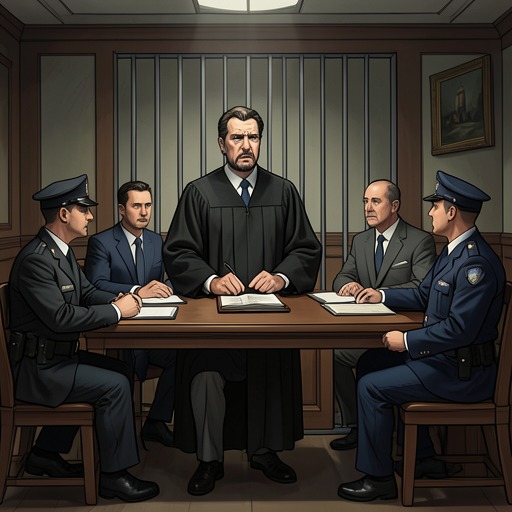
Stacey Lowry
The RoomStacey Lowry is a prominent criminal lawyer who joins newspaper publisher Donald Preston in opposing police abuse and its institutional causes. In the Unnamed protagonist’s imagined campaign, Lowry becomes both a public advocate and a practical legal ally: he helps secure the protagonist’s release and later wins dismissal of the charges at a preliminary hearing. That idealized alliance is thrown into sharp relief by the protagonist’s later conviction that a lawyer of Lowry’s standing would consider representing him beneath his dignity.
Identity and Public Work
Lowry is introduced as an attorney whose public reputation reaches beyond the immediate case: the narrative calls him a world-renowned criminal lawyer. He and Preston describe themselves as having worked for years to make the public understand police brutality not as a collection of isolated officers’ excesses, but as an expression of a larger structure of authority. Lowry has lectured on the subject, while Preston has tried to reach readers through editorials. Both acknowledge that their efforts have often failed to command lasting attention.
Their critique is given a concrete political frame in the letter the Unnamed protagonist is composing. It describes a Police State in which police serve as the visible instruments of state surveillance, and argues that obscure, outdated laws give officers opportunities to harass ordinary citizens. Lowry’s role in the ensuing scene is not to originate the letter’s claims, but to recognize them as an account of the structural problem he and Preston have been trying to expose. His response places the protagonist’s account within an existing public argument rather than treating it as a private grievance alone.
Alliance with Donald Preston
Lowry acts in partnership with Preston. After Preston receives the smuggled letter, he contacts Lowry and arranges for them to visit the imprisoned protagonist the next morning. A captain makes an exception to ordinary visiting hours, but the protagonist privately recognizes that a lawyer can come at any time. The detail sets Lowry’s professional access against the prisoner’s restricted circumstances.
During the visit, the protagonist describes being deprived of his money and even of cigarettes and a toothbrush. Lowry responds with indignation, and Preston says they have already contacted a bail bondsman and expect the protagonist to be released within an hour. The two men promise to remain until the paperwork is finished, wary because the captain has shown curiosity about their visit. Their support therefore has an immediate practical purpose as well as a political one: they seek to remove the protagonist from detention while ensuring that the unusual visit does not expose the letter’s route out of the prison.
The three also discuss how to turn the letter into sustained pressure. Preston proposes that Lowry speak to professional and civic groups, while he continues publishing material in the newspaper and searches old files for statements, letters, depositions, photographs, and even rumors that might provoke public attention. Their stated objective is to force a legislative investigation. Lowry and Preston present public agitation as necessary because publication by itself might produce only brief outrage before everyday concerns displace it. Their plan depends on the protagonist’s experience as a springboard, making him the visible subject of a campaign they intend to conduct through both legal and media channels.
Legal Advocacy
In the courtroom scene, Lowry appears as a controlled and efficient advocate. The Unnamed protagonist stands through the reading of the charges, pleads not guilty, and listens as the preliminary hearing begins. After the prosecution questions the first arresting officer, Lowry rises, walks partway toward the witness stand, and questions him for only a few minutes in a smooth, moderate voice. He then asks the court to dismiss the charges, citing State v Rubens (1958; 173,20.5). The motion is granted, and Lowry leads the protagonist out of the courtroom.
The sequence contrasts sharply with the protagonist’s earlier encounter with appointed counsel, whom he does not know and immediately suspects of having sold him out. In that scene, he tries to listen to the testimony himself and prepares to note discrepancies his lawyer has missed. Lowry’s brief cross-examination and successful motion supply the opposite image: an attorney who sees a legal opening, acts decisively, and obtains release. The contrast helps explain why Lowry carries such force in the protagonist’s hopes, even though the available scene presents the courtroom success as part of an envisioned campaign rather than establishing it as an independently confirmed outcome.
The Protagonist’s Changing Image of Lowry
The protagonist’s imagined alliance initially turns Lowry into proof that his cause can attract powerful allies. At the visit, the protagonist is relieved that the letter reached Preston; he is also ready to cooperate with whatever campaign might remedy the abuses he describes. Lowry’s indignation at the deprivation in custody and the promise of legal assistance give that hope a personal as well as political form. In the imagined courtroom victory, the alliance culminates in freedom and a toast to the campaign still to come.
Later, however, the protagonist’s angry outburst about unequal justice recasts Lowry as inaccessible. He imagines that a famous, well-paid lawyer would not stoop to defend someone like him, would fear losing a case, and would prefer to leave poor defendants to languish in jail. This accusation conflicts with the earlier scenes, in which Lowry visits, works with Preston to secure release, and represents the protagonist at the hearing. The discrepancy is significant not as evidence of Lowry’s conduct, but as a measure of the protagonist’s unstable expectations: the same lawyer can appear first as the capable ally who defeats the prosecution and later as a symbol of the legal profession’s indifference to the poor. Lowry’s narrative significance lies in that double image, joining an ideal of effective public-minded advocacy to the protagonist’s distrust of whether such advocacy could truly be available to him.