Stagnant and Oppressive Time
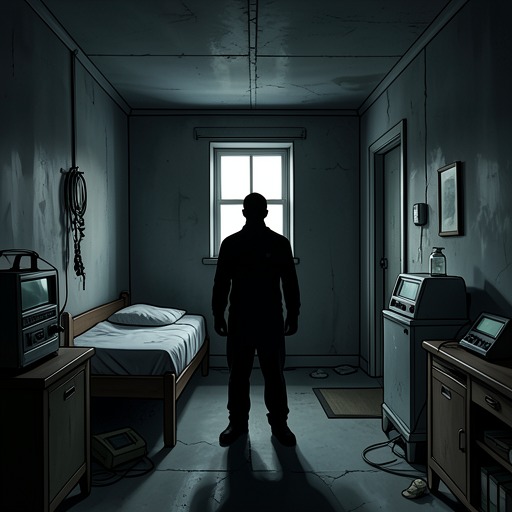
The RoomStagnant and Oppressive Time names a central feature of the protagonist’s experience: time seems not to move, yet its passage remains an unrelenting source of pressure. Sleeplessness, the absence of visible change, and the repeated return of night make duration feel like an ordeal without a clear endpoint. A clock might show change, but without a reliable sense of having slept or moved forward, even the prospect of another day feels like repetition rather than a beginning.
Time as Pressure
The protagonist describes time as capable of moving at opposite speeds. It can drag for so long that duration feels burdensome, or disappear before it seems to have arrived. Neither experience offers comfort: time’s apparent speed does not give it purpose, and its slowness makes waiting itself oppressive. He longs to sleep for twelve or sixteen hours so that time might pass without being endured consciously, but recognizes that prolonged sleep cannot be sustained. After a temporary exception, he returns to the same condition of waiting to sleep again.
This language makes an abstraction immediate and bodily. Time is experienced not as a neutral measure but as a force bearing down on him. The result is a repeated tension between what he knows and what he feels: hours may pass according to the clock, while his consciousness registers no meaningful movement. The passage of time is therefore less a route toward change than a pressure he must continue to withstand.
Sleep Without Assurance
Sleep appears to promise an interval in which the protagonist need not experience time directly. Yet even the loss of consciousness does not reliably provide rest. He may dream that he is awake, still lying in bed and still trying to fall asleep. On waking, he cannot find anything that proves time has passed: the room and his experience seem unchanged, and he cannot identify a tangible difference between one moment and the next. The uncertainty turns sleep into a problem of evidence. Without an observable sign of elapsed time, he cannot reassure himself that he has rested.
The possibility of sleeping for a long stretch consequently fails to resolve the deeper difficulty. What he wants is not only unconsciousness, but a perceptible movement away from the present condition. Even the prospect of death or nonexistence appears in his thoughts as an imagined escape from this pressure, not as a change the narrative confirms. His desire for rest thus becomes inseparable from the desire for some proof that time has moved and that he is no longer suspended in the same moment.
The Clock and the Night
The protagonist’s account of nighttime gives this suspension a recognizable structure. He lies awake as the ticking clock seems to grow more prominent, while darkness and the threat of something beyond the room leave him unable to move freely. He waits for a hint of light that would show the night is over. At daybreak, the clock’s second hand becomes evidence that time is moving outside him, but that evidence also forces the next day into view. The day ahead presents itself as a succession of minutes to get through, after which another night and another attempt to sleep await.
This cycle explains why the clock’s movement is both necessary and insufficient. Watching its hand pass the numbers can establish that time is advancing, yet it cannot make the hours feel bearable or guarantee sleep when night returns. The clock registers motion while the protagonist experiences immobility. Each new day changes the calendar’s sequence, but does not assure release from the condition that made the previous night so difficult.
Grayness, Sickness, and Familiarity
The grayness of the room becomes a visual counterpart to this uncertain duration. Closing his eyes reduces the light without producing full darkness: he seeks a diminished, less demanding field in which there is nothing to see. That grayness does not make time pass, but it marks an effort to lessen the immediate demands of wakefulness. The distinction matters: the protagonist seeks relief from exposure without finding the complete, secure absence of sensation he wants.
His sickness, meanwhile, changes from an acute threat into a constant presence he can rely on. It remains uncomfortable, but for the moment it does not require the crisis of vomiting; instead, he imagines it as a companion that will not desert him. This altered relationship does not cure his distress or resolve the night’s stagnation. It offers a limited kind of constancy within an experience in which change is difficult to perceive. Persistent bodily sensations become familiar markers where the passage of time provides none.
Repetition and Narrative Form
The concept also connects the protagonist’s nights to the structure of repetition in his account. He describes waking, watching time move, facing another day, and returning to bed only to encounter the same difficulty again. Repeated formulations of waiting and immobility make the reader experience the duration rather than merely receive a report that it feels long. The account circles through failed attempts at rest, the search for evidence, and the return of pressure, echoing the cycle it describes.
Stagnant and Oppressive Time therefore does not mean that nothing happens in an objective sense. A clock advances, sleep may occur, and the scene shifts from night to morning. What remains stalled is the protagonist’s felt relation to those changes: he cannot reliably recognize them as progress or turn them into recovery. Time continues, but it offers no dependable exit from the next interval of waiting.