The prison
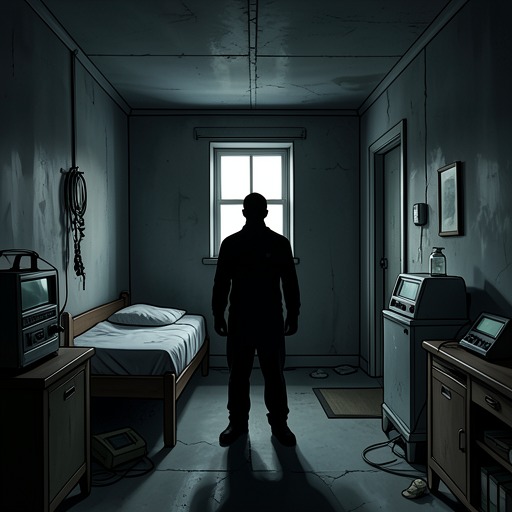
The RoomThe prison is presented less as a backdrop than as a system that organizes the imprisoned man’s time, movement, and attention. Its locked cell can feel like a refuge from the exposed corridors, yet the routines beyond its door continue to dictate when he must rise, eat, and answer a call to court. The contrast between enclosure and compelled movement gives the institution its central significance: it offers shelter only within the same confinement that narrows his choices.
Layout and Boundaries
The cell is furnished with a bunk, a sink, and a mirror, and its door is heavy steel fitted with a small window of thick, wire-mesh glass. From inside, the man looks through the window toward a corridor and its baskets and signs. When the door is shut, he attends to its material solidity: it is locked and, in his perception, impenetrable. That boundary briefly reassures him. The same door, however, is also the barrier through which prison staff control his access to the rest of the institution.
Beyond it, the corridor is described as seven feet wide. Dirty-linen baskets stand opposite the cell, marked with labels for shirts, pants, blankets, bath towels, and hand towels. At night, the man strains to read the last signs through the glass, shifting his position and repeating the list to himself. These small observations become a way to occupy attention inside an environment where movement is restricted. The visible corridor is close enough to inspect in detail, but the locked door keeps it beyond reach.
Routine and Prison Time
The prison’s daily schedule is registered through recurring necessities rather than through a reliable sense of the hour. The man thinks of three meals and an occasional shower as the measures of the day. Lights remain on, though the corridor is noisier during the day, so darkness and brightness do not provide dependable markers of time. Instead, the cell’s lighting becomes something to which he gradually adjusts: what first seems dim can come to feel bright, until a change in the lights unsettles that perception again.
Sleep offers no clear escape from this suspended routine. The man reflects that the same twenty-four hours must pass whether he sleeps at night or during the day, and that more sleep can make time pass faster. An uncertain stretch of rest leaves him wondering whether, or for how long, he slept. He then remembers that he had been awakened for court at about 5:30 and returned to his cell after 7:30, following a day that lasted fourteen hours. In retrospect, he can compress that wait into a short review; while it was happening, its sequence of waiting seemed endless. The prison’s time is thus both repetitive and unstable: hours drag in the moment, then collapse into a few remembered details.
Compelled Movement
The route to meals makes the institution’s control of movement concrete. At the call for food, the man must get out of bed, go to the mess hall, stand in line, take a tray, wait, collect food, sit at a table, return the tray, and go back to his cell. The steps are ordinary, but he experiences them as a chain of required actions with no alternative. Even before leaving the bed, he focuses on the sequence he has to complete, as though the first movement must be managed before the next can begin.
On one occasion, severe distress and physical weakness make that routine difficult to carry out. He struggles to rise and steady himself, then has to make his way down a corridor that seems excessively bright, long, and wide. He fears falling and imagines the walls as surfaces against which he might brace himself. Closing his eyes is no solution: he nearly loses his balance and opens them again. The corridor’s signs, doorways, people, entrance to the mess hall, and lights return to view, along with the sense of being exposed to watching eyes. The required walk turns an institutional route into an ordeal, while the meal schedule remains in force.
Shelter and the Unanswered Call
After returning to his cell, the man lies with his face against the pillow and remains nearly motionless. The door clangs shut, and he registers the sound as evidence that he is safe. He looks again at the thick steel and small window, seeing the locked door as a firm separation from the people, lights, baskets, rooms, and hallways outside. The cell’s security is real within this moment, but it is inseparable from the enclosure that has governed his day.
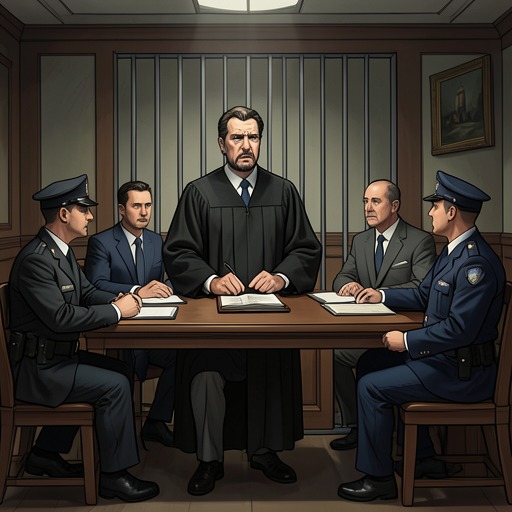
The final scene places that enclosure beside another institutional demand. A set of prison clothes is tossed onto the bed, and a voice calls that it is time for court. The man does not move; he remains on the bed rather than responding to the open doorway. The prison has repeatedly compelled him through meals, corridors, and transfers, but at this point the summons does not produce the expected action. The scene ends inside the cell, leaving the tension between enforced routine and his refusal unresolved.