The protagonist’s imprisonment
The RoomThe protagonist’s imprisonment is a sustained condition that narrows the Unnamed protagonist’s world to a locked cell, its few objects, and the corridor beyond its door. It is not merely a backdrop: confinement governs his daily routine and alters how he perceives time, light, and his own capacity to act. The cell becomes at once the site of his anger at the police, his restless attempts to occupy himself, and, at the end of one passage, the boundary that makes him feel safe.
The Cell and Its Routine
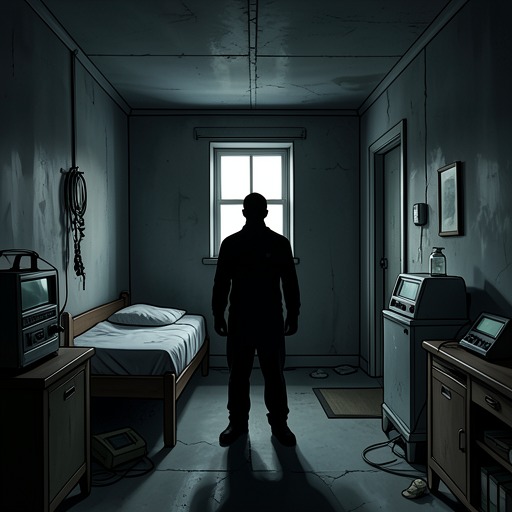
The protagonist’s immediate world is starkly limited. He measures it against the outside, describing the cell as only 50 square feet, with a bed, a toilet, and a steel door, while those beyond it have the whole world to move through. The contrast gives physical form to his sense of unequal freedom: he is fixed in a small space while the officers he resents can come and go.
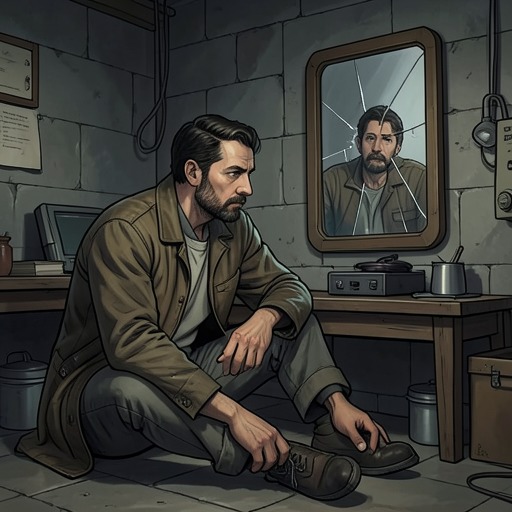
The cell’s familiar details become objects for sustained attention. Through the small window in the door, he sees his reflection, the corridor, laundry baskets, and signs identifying their contents. He reads the labels repeatedly, shifting position to make out the last ones. At the sink, he studies a blemish on his cheek, touching it, reconsidering, and returning to inspect it. These small acts fill the space left by more consequential choices that imprisonment removes.
Daily life is described through institutional regularity rather than meaningful variation. He counts three meals a day and an occasional shower, while the lights remain on so that day and night become difficult to distinguish. The laundry signs, steel door, sink, bed, and toilet persist as the cell’s fixed inventory; repeated observation does not change them, but marks the hours spent inside them.
Time, Light, and Repetition
Confinement unsettles the protagonist’s sense of duration. He reasons that the same twenty-four hours must pass whether he sleeps or stays awake, yet sleep can make time move faster. A memory of waiting for Christmas morning as a child gives him a comparison for the difficulty of falling asleep even when sleep promises to shorten the wait. In the cell, however, there is no anticipated morning that can transform waiting into an occasion; the passage of time is itself the problem.
Light offers another cycle of adjustment without genuine change. The cell appears bright to him under the night light, although he recognizes that it is dimmer than during the day, when the ceiling lights are on. As his eyes adapt, brightness becomes ordinary and darkness returns as a temporary disturbance when the lighting changes. The sequence leaves him with a repeated pattern: he gets used to one condition, then it changes, and he must adapt again.
A day spent going to court shows how confinement can make time feel both endless and compressed. The protagonist recalls being awakened around 5:30 and returning to his cell after 7:30, after roughly fourteen hours of waiting, transfers between holding areas, travel by bus, and court proceedings. At the time, the hours seemed to stretch without end; afterward, he could review the sequence in minutes and remember little of it. Institutional movement fills the day without giving it a lasting sense of progress.
Anger and Restricted Agency
The cell gives the protagonist’s resentment a recurring focus. After a court recess, he paces and condemns the officers, their uniforms, and the authority he believes their badges afford them. He imagines making them regret their conduct, but the action available to him in the moment is walking back and forth within the cell. Elsewhere, his anger intensifies into a private outburst directed at the police, while his body and surroundings remain enclosed. The contrast between the scale of his hostility and the small space in which it reverberates is central to the depiction of his imprisonment.
His attention repeatedly returns to the cell’s boundaries and imperfections. He looks through the door’s small window at the corridor and its signs, then turns back to the mirror or the bed. Later, he studies the gray concrete floor, where spots, cracks, and patches differ only slightly in shade. As he reflects that everything seems the same and nothing matters, the physical sameness of the cell becomes entangled with a broader sense of futility. A memory of childhood camp, with swimming, hikes, and a canoe race, also returns through this present confinement; even that recollection is qualified by the feeling that the experience was never quite what it should have been.
Confinement and the Feeling of Safety
Leaving the cell does not immediately restore the protagonist’s sense of control. In a corridor he experiences as too bright, too long, and too wide, he struggles to keep moving and imagines narrower ways through it, such as bracing himself against the walls. He tries to close his eyes but cannot sustain the attempt, and remains aware of the floor, walls, signs, doorways, people, and lights. The scene presents institutional space as difficult to navigate as well as impossible to escape.
When the steel door finally clangs shut, the protagonist registers the sound and feels safe. He looks at the thick gray door, its small window of reinforced glass, and the heavy bolt; outside it are people, lights, baskets, signs, rooms, cells, and corridors, but the barrier holds. This sense of safety does not mean that imprisonment has ended. Rather, the same locked boundary that restricts his movement can also protect him from the exposed, overwhelming space beyond it. The passage closes with him facing the door and confirming that it is locked, leaving confinement as both an imposed condition and, for that moment, a refuge.