The protagonist’s obsessive rage and violent fantasies
The RoomThe protagonist’s obsessive rage and violent fantasies are a recurring state in which confinement, fixation, and resentment feed one another. A minor blemish in the mirror becomes an immediate focus of distress; anger then surges toward police officers whom he blames for his imprisonment and for the abuse of Mrs. Haagstromm. His retaliation grows in imagination from threats against individual officers to an elaborate campaign against them and their families. The contrast is decisive: he can picture punishment on an immense scale, but remains alone in a cell, pacing, staring, and returning to the same grievances.
Confinement and Fixation
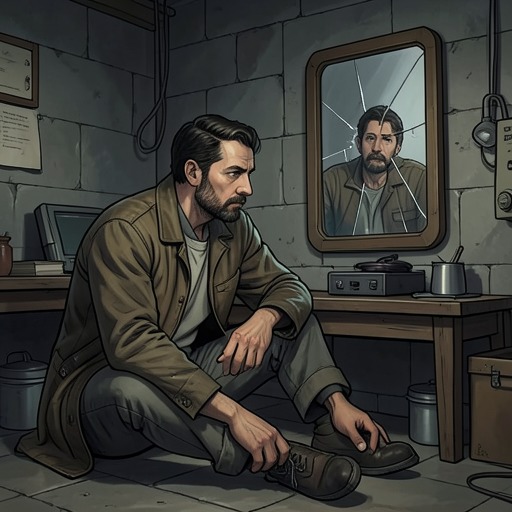
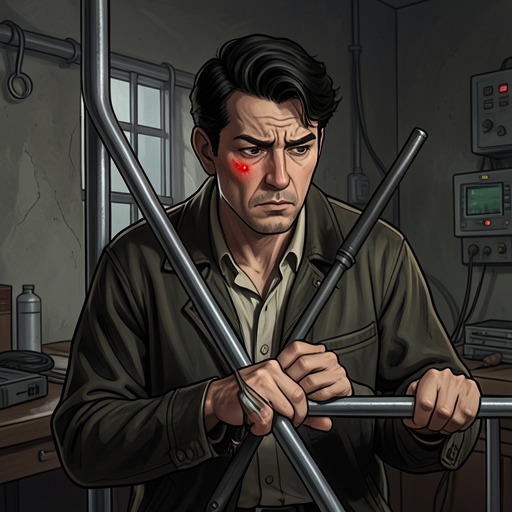
The cell gives the rage a narrow, repetitive setting. The protagonist approaches its small window, catches his reflection, and then looks into the mirror above the washbasin. His attention settles on his bloodshot eyes and, more insistently, on a pimple on his cheek. He believes it has grown since he last examined it and fears that it is spreading. Touching it causes pain, and he struggles to keep himself from clawing at his face. The passage presents the pimple not as a passing irritation but as an object that seems to command his attention and threaten his control.
That fixation is also a way the cell’s sameness becomes perceptible. After his outburst, he turns toward the barred window and its faint light, then lowers his head to study the concrete floor. Spots, cracks, blemishes, and slight variations in gray occupy his attention. The movement from the pimple to the floor links his bodily preoccupation with the oppressive visual monotony around him: both offer details to inspect, but neither offers a way out. His gaze repeatedly returns to surfaces, while his thoughts return to the people he holds responsible.
From Anger to Violent Ideation
The anger takes the form of movement as well as thought. He storms across the cell, shouts threats in his own mind, and makes gestures as if attacking people who are not there. His body turns and his hands move through the confined space, but no confrontation occurs. The scene makes the distinction between violent fantasy and action clear: the fury is intense, yet it remains enacted within the cell as pacing, gesturing, and imagined speech.
A related episode shows how the fixation recurs rather than resolving. After thinking of the officers he believes are free to escape consequences, he crosses the cell repeatedly, stops at the mirror, and squeezes the pimple. The effort produces no lasting relief; he continues to examine it and hopes it may eventually disappear. The return from anger at the officers to the blemish, and from the blemish back to anger, makes the two preoccupations part of the same closed loop. Neither the physical irritation nor the grievance is settled, so each becomes available to restart the other.
Police Abuse and the Grievance
The fantasies draw force from the protagonist’s conviction that police officers use their authority to mistreat people and avoid punishment. In the context of his thoughts about Mrs. Haagstromm, he imagines the officers laughing while he remains jailed and regards their impunity as another injury. The passage presents this as his perception and grievance, not as an independent account of what the officers are doing at that moment. His resentment is directed at the officers, but it also widens into contempt for the badge, uniform, and social standing that he believes allow them to dominate others.
After a courtroom recess, he imagines that he does not need a lawyer to make the police look foolish. He dwells on the officers’ presumed arrogance and on the possibility that people with badges can push others around and get away with it. His imagined response is to expose and punish them. The courtroom setting sharpens the contrast between formal proceedings and the private scene unfolding in his cell: the legal process continues, while his own version of justice takes shape as an increasingly personal promise of retaliation.
The Scale and Limits of Revenge
The imagined campaign eventually extends far beyond the officers themselves. The protagonist pictures them confined for years in a locked psychiatric ward, watched by independent psychiatrists, deprived of privileges, and made to live among other distressed and violent patients. He imagines their release being delayed and their public reputations permanently marked. These punishments belong to his fantasy; the account does not establish that they occur. Their detail shows how revenge has become a project of prolonged control rather than a response limited to the original grievance.
He then extends the punishment to the officers’ families. He imagines pursuing them wherever they move, making them targets of public whispers and hostility, and driving them from place to place until they are exhausted and despairing. His imagined retribution is explicitly presented as his own design, carried out in his own time. The expansion from officers to children and relatives reveals the extremity of the fantasy: its imagined victims multiply, and its intended duration becomes lifelong. The account does not turn these wishes into completed events.
The imagined courtroom outcome offers a final contrast between outward restraint and inward escalation. The officers, in the protagonist’s imagined proceeding, do not protest; he interprets their silence and their expressions as signs of fear. He imagines that their suffering has only begun and that he will keep thinking about them for years. The certainty he assigns to their inner state belongs to his perspective, just as the elaborate punishments belong to his fantasy. His rage therefore does not resolve the confinement that sustains it. Instead, the cell’s restricted routines, the repeated scrutiny of the pimple and the floor, and the recurring grievance keep the fantasy active while leaving its promised revenge unrealized.