Things Keep Getting Spoiled · “Leave Me Alone”
The RoomThings Keep Getting Spoiled / “Leave Me Alone” is a recurring motif in which the protagonist interprets disappointment as evidence that someone or something is continually interfering with his life. It binds his anticipation of an ordinary Saturday to his resentment of imprisonment and to smaller frustrations with his body and everyday objects. The refrain gives these episodes a shared shape: a modest expectation is obstructed, and the obstruction becomes proof, to him, that he cannot be left in peace.
The Pattern of Anticipation and Disappointment
On Saturday, the protagonist sits in his room waiting for his mother to call him to dinner. He is somewhat more relaxed, but remains puzzled and dissatisfied, even though the day has gone as planned so far. Saturdays matter because he looks forward to them from Sunday onward; the promise is not secure, however. He worries that something will prevent the evening from unfolding as expected, as it has on other occasions.
The plan involves seeing Mary after dinner. He expects to spend time with his friends first, then find an excuse to leave without telling them where he is going. A possible change in the babysitting arrangements could disrupt the meeting, and he recalls being caught off guard on a previous evening when Mary said she could not babysit. His frustration is less about a single canceled plan than about the threat that a carefully anticipated routine may be spoiled at the last moment.
The weekly cycle makes that threat feel larger. The passage moves from Saturday’s expectation toward Sunday morning, when he describes a persistent heaviness and a sense that the day is gray. His mother asks whether he wants to go to church; he declines, then spends the day with friends. School days follow, and Saturday returns as the next opportunity to see Mary. The repetition offers a schedule but no lasting relief: each week renews the hope, and the next Sunday restores the dissatisfaction.
Confinement and the Demand to Be Left Alone
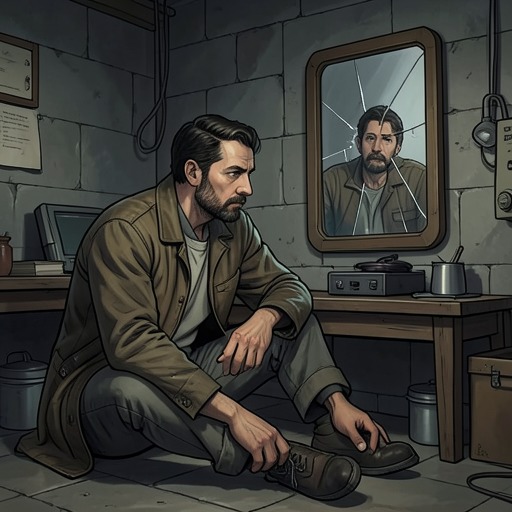
In the cell, the same complaint takes on a sharper setting. The protagonist studies the junction of wall and floor, paces, and pauses at the mirror before looking around at the bed and steel door. He measures his surroundings against the freedom he attributes to the officers outside: his cell is only fifty square feet, with a bed, a toilet, and a steel door, while they can roam the world. The contrast turns confinement into a repeated confrontation with what he cannot do and what he believes others can do without restraint.
His thought returns insistently to the idea that people keep spoiling things and will not leave him alone. He imagines the officers driving around and laughing while he remains locked up. In this setting, the wish for five uninterrupted minutes is not a practical request with a clear solution; it is a compressed expression of his broader grievance. The refrain makes the cell’s physical limits and his sense of grievance echo one another, while revealing that he experiences obstruction as a pattern rather than as an isolated event.
Small Obstacles Enlarged into Grievances
A painful pimple provides another instance of that pattern. The protagonist recalls the ingrown hair that caused a lump on his cheek, kept him from sleeping on that side, and left him in pain until he removed it. Even after the immediate problem has been dealt with, he dwells on the ordeal and generalizes from it: a single hair, like other people, has managed to upset his life. He examines the material he has removed and the affected area, then eventually flushes it. The detailed attention to this minor bodily problem shows how completely the grievance can absorb his attention, even as his conclusion expands beyond the pimple itself.
A length of string and a knot produce a similar escalation. Trying to remember a bowline, he cannot make the string behave as he expects. He recalls the illustrations in a Boy Scout manual and tries another method, but still fails. He then berates the string, throws it down, and eventually flushes it. His complaint widens from this immediate failure to knot-tying contests and a teacher’s decision to schedule arithmetic after English. In his account, different frustrations join under the same judgment: people in charge do not know what they are doing, yet others must comply with them.
His example of buying shoes extends the complaint into a general scenario of ordinary dependence. A customer specifies a kind and size, but the salesperson insists that the shoes fit and look good; by the time the customer gets home, the shoes have caused blisters. The passage presents this as an example of how an everyday transaction can leave someone with little recourse, not as a separately established event in the protagonist’s life. Its place in the motif is clear: even a basic request can, in his telling, be overridden by someone else’s assurance.
Repetition and Its Significance
Across these scenes, the objects change—the Saturday plan, the cell, the hair, the string, the shoes—but the interpretive pattern persists. A possible interruption becomes a spoiled day; a failed knot becomes evidence of incompetence; physical discomfort becomes another instance of being thwarted. The protagonist’s complaints name real constraints in the scenes, including his confinement and the pain caused by the ingrown hair, but his repeated generalizations also collapse different kinds of frustration into one account of universal interference.
The motif therefore connects domestic routine and prison anger without treating them as equivalent circumstances. In the Saturday passage, the feared disruption is a change to a plan; in the cell, the demand to be left alone is voiced from a severely restricted space. The repeated language supplies continuity between those settings, while its accumulation makes the protagonist’s response feel increasingly consuming. His refrain promises that a brief period without interference would make everything right, but the recurring structure offers no such resolution: each new obstacle renews the same grievance.