United States Senate Special Investigating Committee
The RoomThe United States Senate Special Investigating Committee is the imagined congressional forum through which the Unnamed protagonist recasts personal grievance as a national demand for accountability. Its importance lies less in any documented institutional action than in the platform it supplies: a room of Senators, cameras, and microphones becomes, in his vision, a stage from which he can expose police abuse to the country and the world.
Appearance and Narrative Status
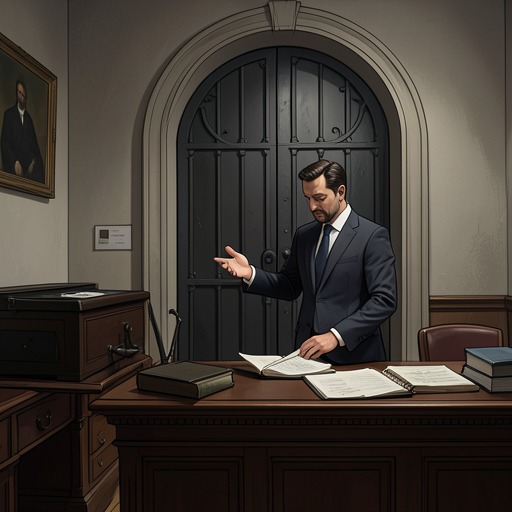
The committee enters the narrative during a carefully staged scene of testimony. The Unnamed protagonist pauses, looks down at his hands, then faces the Senators seated behind a long table. He is conscious of the microphones, cameras, lights, and eyes on him, and imagines that his words will reach audiences far beyond the chamber. The high-ceilinged room and its applause give the scene the scale of a public reckoning.
The surrounding narrative frames this appearance as part of the protagonist’s imagined campaign against police corruption, not as an independently established Senate proceeding. The committee functions as the destination of his fantasy of exposure: a national institution before which his account might acquire authority and an audience. The text does not establish that the committee actually convened, opened an investigation, or issued findings.
The Protagonist’s Appeal
In his address, the Unnamed protagonist presents his testimony as service to people beyond himself. He invokes victims who have suffered before him and those who, he says, are suffering at that moment, then extends the stakes to people who might be harmed in the future. His appeal moves from individual injury to a broad warning: abuses tolerated in one place can threaten everyone. He urges that injustice be brought into public view rather than protected by silence or inattention.
The address gives the committee a moral and rhetorical function. The protagonist casts the Senators as witnesses to a danger that reaches from the largest cities to the smallest communities, and presents public exposure as a means of preventing further harm. His composure is described as the calm of purposeful action, even as he claims that his life remains in danger. The scene’s applause appears to confirm, within the imagined hearing, the force of his appeal; it does not supply evidence that the committee has accepted his claims or taken action on them.
The Case Presented
The testimony’s central example is the case of Mrs. Haagstrom. The protagonist recounts that two police officers stopped her while she was driving, claiming that her car resembled a stolen vehicle, and then assaulted her in a secluded area. He describes the severe consequences: she was found the next morning, treated at General Hospital, and suffered injuries that included the amputation of one foot. The account also says that, after extended treatment, she remained profoundly psychologically impaired and was expected to spend the rest of her life in a locked ward.
The speech emphasizes the contrast between the life she had before the assault and the condition in which she was later described. It presents her as a young wife and mother whose ordinary family life was abruptly destroyed. The protagonist says that her identification of the officers occurred when she was shown photographs supplied by the police commissioner. According to his account, she reacted to two images in separate showings, but there was no admissible evidence with which to bring the officers to justice; they continued serving as police officers. That contrast—an asserted identification and catastrophic harm on one side, the absence of legally usable proof on the other—forms the testimony’s sharpest indictment of institutional impunity.
Limits and Significance
The committee scene makes the difference between public accusation and legal proof central to the protagonist’s imagined remedy. His speech can name the alleged perpetrators’ continued service and ask a national audience to confront the case, but the account itself acknowledges that the available evidence cannot support legal action against them. The hearing therefore supplies visibility, not a demonstrated verdict or remedy.
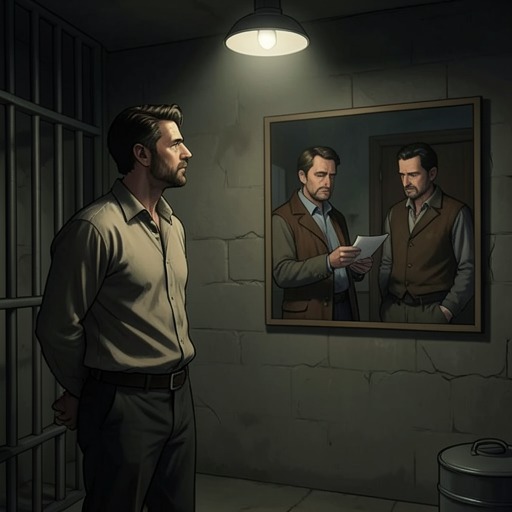
The narrative also places the protagonist’s political performance beside his profound distrust of legal institutions. Elsewhere, he describes being arrested on suspicion despite presenting identification, processed through a confusing sequence of rooms, and left unable to understand the charges read in court. At his hearing, legal language registers to him as nearly incomprehensible, and he assumes that his appointed defender has already abandoned him. Against those experiences, the imagined Senate forum offers a reversal: instead of being processed or ignored, he speaks while officials listen. Yet the force of the scene depends on the same uncertainty that shadows his other claims. The committee gives his vision of justice a public shape, while the narrative does not confirm that the speech, investigation, or political victory exists outside that vision.