Unnamed prisoner and defendant
The RoomThe Unnamed prisoner and defendant is both the accused man at the center of a trial and the consciousness through which the book renders confinement as a struggle over attention, agency, and belief. He begins by trying to follow the legal case closely enough to expose its weaknesses; as the proceedings continue, his conviction that the system is designed to defeat him overwhelms that effort. His final refusal to move when court is called turns an argument about justice into a bodily act of withdrawal.
Identity and Confinement
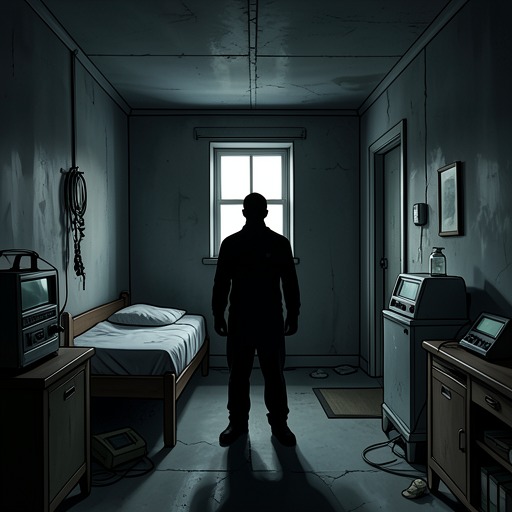
The character has no personal name in the supplied passages. He appears as a prisoner, a defendant, and a consciousness that moves between third-person narration and a first-person inner voice. The prison bunk and locked door establish the limits of his immediate world: he stares at the door, feels his leg muscles flex in time with his heartbeat, and then lies back and closes his eyes. Even before the trial scene, confinement is rendered not simply as a setting but as an enclosing physical and mental condition.
His account of the surrounding society is shaped by the same sense of being watched and constrained. He describes life under a Police state in which the police embody the State’s observing presence. He argues that the abundance of obscure and archaic laws makes it impossible for an ordinary person to avoid breaking some rule, giving police opportunities to harass people. He points to sidewalk spitting as an example and contends that petty violations can be used vindictively when an officer has a grievance. These are his claims about the system, not neutral findings established by the trial scene; they reveal how he interprets law as a potential instrument of arbitrary power.
The Trial and His Attempt to Participate
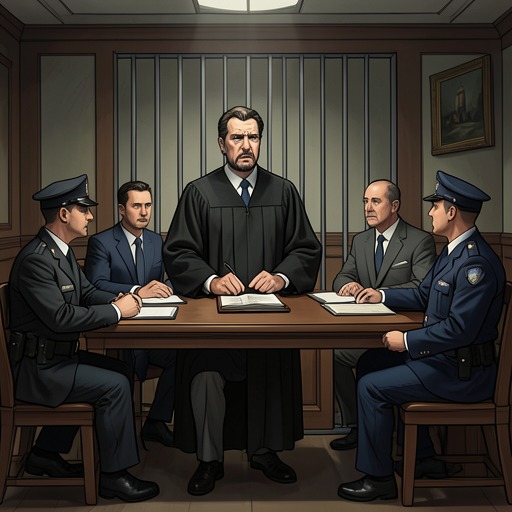
When the charges are read, the Unnamed prisoner and defendant recognizes only a few words. Legal phrasing registers as sound rather than meaning, and he describes himself as standing there without truly listening. Asked for his plea, he answers not guilty. His appointed public defender gives him paper and a pencil and instructs him to write down questions rather than interrupt testimony. The defendant accepts them silently, but he does not experience the lawyer as an ally: he does not know the man’s name, has never seen him before, and concludes that he has already been sold out.
That suspicion does not at first make him passive. As the first witness is called, he leans forward with his pencil poised, determined to follow each word and gesture. He expects to identify discrepancies the attorney misses and supply material that could undermine the prosecution’s case. The effort marks a sharp contrast with his initial bewilderment: he cannot make the legal language intelligible, yet he tries to turn close observation into a means of defense.
Later, the Courtroom explicitly recalls that he insisted on acting as his own counsel despite the court’s contrary advice and the availability of a public defender. After the judge offers him another chance to accept representation, he declines. The court then warns that proper trial procedures must be followed or he may be held in contempt. The exchange shows the narrowness of his position: he wants control over his defense, while the court frames that control as conditional on compliance with procedure.
Distrust of Law and Counsel
The defendant’s account of the trial widens into an indictment of unequal access to justice. He believes that people without money for lawyers are left to face the system alone, while wealthy defendants can hire a roomful of attorneys and may escape serious consequences. To make the disparity concrete, he recalls a person sentenced to a year and a day for stealing forty dollars from the government, and another who spent years in jail awaiting trial after stealing boxes of cookies. He contrasts those cases with his image of the well-funded businessperson who can afford skilled representation.
He also names Stacey Lowry as someone he cannot imagine defending a man like himself, treating the imagined refusal as evidence of the distance between prestigious counsel and a poor defendant. His anger extends to the public defender as well: he suspects the authorities fear a defendant who might do better for himself than appointed counsel, and sees procedural rules as a way to stop such a challenge. These accusations express his interpretation of the proceedings and his own isolation; the passages do not independently confirm the motives he assigns to lawyers or the court. The conflict between formal process and his sense of being railroaded remains unresolved.
Crisis, Stillness, and Retreat
The character’s helplessness also appears in a crisis that is physical before it can become purposeful action. After lying exposed on the bed, he becomes increasingly conscious of the need to protect himself. His thoughts press him to run, hide, curl up, or find cover, but his body will not respond. Only when the pressure becomes unbearable does he manage to move: he draws his knees to his chest, holds them with his wet hands, and rocks while sobbing. Tears darken the grayness around him until he falls into a shallow sleep born of exhaustion. The sequence makes the gap between intention and action tangible: thought commands, but the body remains inert until distress forces a minimal movement.
The ending returns him to that tension between inward experience and outward demand. His legs swing slowly over the side of the bed, his hands stay clasped between his thighs, and he experiences an intimate, bodily presence as a friend whose recurring pull and taste keep him from feeling alone. He concludes that trying has made no difference and that he might as well remain where he is. When the door opens and clothing is tossed onto the bed with a call for court, he does not move or answer the summons. The trial continues to demand his participation, but the final image leaves him suspended between compulsory legal procedure and a private retreat he will not relinquish.