Unnamed protagonist
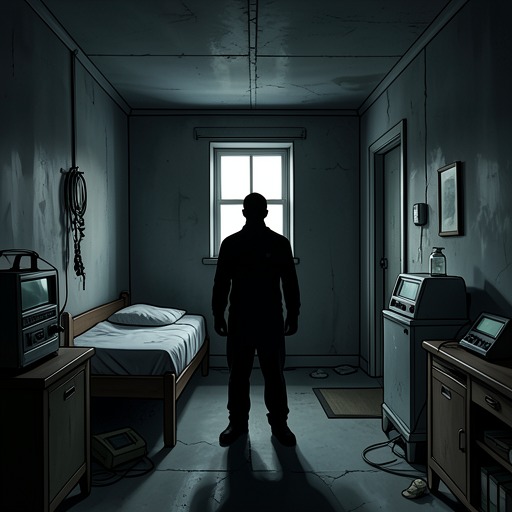
The RoomThe Unnamed protagonist is an imprisoned defendant who interprets law enforcement and the courts as instruments of arbitrary power, yet imagines transforming his own persecution into a public crusade. His character is defined by a widening gap between the powerless man who can barely follow a hearing and the commanding reformer he pictures addressing the nation. The fantasies offer a form of agency, but they also turn justice into a vehicle for retaliation and leave his deeper longing unresolved.
Identity and Background
The narrative gives him no personal name. It presents him instead through unstable roles: prisoner, accused man, would-be advocate, and imagined public figure. His account of the legal system is not detached analysis. He experiences its procedures as something done to him, and frames them as evidence that people without wealth or influence are denied a fair chance.
His suspicion extends beyond his own case. He imagines a pervasive Police State in which uniformed officers make the State’s scrutiny present wherever people go. He argues that ordinary citizens cannot know every law on the books, including archaic prohibitions such as spitting on a sidewalk, and cannot walk for five minutes without violating some rule. In his account, this abundance of offenses gives police tools to harass people at will. He further insists that an officer may use authority vindictively over minor conduct, such as parking a few inches from the curb or dropping a cigarette butt. These claims establish his view of law as not merely complicated but selectively available for abuse.
Confinement and the Hearing
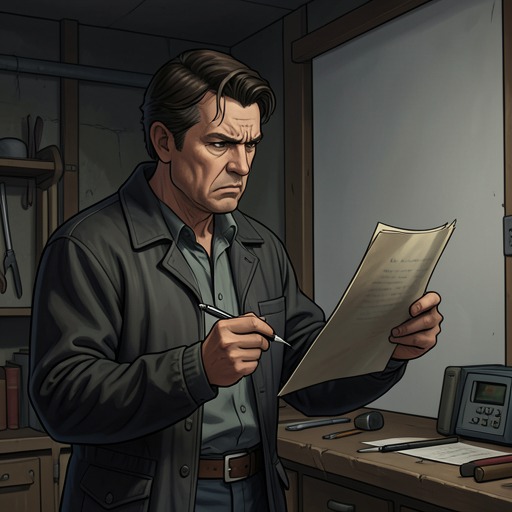
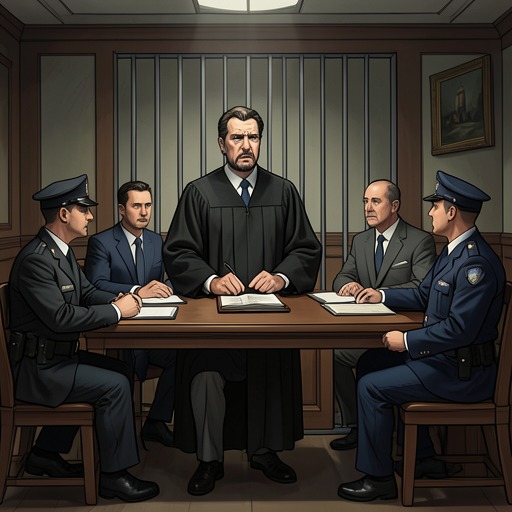
At the reading of the charges, he stands and recognizes a few words, while the rest registers as sound without meaning. He knows the proceeding is real, but describes himself as scarcely aware of what is happening. When asked for his plea, he answers not guilty. The public defender beside him gives him paper and a pencil, instructing him to write down questions rather than speak during testimony. The protagonist accepts the materials silently, but reads the lawyer’s attention to papers and conversation with the district attorney as proof that his appointed defender has already sold him out.
His response is to try to become his own watchful advocate. As the first witness is called, he leans forward with pencil poised, determined to catch discrepancies his attorney misses and turn them into ammunition against the prosecution. The contrast is stark: moments earlier, legal language had seemed almost foreign to him; now he imagines that attentive observation might let him expose the case. His mistrust does not make him passive, but it shapes even his effort to participate as a struggle against presumed betrayal.
Later courtroom material gives that mistrust a broader, class-conscious form. He argues that poor defendants are railroaded while people who steal large sums can afford lawyers and escape serious punishment. He contrasts that imagined impunity with the severe treatment of people accused of minor theft, including a man jailed for taking cookies while awaiting trial. He doubts that an elite lawyer such as Stacey Lowry would stoop to defend someone like him, and regards the cost of legal representation as a barrier separating the powerful from the poor. He also believes that procedural rules prevent defendants from defending themselves effectively, especially when their arguments seem to put the authorities on the ropes. His complaint is not simply that the law has rules, but that those rules appear to him as an endlessly renewable means of denying a hearing.
The Crusader He Imagines
The protagonist repeatedly recasts vulnerability as public purpose. In an imagined appearance before a special investigating committee of the United States Senate, he sees himself calm beneath the microphones, cameras, lights, and watching eyes. He pictures the threat of death as constant, even inside the committee’s chambers, but treats that danger as a reason to continue pursuing injustice. He speaks in his mind not only for himself but for people who have suffered before him and those suffering now, as well as for people who might be spared similar harm if injustice were exposed.
This imagined composure differs sharply from his disorientation at the actual reading of charges. In the Senate scene, he can turn fear into resolve and personal grievance into a national mission. Public attention becomes part of the fantasy’s proof of success: the country, perhaps the world, will hear him. Yet the crusading role does not erase the personal injury from which it grows. His imagined cause promises recognition and power as well as reform, making it difficult to separate his pursuit of justice from his wish to reverse his own humiliation.
Anger, Retaliation, and Public Exposure
A courtroom outburst sharpens the conflict between advocacy and revenge. A witness threatens counsel and is dragged from the courtroom while continuing to scream. Counsel asks that the officer undergo a psychiatric examination. In a later imagined proceeding, the protagonist listens as court-appointed psychiatrists describe two officers as emotionally disturbed, hostile, sadistic, and unfit to serve. Outwardly he sits quietly; inwardly he celebrates their humiliation and punishment.
His imagined victory goes well beyond establishing that the officers are unfit. He expects them to be committed to a state mental institution, and plans to keep pressure on the authorities through independent examinations and public scrutiny so that their release will be delayed. He imagines them confined in a locked ward, stripped of privileges, surrounded by walls, other violent patients, and screams. He also wants their identities and history made known wherever they go after release. The scene turns institutional accountability into a fantasy of prolonged confinement and public disgrace. When the proceedings end, he reads fear in the officers’ faces and imagines their panic worsening over the years; his victory depends on keeping them, and their suffering, continually present in his thoughts.
The public crusader’s performance continues in the corridor. He expects reporters and photographers, anticipates where he will stand, and knows how to answer questions quickly; the routine has become automatic. As he passes through the doorway, he lights a cigarette and carefully puts the burnt match in the wall ashtray. The small, controlled gesture sits beside the grand public role: he has rehearsed the mechanics of appearing before the press, just as he has rehearsed the story that makes him its central witness.
Unresolved Desire and Narrative Role
The text also shows a private emptiness that political grievance cannot explain away. After a movie, he sits on his bed feeling that something is missing or not right, though he cannot identify it. The thought gives way to a sexual urge. He tries to invent a new image that might give meaning to what he calls the more and what, but returns to the same remembered comic-book frame: a woman chained to a pillar and threatened by a sinister man. The fixed image supplies excitement and satisfaction, yet it does not answer the longing that prompts him to seek something new. The cycle gives his character another form of repetition: an appetite temporarily satisfied, then left without a name or resolution.
Together, the courtroom scenes, political visions, and private repetitions make him neither a straightforward reformer nor only a victim of the institutions he condemns. He identifies real asymmetries of power in his account, but his imagined remedies reproduce coercion through punishment, exposure, and control. The narrative’s movement between legal helplessness and imagined mastery preserves that contradiction. The Unnamed protagonist can envision himself as a witness for millions, yet the justice he imagines remains bound to his own injury and to the desire to make his adversaries suffer.