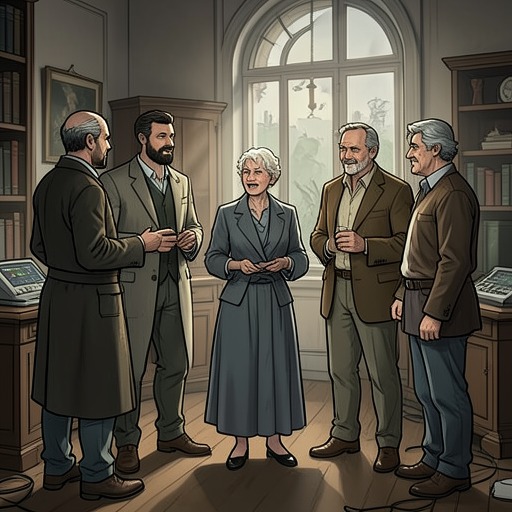
Daphne Greengrass
The Rules of WerewolfDaphne Greengrass is a recurring presence in the post-war social world, associated with the gatherings where former school divisions have begun to soften. Although the supplied scenes do not give her an independent plotline, they place her within an important network of friendship, courtship, and public social visibility. Her appearances help show how the characters’ lives are being reorganized beyond the old conflict.
Identity and Social Setting
Daphne is identified by her surname, Greengrass, and appears among the former Hogwarts students who gather across previously opposed social circles. At Theodore Nott’s party, Hermione Granger inventories the guests and recognizes Nott, Pansy Parkinson, Blaise Zabini, and Daphne Greengrass among those already present. Daphne is therefore established as part of the same interconnected circle as both the former Slytherin group and Hermione Granger’s friends, rather than as a distant or isolated figure.
Her presence also links the party to the broader culture of post-war influence and achievement. At the Witch Weekly 2010’s 10 Most Influential Witches & Wizards photoshoot, Daphne is included among the people being assembled for the group image, alongside figures connected with Gringotts and Ministry of Magic initiatives. The scene presents her as one member of a socially prominent cohort whose identities are shaped not only by school history but also by professional reputation, institutional work, and public recognition.
Role in the Social Network
Daphne’s clearest function is relational. During Nott’s party, Ginny Weasley sits on a large leather couch between Blaise Zabini and Daphne. Hermione Granger watches her friend from across the room and takes pleasure in seeing Ginny animated and enjoying herself. Daphne is consequently positioned within an intimate cluster that gives Ginny access to companionship outside her former Gryffindor-centered friendships.
The arrangement matters because the party is not simply a reunion of old classmates. Its social geography brings together people whose wartime affiliations once implied rivalry or distrust. Daphne’s place beside Blaise and Ginny makes her part of that recomposed network, in which proximity itself signals a new ease between groups that had once been sharply separated.
Connection with Harry Potter
Later, Daphne is seen standing by a window with Theodore Nott, Harry Potter, and Astoria Greengrass. Harry and Theodore have become good friends and are frequently seen with the Greengrass sisters. This places Daphne in a circle that includes both the former Slytherin social world and Harry’s post-war friendships.
The scene also shows Daphne in a developing intimate context with Harry. When she removes her outer sweater in the crowded pub, Harry takes her cocktail so that she can do so; she responds with a brilliant smile, and Harry blushes. Hermione Granger feels that she may be intruding on a budding intimate moment, but she is very happy for her friend. Daphne’s interaction with Harry is therefore not presented as a settled relationship in the supplied evidence, but as a new and visibly charged possibility that Hermione welcomes.
Connection with Astoria Greengrass
Daphne is also associated with Astoria Greengrass, who stands beside her in the later pub scene. The sisters are described as part of the same attractive and socially prominent group, while Theodore appears lovestruck next to Astoria. Through this arrangement, Daphne occupies a position within a family and friendship network that is simultaneously social and romantic: Astoria’s relationship with Theodore develops beside Daphne’s apparent closeness with Harry.
The parallel pairings give Daphne’s presence a structural importance beyond her limited individual dialogue. Her association with Harry and Astoria’s association with Theodore show former school factions forming new attachments, while Hermione Granger observes the changes with approval. Daphne belongs to the generation whose relationships make the transformed social order visible in everyday gatherings.
Narrative Significance
Daphne Greengrass functions as a marker of social transition. She appears in the Witch Weekly group setting, where influence is publicly displayed, and in private or semi-private gatherings, where friendships and romantic possibilities are negotiated through small gestures and shared space. Her placement among Blaise, Ginny, Harry, Theodore, and Astoria illustrates the movement from wartime identity toward a more fluid network of adult alliances.
Because the evidence gives Daphne no sustained viewpoint or decisive solo action, she is best understood as a connective character rather than the driver of the central plot. Her importance lies in what her presence reveals: Ginny can socialize comfortably with her, Harry can enter an unguarded moment with her, and the Greengrass sisters can stand at the center of a mixed circle that includes former enemies and former allies alike. Daphne helps make the story’s changing social landscape concrete, turning reconciliation from an abstract historical condition into the visible arrangement of people at a party, a photoshoot, and a pub.