Draco's flat
The Rules of WerewolfDraco's flat is the decisive private setting for the relationship's movement from public performance to personal intimacy. Although the available scenes do not provide a complete architectural description, they establish the flat through its sitting room, green settee, bookshelves, floo, and bedroom, making it a lived-in space where Draco's composure fails, his private hopes are exposed, and Hermione Granger can choose to cross the threshold after their charged encounter at Theodore Nott's birthday party.
Definition and Domestic Setting
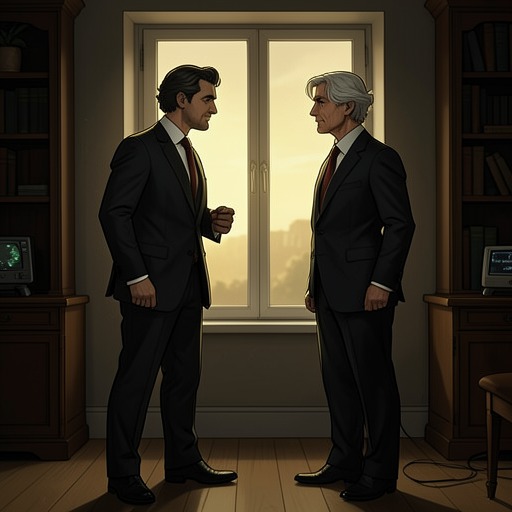
Draco's flat is presented first through the sitting room, where Draco returns by floo after the party. In a moment of anger and embarrassment, he kicks the large green settee, only to remember that it is an antique. The object registers the collision between his aristocratic surroundings and his loss of control: even in frustration, the room reminds him of the material world he is damaging. The sitting room is therefore neither a neutral backdrop nor a purely comfortable home. It is the place where the polished Draco Malfoy of public gatherings gives way to someone agitated enough to lash out at his own furniture.
The flat also contains bookshelves that reveal a more tentative and hopeful side of him. Draco has recently added a few Muggle authors and kept a small section of books he intends to read. He had hoped to finish them before seeing Hermione again so that he could surprise her with some knowledge of Muggle literature. His reading project turns the shelves into evidence of courtship: the books are not simply possessions but preparations for a future conversation. When he picks up Stardust, he treats Muggle fiction with the mixture of curiosity and skepticism that characterizes his guarded identity, remarking that Muggles never seem to get witches right. The book becomes an object through which his private effort to meet Hermione on her intellectual ground is revealed.
Arrival After the Party
The flat becomes important because Draco reaches it immediately after losing the sense of control he had maintained at the party. He has spent the evening watching Hermione, pursuing her through the house, and engaging her in a sequence of whispered provocations during the Werewolf game. Their attraction has been conducted through thresholds, corridors, darkness, and concealment, but Hermione eventually stops their encounter on the balcony because the pace feels too fast and she needs to proceed on her own terms. Draco then returns home, distressed that he has mishandled the moment.
His reaction is unusually direct. He admits that he had Hermione and ruined the opportunity, explains that she wanted to slow down and then left, and confesses to Theodore Nott that the witch has made him completely smitten. He cannot decide whether to seek her out that weekend or wait until Monday, and he even asks whether Theodore can get him into the Department of Mysteries. The flat thus receives the emotional aftermath of the balcony scene: it is where desire becomes anxiety, and where Draco's confidence gives way to pacing, swearing, and uncertainty about what action would be acceptable.
Bookshelves, Floo, and the Unexpected Visitor
The most revealing turn in the flat occurs while Theodore is preparing to leave. Draco stands facing the bookshelves, reaches for Stardust, and complains about the way Muggle writers represent witches. The floo lights behind him, and he assumes Theodore has returned or is speaking from the fireplace. The assumption is immediately overturned when the voice answering him is not Theodore's. Draco closes the book, puts it back on the wrong shelf, and turns to find Hermione standing alone in the room.
This arrival transforms the flat from a place of solitary regret into a space of mutual decision. Hermione has not merely followed him through another public or semi-public setting; she has crossed into his home after leaving him at the party. Draco's hands remain in his pockets because he fears that, if left at his sides, they will reach for her before he can control himself. Hermione answers his question about why she is there with a smile he experiences as intensely seductive, and then she crosses the room and jumps into him. The bookshelves that had held his imagined preparation for their next meeting now stand behind the first sustained physical reunion in his own space.
Bedroom and the Reversal of Control
The flat's bedroom marks a further shift in the power and rhythm of the encounter. Hermione initially takes the initiative by leaping into Draco, wrapping her arms and legs around him, and kissing down his neck. Draco, however, interrupts her because he needs to address an anxious thought before they continue. The pause is significant: after Hermione had stopped the balcony encounter to slow the pace, Draco now insists on stopping long enough to clarify what is troubling him, even though he makes clear that stopping is the last thing he wants.
The scene then turns from hesitation to renewed physical urgency. After they resume, Draco tells Hermione to come with him, lifts her over his shoulder, and carries her toward the bedroom. Hermione experiences being carried there as the highlight of a night otherwise defined by prolonged foreplay. The bedroom consequently functions as the destination of a movement that has passed through several degrees of privacy: from the Witch Weekly photo shoot, to the party, to the hidden game-space, to the balcony, and finally to Draco's home. It is not simply a room where intimacy occurs; it is the endpoint of the couple's repeated testing of distance, interruption, and return.
Rest, Continuity, and Narrative Significance
By the end of the night, the flat is associated with more than immediate sexual fulfillment. Draco tells Hermione that she is in his head and has not left, kisses her temple, and tells her to sleep. His arm remains around her as his breathing settles. Hermione understands the night as the culmination of flirting, taunting, wanting, and denying, but also as something better than she had imagined. The flat therefore holds the aftermath of consummation as well as the encounter itself: physical closeness is followed by sleep, tenderness, and a sense that the relationship has acquired continuity.
The location's importance is sharpened by its contrast with the other spaces connected to Draco and Hermione's attraction. At the Witch Weekly photo shoot, Draco's gaze is caught and returned across a public image-making environment. At Nott Manor, Hermione wanders through the library, reaches an empty room, and is mocked by Draco after expecting hidden secrets; later, the balcony gives them the setting for their first kiss but also for Hermione's decision to pause. Draco's flat absorbs the consequences of those earlier scenes. Its green settee receives his frustration, its shelves preserve his private attempt to understand Hermione's world, its floo admits the unexpected visitor, and its bedroom allows desire to become rest. In this progression, the flat is the narrative's most intimate threshold: the place where Draco's performed confidence is replaced by exposed feeling and where Hermione's return changes an aborted encounter into a shared, continuing relationship.