Ginny Weasley·Blaise Zabini
The Rules of WerewolfGinny Weasley/Blaise Zabini is one of the secondary romantic pairings that makes the post-war social world of The Rules of Werewolf feel newly porous. Their relationship begins in public, through flirtation that neither character bothers to disguise for long, and reaches a clear early confirmation when Blaise walks Ginny to the door and does not return. By the later pub scene, the attraction has become an established physical intimacy: Blaise has his arm securely around Ginny’s waist, placing their relationship within the story’s increasingly mixed and affectionate community.
First Attraction at Theodore Nott’s Party
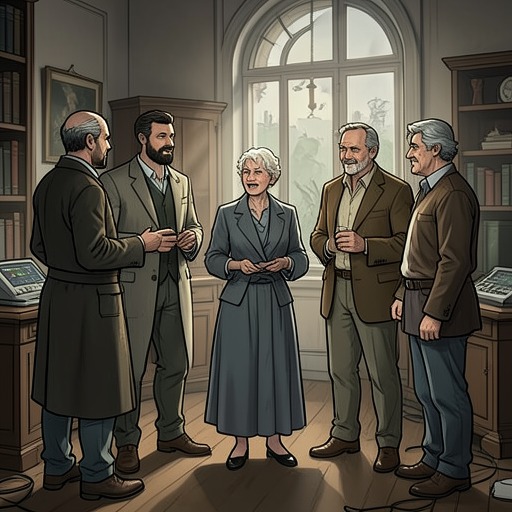
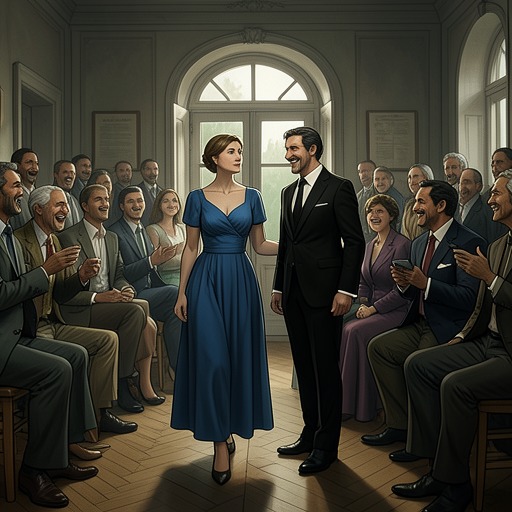
The relationship takes shape at Theodore Nott’s birthday gathering in Nott Manor, where Gryffindors and Slytherins meet as a deliberately mixed group rather than as opposing factions. Blaise Zabini is already carrying himself with the confidence of someone accustomed to winning social encounters; he greets Harry Potter by announcing that he is fifty galleons ahead and assumes that Harry’s arrival was inevitable. His composure changes when he looks past Harry and notices Ginny Weasley. The reaction is immediate and theatrical: he puts his hands over his heart and addresses her with astonished admiration.
Ginny does not meet that attention shyly. She walks forward and stands directly before Blaise, daring him to respond to her plunging attire, then greets him as Zabini and pointedly notes that it is good to see him away from the pitch. Her clothing and posture make the encounter a controlled performance of confidence rather than a passive reception of his interest. Blaise briefly stammers, but he recovers quickly and redirects the group toward the birthday boy. The exchange establishes the pairing’s central rhythm: Blaise is openly captivated, while Ginny recognizes the effect she has and answers his confidence with a challenge of her own.
The party’s social arrangement reinforces the attraction. Hermione Granger sees Ginny sitting on a large leather couch between Blaise and Daphne Greengrass, vivid and animated with the fire behind her. Hermione wants her friend to enjoy herself, and the scene presents Ginny’s connection with Blaise as part of a broader evening in which old social boundaries are being tested through pleasure, conversation, and mutual curiosity. Ron Weasley notices the Slytherins’ attention to Ginny and Parvati Patil and complains that he may take one drink before leaving, but his irritation cannot prevent the new pairings from forming around him.
Flirtation Within the Werewolf Game
Blaise and Ginny’s attraction continues while Pansy Parkinson conducts the party’s game of Werewolf. The rules assign secret roles, including a werewolf, a healer, and villagers; during each “Full moon,” the werewolf names a victim, while the werewolf is permitted to use legilimency for the purposes of the game. The game therefore gives flirtation an artificial structure of secrecy, suspicion, and performance, allowing private attention to circulate beneath a public activity.
Ginny becomes one of the game’s most noticeable social forces. When the others begin accusing Draco Malfoy, she moves to stand beside Blaise, and the narration emphasizes that the accused player has little chance of resisting the argument when Ginny is beside him. Blaise joins the accusation and declares Draco the werewolf, even though the scene makes clear that Ginny’s presence helps settle the decision. His alliance with her is therefore not merely romantic decoration: attraction alters the game’s social balance, turning him into an eager participant in her side of the room.
Ginny is also named as the healer’s protected villager. When Pansy asks the healer to identify the person to save, the answer is Ginny Weasley for a second time, prompting Ginny to laugh loudly. The repetition makes her central to the game’s concealed loyalties, while Blaise’s later movement toward her gives those loyalties a flirtatious public expression. After his supposed elimination as the second victim, he takes Ginny’s hand, raises it to his lips, and bids her farewell until they meet again. The gesture is smooth, conspicuous, and deliberately courtly; it converts a game exit into another opportunity to display his interest.
From Party Chemistry to Private Pursuit
The party’s conclusion turns the chemistry into action. After the gathering breaks apart, Blaise walks Ginny to the door and never returns. Draco Malfoy observes this disappearance, along with Pansy’s departure with Neville Longbottom, as the surrounding group divides into couples and private conversations. The detail is brief but decisive: Blaise does not simply flirt with Ginny before rejoining the party, but chooses to continue the encounter beyond the shared room.
That departure also contributes to the romantic-comedy structure of the evening. The larger party repeatedly transforms apparent conflict into intimacy. Hermione Granger and Draco’s antagonistic banter becomes sexual tension; the game’s accusations become theatrical courtship; and Blaise’s attention to Ginny becomes an actual private pairing. In this pattern, the relationship helps demonstrate how the story’s low-conflict post-war setting converts old labels and rivalries into occasions for contact. Ginny and Blaise do not require a dramatic reconciliation scene. Their connection is normalized through the ease with which the social group allows them to leave together.
Established Intimacy and Social Integration
By the later pub scene, Ginny and Blaise are no longer presented as a possibility awaiting interpretation. Ginny Weasley is seen with Blaise’s arm securely around her waist, a relaxed and possessive gesture that confirms the relationship through ordinary public closeness. The image is especially significant because it appears while Hermione surveys a crowded bar and recognizes how mixed the group has become. Their pairing is part of a social network that now includes former adversaries, friends, colleagues, and several emerging romances.
The surrounding arrangements make the relationship’s place in that network visible. Harry Potter and Theodore Nott have become good friends and stand near Astoria and Daphne Greengrass; Harry’s attention to Daphne reveals another budding intimacy, while Theodore appears lovesick beside Astoria. Ginny and Blaise’s established physical closeness consequently functions as one strand in a wider pattern of social integration. The old separation between Gryffindor and Slytherin is not erased through speeches or official declarations, but weakened by repeated gatherings in which people flirt, pair off, and return together as friends and lovers.
Character and Thematic Function
Ginny’s role in the relationship is active and self-aware. She deliberately presents herself before Blaise, allows him to react, and answers his admiration with teasing confidence. The evidence does not frame her as being swept passively into romance; instead, she controls the terms of their first exchange and becomes a source of pressure within the game. Blaise, by contrast, begins with conspicuous admiration, briefly loses his verbal fluency, then restores his polished confidence through gestures such as guiding the group and kissing Ginny’s hand.
Their pairing also contrasts with the more interrupted and uncertain attraction between Hermione Granger and Draco Malfoy. Ginny and Blaise move quickly from mutual display to private departure, while Hermione and Draco remain caught in hesitation, interruption, and repeated negotiation. That contrast gives the secondary couple a clarifying function: their uncomplicated momentum shows what romantic possibility looks like when public flirtation is answered rather than resisted, and when a newly mixed community treats the resulting intimacy as natural.
Ultimately, Ginny Weasley/Blaise Zabini embodies the story’s movement from post-war division toward ordinary connection. Their romance begins with a look across a crowded room, intensifies through a game built on hidden roles and selective protection, becomes concrete when Blaise escorts Ginny away from the party, and settles into visible closeness at the pub. The relationship matters not because it carries the book’s largest conflict, but because its ease supplies evidence that the surrounding world has changed: former boundaries can now be crossed through attraction, humor, and the simple decision to remain together after everyone else has gone.