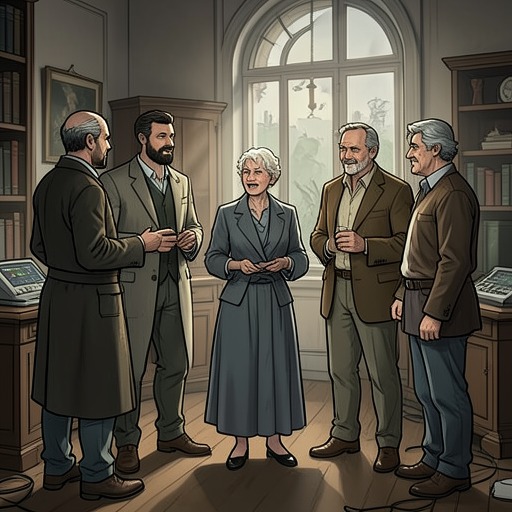
Hermione Granger
The Rules of WerewolfHermione Granger is a brilliant Ministry witch whose defining importance lies in the combination of institutional achievement and personal agency. She has spent the last few years reworking the Trace after remaining troubled by what happened with Harry Potter; the revised charm can distinguish magic performed by an underage witch or wizard from magic merely performed in that child’s presence, and the Wizengamot has approved it. Yet the same Hermione Granger who reshapes a system is also drawn into a volatile, increasingly intimate exchange with Draco Malfoy, where curiosity, argument, performance, and desire repeatedly test the boundaries she has built around herself.
Identity and Public Authority
Hermione Granger first appears at the Witch Weekly 2010’s 10 Most Influential Witches & Wizards photoshoot in a rush, arriving with loose curls cascading down her back, a petite black suit, heels, and a lace-trimmed bodysuit glimpsed beneath her opened blazer. Her entrance makes her immediately visible both as a professional subject and as a body under observation. She greets Parvati Patil with clasped hands and cheek kisses before being ushered toward the make-up chair, apologizing for her lateness because of an emergency. The scene places her inside a highly mediated public environment, but her haste and work obligations remain as important as the carefully arranged image.
The shoot also reveals how far Hermione’s adult identity has moved beyond her school-era reputation as a former enemy swot. When she approaches Draco Malfoy and Pansy Parkinson, she looks weary yet accepts Pansy’s polite handshake confidently. Her composure does not erase the old rivalry; instead, it gives her control over how that history is revisited. During the modeling session, she watches Draco while pretending to attend to her Muggle mobile device, and Parvati later captures a candid photograph of the pair locked in a repeated gaze. The published article and cover turn an unspoken moment between them into a public image, leaving Hermione angry at Parvati and unsettled by the experience.
Her most substantial public achievement is the Trace rework she explains at the shoot. Hermione says that the original system never sat right with her after what happened with Harry Potter, so she spent several years developing a version capable of separating an underage person’s own magic from magic performed nearby. The reform has recently received Wizengamot approval. Her pride is restrained but unmistakable: she smiles at the achievement and challenges Draco over whether it means she is no longer riding Potter’s coattails. The question frames her accomplishment as both a legal and technical intervention and a personal claim to recognition independent of Harry Potter’s fame.
Curiosity and Threshold Spaces
Hermione’s movement through the story repeatedly follows physical thresholds: the Witch Weekly modeling area, a locked Ministry door, Nott Manor’s library, a hidden alcove, and the balcony where confrontation becomes intimacy. At the Ministry, she whispers a cipher spell while making the corresponding wand movement, clears the wards around her private office, and enters a room protected by deliberate secrecy. The office contains a powerful Amortentia whose recurring scent is parchment, spearmint, and an unfamiliar third note. Her attraction to the potion is described as irresistible, recalling her response to Horace Slughorn’s classroom lesson while emphasizing that this brew is even stronger. The potion makes an otherwise controlled workplace a site of involuntary recognition.
At Theodore Nott’s birthday gathering in Nott Manor, Hermione’s intellectual curiosity takes her away from the party. After deciding that her resistance to exploring the books has nearly expired, she wanders among the shelves for more than fifteen minutes until the party noise fades. A lane opens into a small alcove with an arched doorway, and she approaches the handle, hesitates, withdraws, and finally opens it. The expected secret does not appear: the room is simply a room. Draco, who has been watching from behind her, laughs at what he reads as an imagined treasure hunt through Nott Manor. Hermione answers his mockery rather than retreating, asking whether he had been skulking around the corner. Her exploration therefore becomes less a discovery of a hidden object than a route into direct, charged contact with him.
That pattern continues when Draco finds her on the balcony. The door is slightly ajar, and he identifies her by the glimpse of her caramel-colored skirt before entering and closing it behind him. Hermione does not turn around when the door clicks shut; she already knows who has followed her. She calls him an innumerable ass and says she has questions, while he waits for whatever challenge she intends to make. The balcony functions as a threshold between the crowded party and a private exchange, allowing Hermione to preserve her argumentative authority even as the encounter shifts toward physical attraction.
Intellectual Resistance and Rules
Hermione does not become passive when placed among former Slytherin rivals. During Pansy Parkinson’s Werewolf game, she objects that the premise propagates the false narrative that werewolves are inherently violent and should be feared. Her objection interrupts the party’s easy entertainment and exposes her instinct to examine the social meaning of a rule rather than merely accept its amusement. The game itself is governed by elaborate restrictions: one werewolf, one healer, and villagers receive temporary roles; the werewolf may use legilimency for the game; each full moon permits a secret killing choice; the healer may nominate someone to save; players are magically prevented from opening their eyes; and three wrong guesses allow the werewolf to win. Hermione’s protest therefore arises inside a setting where manufactured rules turn prejudice into play.
Her participation nevertheless shows that resistance and involvement coexist. She joins Draco Malfoy, Blaise Zabini, Ginny Weasley, and Neville Longbottom in the circle, while Harry Potter and Ron Weasley play chess nearby and Adrian and Daphne Greengrass watch from the side. Hermione questions the game’s representation of werewolves, but she remains within the social experiment rather than simply rejecting the gathering. This duality—critical scrutiny combined with willingness to enter unfamiliar spaces—also characterizes her response to Draco. She challenges him, explores the library, and later seeks him out, but none of those actions require her to abandon her judgment.
Desire and Deliberate Agency
Hermione’s attraction to Draco Malfoy develops through looks, banter, and chosen proximity before it becomes explicit. At the photoshoot, she notices him while concealing her attention behind her mobile device. The cover photograph preserves that mutual gaze, and the image continues to trouble her after the article appears. Draco’s fixation is equally persistent: he repeatedly studies the cover, replays their interaction, and wonders whether she will answer the note he left for her. Hermione’s role in this dynamic is not merely that of an object of desire. Her gaze is returned, her questions are purposeful, and her later appearances make clear that she can redirect the encounter.
The clearest statement of her agency occurs on the balcony, when Draco presses for an exact declaration of what she wants. Hermione remains still, meets his fervent gaze, and says, “I want you to kiss me.” The request transforms the preceding uncertainty into an articulated choice. Draco’s defenses break after hearing it, but the decisive verbal movement belongs to Hermione: she names the desired act rather than leaving him to infer it. The kiss thus follows a moment of negotiation and consent, not merely the accumulation of his fantasy or her silence.
Her initiative is even more pronounced when she later appears alone in the library. Draco hears a voice and realizes it is not Theodore Nott’s; after closing a book and turning, he finds Hermione standing there. He asks what she is doing, keeping his hands in his pockets because he fears he will reach for her, while she answers with a smile he experiences as unmistakably seductive. Her arrival reverses the earlier pattern in which Draco pursued her through the manor. Hermione crosses the threshold herself, and her presence makes desire an action she undertakes rather than a feeling imposed upon her.
The relationship also enters Hermione’s professional space. While working in the Department of Mysteries, she is interrupted during research into a substitute for increasingly rare Ashwinder eggs. She is developing the Forget Me Potion because no witch or wizard should have to endure the embarrassment of behavior caused by a powerful love potion, while Obliviate is too powerful to serve as a simple solution. She hides the untested ingredients before admitting the visitor, but Draco’s arrival quickly turns the office from a controlled laboratory into an intimate setting. He lifts her from her chair, moves her onto the desk, removes her shoes and suit pants, and begins touching her beneath the bodysuit. The scene presents her as physically responsive, but it remains rooted in a space defined by her research, secrecy, and professional competence.
Change, Continuity, and Narrative Role
Hermione’s trajectory does not replace her public identity with romance; it places her intellectual, ethical, and sensual selves in direct contact. She remains the witch who secures Wizengamot approval for a major reform, protects confidential work behind wards and a cipher spell, and questions the assumptions embedded in a party game. At the same time, she follows curiosity into an empty room, lets a locked balcony become a private stage, and explicitly asks Draco Malfoy for a kiss. The contrast is central to her characterization: discipline does not cancel desire, and desire does not erase discipline.
Her relationship with Draco is shaped by the same threshold logic that governs her other actions. Public photography first makes their mutual attention visible; the Ministry elevator and the Witch Weekly aftermath intensify her awareness of their renewed contact; Nott Manor’s library and balcony move that contact into secluded spaces; and her Department of Mysteries office brings intimacy into the center of her own professional domain. Each transition makes Hermione less a passive subject of observation and more an active participant in choosing where the relationship can exist.
The available episodes leave Hermione in motion rather than providing a final resolution. Her last clearly supported position is one of simultaneous research and intimacy: she is still pursuing a safer alternative to Obliviate through the Forget Me Potion while permitting Draco’s desire to enter the office she has carefully protected. Her significance lies in that refusal of simplification. She is neither merely Harry Potter’s former companion nor merely Draco Malfoy’s object of fascination; she is an institution-changing witch whose curiosity and self-declared desire drive the story across public, intellectual, and private thresholds.