Hermione Granger·Ron Weasley
The Rules of WerewolfHermione Granger/Ron Weasley is presented as a durable friendship after the end of their romantic relationship, sustained by shared history even when Hermione is impatient with Ron and Ron is openly reluctant to join her plans. Their connection matters because it places Hermione’s developing interest in Draco Malfoy inside an existing network of friends rather than outside it: Ron remains close enough to tease, complain, and be included, while Hermione continues to insist that the old group can gather without turning the evening into a confrontation.
Definition and Background
The relationship is explicitly framed as friendship rather than romance. Harry Potter tells Ron that he and Draco Malfoy are friends and work well together, and Hermione supports that broader post-war adjustment by arguing that everyone should attend Theodore Nott’s birthday gathering together. Ron’s resistance is not treated as a decisive rupture. He distrusts Draco and dislikes Theodore Nott, but he remains part of Hermione’s circle and accepts her insistence that the former enemies are now sufficiently “tamed.”
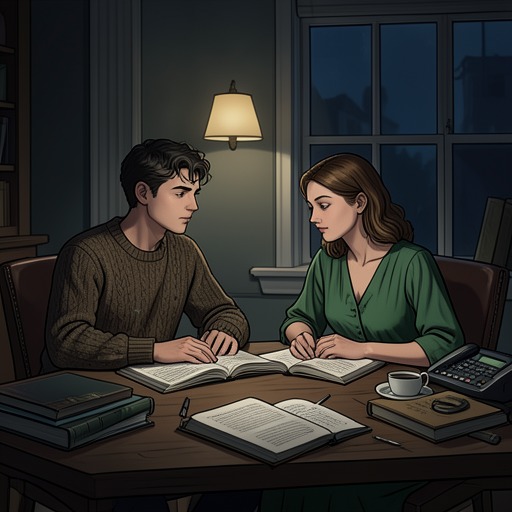
Hermione’s own position is complicated by her growing attraction to Draco. She confesses to Ginny Weasley that she and Draco have exchanged notes at work and that she cannot stop thinking about the correspondence. Ron is not the object of this uncertainty; instead, his presence marks the stable, familiar relationship from which Hermione is moving toward something new. The contrast makes the post-breakup friendship legible: she can be candid about her romantic confusion while still treating Ron as a trusted companion whose company belongs in her ordinary life.
Friendship in the Shared Social Circle
Draco’s invitation to his birthday celebration at Nott Manor includes Hermione and, through her, Ginny Weasley, Neville Longbottom, Harry Potter, and Ron. Hermione repeats the invitation to Harry and Ron and refuses to let Ron’s reluctance determine whether the group attends. Her insistence that they go “all of us” is both practical and symbolic. She wants their friends to meet across the old Gryffindor-Slytherin divide, and she uses the outing to test whether everyone can occupy the same social space without reverting to wartime hostility.
Ron complains that the party is not neutral territory and suggests that a Quidditch match would be safer. Hermione answers that the gathering is not preparation for a fight. The exchange preserves their old rhythm of argument and exasperation: Ron voices suspicion, Hermione counters with reason, and neither treats disagreement as a reason to sever contact. Their friendship therefore operates through friction as much as tenderness, with irritation functioning as evidence of familiarity rather than proof of renewed romantic conflict.
At Nott Manor, Ron remains physically and socially close to Hermione even though he is eager to leave. He refills his glass beside her and says that he wishes Parvati Patil-Weasley were present because he is ready to go home. Hermione responds by telling him to lighten up and suggesting that he talk about Quidditch. When Ron admits that he and Theodore Nott do not get along, he explains that he has come to speak with Hermione because Harry has gone with Adrian Pucey to taste Firewhiskey. The scene shows the relationship in its most everyday form: Ron seeks out Hermione for company, and she redirects him toward an interest that will occupy him without humiliating or excluding him.
Boundaries and Changing Attachments
The friendship’s boundaries are especially clear because Hermione is emotionally preoccupied elsewhere. She searches the room for Ginny Weasley and notices her friend sitting between Blaise Zabini and Daphne Greengrass, while Ron remains nearby trying to engage her. Hermione can recognize that Ron is about to complain again and quickly diverts him by pointing out a Phoenix Flint chess set. Ron immediately abandons the conversation to investigate it, leaving Hermione relieved but not resentful. The moment is comic, yet it also reveals a settled intimacy: Hermione knows precisely how Ron behaves, knows what will capture his attention, and can manage the interaction without reopening their former relationship.
Ron’s marriage to Parvati Patil-Weasley further confirms that the bond has changed form. He wishes she were at the party, while Hermione jokes that Parvati is on her “shit list.” The remark is sharp but domestic in its familiarity, not a declaration of romantic jealousy. Both characters have lives and attachments beyond one another, and their continued ease depends on that separation. Hermione’s attraction to Draco can develop without the narrative treating Ron as an abandoned lover or an obstacle who must be defeated.
The surrounding gathering reinforces this new arrangement. Hermione enters a room containing Nott, Pansy Parkinson, Daphne Greengrass, Blaise Zabini, Adrian Pucey, and the absent-but-expected Draco, while Ron participates in the same mixed social environment despite his complaints. Later, Harry Potter arrives when Hermione is outside with Draco and assumes that she and Draco have been having a friendly conversation. Hermione does not use Ron’s friendship as a shield or explanation; the old bond has become secure enough that it does not need to define every new intimacy.
Consequences and Narrative Significance
Ron’s presence helps make the party a social experiment in reconciliation rather than a private romantic stage. Hermione’s determination that he attend keeps the former friends together as a group, while his skepticism supplies much of the evening’s comic resistance. He is allowed to dislike the setting, miss his wife, complain about Theodore, and still belong. The relationship thus demonstrates that post-war reconciliation is not the erasure of old loyalties or personality differences; it is the ability to carry them into shared life without allowing them to dictate every encounter.
The friendship also sharpens the contrast between Hermione’s established familiarity with Ron and the uncertainty of her attraction to Draco. With Ron, she knows how to interrupt a complaint, redirect a conversation, and interpret a gesture. With Draco, even a remark about lace leaves the boundary between fighting and flirting unclear. That difference gives the romantic plot its tension while preserving Ron’s importance as an emotional constant.
By the end of the supplied arc, Hermione, Harry, and Ron leave Nott Manor together after the farewells. Hermione watches the door for Draco, who does not return inside, and allows Harry and Ron to lead her out of the house. The image is quietly consequential: the new romance remains unresolved in that moment, but Hermione is not isolated. Her disappointment unfolds within the continuing companionship of Ron and Harry, confirming that the breakup has not destroyed the friendship or the larger group to which she belongs.
Thematic Function
Hermione Granger/Ron Weasley embodies the story’s low-conflict model of emotional change. The relationship does not require a dramatic second breakup, a rivalry over Hermione, or the denigration of Ron to make room for Draco. Instead, it survives through ordinary conversation, mutual inclusion, teasing, and the willingness to attend an uncomfortable party together. Its narrative function is to show that romantic transformation need not invalidate a previous attachment.
The bond also helps the story connect personal reconciliation with wider social repair. The party gathers former opponents and former partners in one candlelit library, and Hermione’s insistence on Ron’s attendance turns that mixed company into a choice rather than an accident. Ron’s friendship with Hermione is therefore both intimate and structural: it preserves the emotional history of the central group while allowing its members to form new relationships, especially Hermione’s eventual committed relationship with Draco Malfoy.