Hermione returns to Draco
The Rules of WerewolfHermione returns to Draco is the decisive reconciliation that follows the interrupted balcony encounter at Nott Manor. After leaving because the intimacy had become too fast and occurred on terms she could not accept, Hermione refuses to let the separation define what happened. Her return turns panic into explanation, and explanation into a more deliberate intimacy: Draco admits that his attraction began as provocative play but has become emotionally serious, while Hermione confirms that she stopped him because she wanted more than a balcony encounter, not because she wanted less of him.
Causes and Background
The return grows out of a sharp contradiction in Hermione’s response to Draco. At Nott Manor, the two had been drawn together through the Werewolf game, whose rules gave Draco a limited, explicit role for legilimency and created an atmosphere where teasing, secrecy, and bodily proximity could overlap. His whispered challenge about rules and her answer, “I don’t always play by the rules.” established mutual participation in the flirtation, but the game also blurred the boundary between performance and genuine authorization. When he touched her in the darkness and asked her to tell him to stop, the scene made her agency audible even as the surrounding party continued, unaware, to call them back.
Their encounter on the balcony intensified that ambiguity. Draco pursued Hermione physically, lifting her against the balcony while the night air moved around them, but she pulled herself out of his grip and put her feet back on the ground. She identified the problem precisely: the encounter was “too fast,” and she needed to proceed on her own terms. The decision was not a rejection of desire. At home, Hermione understood the distinction with painful clarity: the kiss had been the best of her life, the Amortentia in her office smelled like Draco, and she regretted leaving him almost immediately. The emotional consequence was therefore not relief but mounting fear that she had damaged something before it had properly begun.
The Return to Draco’s Flat
Hermione’s response is active rather than merely reflective. She paces through Grimmauld Place, returns to her flat, considers waiting until Monday, and then rejects delay because the more time passes, the more she feels Draco slipping away. She prepares to go back and apologize and explain. The green fabric she chooses from her drawer carries forward the charged imagery of the earlier encounter and shows that her return is motivated by renewed desire as well as the need for clarification; she is not simply repairing a misunderstanding from a safe distance.
Draco, meanwhile, is also caught in the aftermath. He believes he has ruined the encounter, worries about whether to find Hermione immediately or wait until Monday, and asks whether he can be admitted to the Department of Mysteries. His distress is expressed through pacing and through the admission that Hermione has him “completely smitten.” While waiting for Theodore Nott, he turns toward a small section of Muggle books he has recently added to his shelves. He had hoped to read them before seeing Hermione again and surprise her with knowledge of Muggle literature, a quiet effort to meet her world rather than merely provoke her within his own.
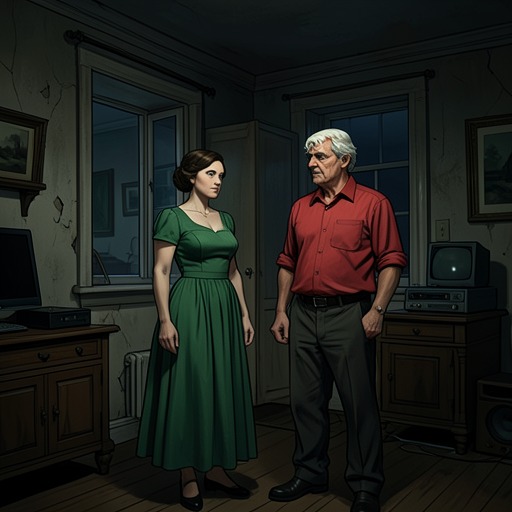
The physical return is staged through a threshold. Draco is facing his bookshelves, holding Stardust, when the expected voice behind him proves not to be Theodore’s. He closes the book, puts it back on the wrong shelf, and turns to find Hermione standing alone. His hands remain in his pockets because he fears he will reach for her if he leaves them at his sides. Hermione answers his guarded question with a smile that he experiences as stunningly seductive, and then crosses the room and jumps into him, wrapping her arms and legs around him. The movement converts an anxious reunion into unmistakable physical initiative.
Reconciliation Through Explicit Negotiation
The reconciliation does not proceed simply because desire overwhelms the earlier conflict. Draco interrupts the embrace and asks Hermione to stop, fearing that he has mishandled the situation again. He leads her to the couch rather than allowing the encounter to remain an uncontrolled repetition of the balcony. There he explains that he does not want her to think his interest is an artifice designed only to get her into bed. He admits that sexual attraction and the pleasure of riling her up were present from the beginning, but he also wants to take her to dinner and see her wake in his bed. Most importantly, he says that the balcony was not where he intended to have sex with her.
Hermione supplies the missing half of the misunderstanding. She tells him that this is why she stopped them: she wanted more, but she did not want that particular place or circumstance. Her explanation changes the meaning of her departure from refusal to boundary-setting. The scene’s emotional reversal depends on that distinction. Draco had interpreted her withdrawal as evidence that he had lost her; Hermione reveals that the withdrawal was an attempt to preserve the possibility of a fuller relationship.
Draco then names the change in their connection: what felt like a game at first is no longer a game to him. Hermione confirms that it is not a game to her either. These statements function as more than declarations of mood. They redefine the rules under which their previous teasing operated. The Werewolf game had permitted coded contact, hidden intentions, and a temporary suspension of ordinary behavior; at Draco’s flat, the pair replace that theatrical framework with direct acknowledgment. Their intimacy remains playful, but it is no longer protected by the claim that either person is merely performing.
Renewed Intimacy and Consequences
Once the misunderstanding is addressed, Hermione takes the next initiative. She tells Draco that he will be rewarded for his imagination, pushes him against the couch, and moves on top of him. Draco explicitly says that they can go slowly and that he is not pressuring her, even though he does not want to stop. This exchange preserves the significance of the balcony interruption: the new encounter is not presented as a demand that Hermione surrender her earlier boundary, but as a continuation made possible by her clarification and his willingness to recognize it.
The tone then shifts into consensual erotic play with a negotiated rhythm of pursuit and restraint. Draco teases Hermione about making him wait after leaving him, while her request for him is clear and direct. He lifts her and carries her to his bedroom, and the narration treats being carried there as the highlight of a night otherwise defined by prolonged anticipation. The movement from balcony to flat, and then from sitting room to bedroom, gives the reconciliation a spatial logic: public exposure and interruption yield to a private setting in which the pair can act on the terms they have just articulated.
The return also establishes that their attraction has consequences beyond one interrupted kiss. Hermione’s immediate homeward panic and Draco’s solitary spiraling mirror each other, creating a pursuit-and-withdrawal loop in which both fear that the other’s hesitation means permanent loss. Their reunion breaks that loop not through a grand public gesture but through reciprocal movement: Hermione goes back, Draco stops long enough to explain himself, and both answer the other’s uncertainty. The resulting intimacy is therefore also a behavioral commitment to clearer communication.
Narrative Significance
As a romance beat, Hermione’s return marks the shift from flirtation to acknowledged emotional stakes. Earlier scenes depend on indirectness: a stare at a photography shoot, exploration of the secluded library, Draco’s laughter when Hermione expects a hidden secret, and the Werewolf game’s concealed roles. The balcony seems to promise consummation but instead produces a separation. The return supplies the recognition scene that the interrupted encounter lacked, making the pair articulate what their bodies had already revealed.
The action also makes boundaries part of desire rather than its negation. Hermione’s decision to stop the balcony encounter remains valid after she returns; what changes is the setting, the pace, and the mutual understanding of what each person wants. Draco’s confession acknowledges both the erotic origin of their antagonistic play and its emotional development. By placing that confession before their renewed physical encounter, the narrative makes the relationship’s turning point depend on naming intent, receiving a boundary, and choosing to continue with better knowledge.
The event ends not with the uncertainty of the balcony but with a confirmed return to Draco’s private space and a shared acceptance that their connection has crossed the line separating a game from something real. Hermione’s initiative repairs the rupture, Draco’s explanation removes the central fear, and their resumed intimacy converts the night’s earlier failure into the beginning of a more deliberate relationship.