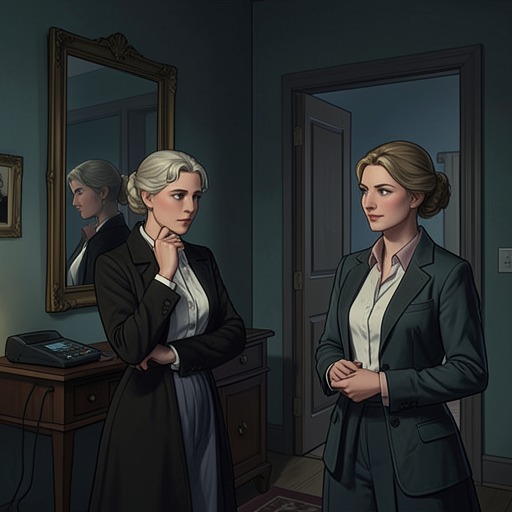
Hermione's flat
The Rules of WerewolfHermione's flat is the first clearly intimate domestic setting associated with Hermione Granger's response to Draco Malfoy. It is not merely a place she inhabits between public scenes. After the charged encounter at Nott Manor, the flat becomes the space in which attraction is converted into decision: Hermione paces, replays what happened, seeks counsel, and finally equips herself to return. Its significance lies in the contrast between outward composure and inward agitation, and between the controlled professional world of the Ministry of Magic and the private room where Hermione admits that she wants something she cannot yet safely name.
Domestic Setting and Narrative Function
Hermione's flat is presented as a small kitchen-and-bedroom environment reached after Hermione leaves 12 Grimmauld Place and immediately floos home. The movement is brisk and unsettled: she paces from the entrance to the kitchen and then to the sitting room before using the Floo. Once home, she remains in motion rather than settling into domestic calm, pacing around the small kitchen while refilling a kettle and searching through a cabinet. The flat therefore registers her agitation physically. Its limited, familiar spaces contain a mind that has not caught up with the decision her body has already made.
The setting also stands apart from the social and professional locations surrounding it. At the Witch Weekly photoshoot, Hermione is watched within a public arrangement that includes Draco Malfoy and Pansy Parkinson; at Nott Manor, she moves through party noise, book stacks, alcoves, doorways, and a balcony where Draco follows her. Hermione's flat offers no audience except the friends she chooses to contact. The shift into it removes the external spectacle while intensifying self-scrutiny.
Hermione's Retreat and Emotional Crisis
Hermione returns to the flat immediately after walking away from Draco. The narration emphasizes that the Amortentia in her office smells like him and that she has never more regretted leaving someone, linking the domestic scene to a desire already made undeniable elsewhere. At home, she asks herself why she left Draco but cannot produce a satisfactory answer. She considers visiting his office on Monday, three days away, and worries that he may interpret her withdrawal as a decision to slow or end what had begun.
Her memories of the balcony encounter sharpen the conflict. The snogging had been brilliant, and she had wanted more in the sense that she did not want the encounter to stop; what frightened her was the possibility that something too risky might happen at Nott Manor. Hermione distinguishes between not wanting a public escalation on the balcony and not wanting Draco at all, but she has no opportunity to explain that distinction before Harry Potter interrupts. In the flat, that interruption becomes part of her uncertainty: she wonders whether Draco understood the difference and whether the moment can still be repaired.
Communication and Muggle Technology
The flat is also the site of Hermione's attempt to turn private confusion into practical advice. She searches for her purse, takes out the mobile phone she bought for Ginny Weasley the previous Christmas, and calls her friend. The detail of the device matters because Hermione and Ginny had found that Muggle technology gave them more to discuss, making the phone a material sign of their close friendship and of Hermione's ability to bring a non-magical tool into her magical life.
The call begins before Hermione has regained composure. She continues pacing while waiting for Ginny's response, asks for help concerning Draco, and tries to determine whether Ginny is still at Nott Manor and too busy to talk. The conversation cannot fully resolve the problem: Hermione ends the call abruptly, promises to return, says they will talk the next day, and throws the phone back into her purse. Even in failure, the call marks a change. Hermione is no longer only analyzing Draco from a distance; she is openly naming the problem to a trusted friend and treating her own desire as something requiring action rather than concealment.
From Withdrawal to Return
The decisive movement within Hermione's flat is a reversal. She initially leaves Nott Manor in panic, but the domestic interval transforms retreat into preparation. She tells herself that she has options and agency, then searches the drawer containing her underwear and selects soft green fabric for the return journey. The action is concrete and deliberate: rather than waiting until Monday or accepting that Draco might have lost interest, she steadies her nerves with her wand and goes to prepare herself.
Her return is not framed as passive surrender. Hermione intends to apologize and explain, and she believes Draco must still be at Nott Manor. The flat thus functions as a threshold between interruption and continuation. She enters it after breaking away from Draco, confronts the consequences of that choice in private, contacts Ginny, and leaves with a renewed decision to cross back into the same charged social space. The domestic setting makes the emotional sequence legible: desire produces fear, fear produces flight, and self-recognition produces pursuit.
Relation to Other Threshold Spaces
Across the surrounding narrative, Hermione's flat belongs to a recurring pattern of doors, corners, corridors, and enclosed rooms. At Nott Manor, Hermione wanders for more than fifteen minutes through the library stacks, follows a lane into an alcove, and opens an arched doorway expecting hidden danger, only to find an ordinary room and Draco waiting behind her. Later, Draco finds her through a balcony door left slightly ajar; the click of the closing door announces his arrival while she refuses to turn around. These spaces repeatedly make curiosity, concealment, confrontation, and intimacy change places.
Hermione's flat is the domestic counterpart to those Manor thresholds. It contains no secret passage or dark object, yet it shelters a comparable act of discovery: Hermione recognizes the intensity of her attraction and the extent of her own choice. The later encounter in the Department of Mysteries, where Draco quickly lifts her from her chair and places her across her desk, extends the same movement from private preparation to physical consummation. In that sequence, the flat's significance is retrospective as well as immediate: it is where Hermione decides that the interrupted encounter is not an ending.
Narrative Significance
Hermione's flat gives the romance a private chamber in which the public image of Hermione Granger yields to a more vulnerable but still self-directing consciousness. She is weary and controlled in public, yet at home she paces, questions her judgment, calls Ginny, and chooses to return. The location makes her agency visible through small domestic acts rather than grand declarations: refilling the kettle, retrieving the mobile, taking up the wand, opening the drawer, and selecting what she will wear.
Its narrative power comes from compression. A brief visit contains regret, desire, fear of misinterpretation, friendship, technological intimacy, and a renewed decision. Hermione's flat is therefore less a fully mapped residence than an emotional instrument. It converts the aftermath of the balcony into a conscious commitment to act, establishing that Hermione's movement toward Draco is not simply something that happens to her in hidden corners. She leaves home because she has decided to go back.