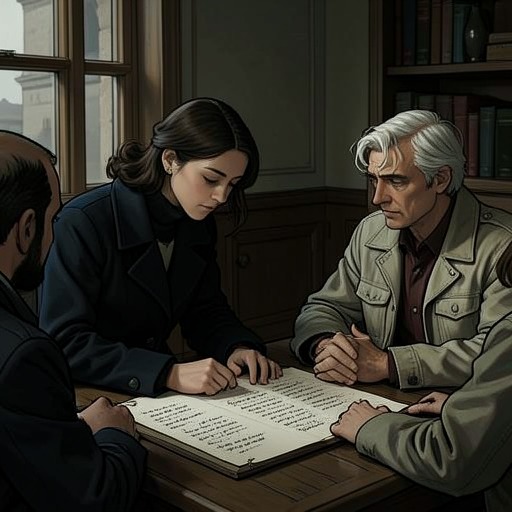
I don't always play by the rules
The Rules of Werewolf“I don't always play by the rules” is the defining expression of Hermione Granger and Draco Malfoy’s flirtation during the Werewolf game at Theodore Nott’s birthday gathering, and later becomes a private shorthand for the way their attraction has crossed the boundaries they initially pretend to observe. The phrase matters because it does not simply reject rules: it first names Hermione’s willingness to depart from them, then allows Draco to claim an equal position beside her, and finally becomes a retrospective explanation for how the game led them toward a real relationship.
The Expression in the Werewolf Game
The phrase emerges inside a tightly controlled party ritual. Pansy Parkinson establishes the game’s rules: each participant receives a hidden role, one werewolf selects a victim during each “Full moon,” the werewolf may use legilimency for the game, the healer may secretly nominate someone for protection, and a jinx forces everyone’s eyes shut during those phases. Once a player is dead, that player must leave the game; after each round, the group guesses, and three wrong guesses allow the werewolf to win. Draco Malfoy receives the role of villager, while Hermione Granger remains among the players with Draco, Blaise Zabini, Ginny Weasley, and Neville Longbottom.
The official rules create the conditions for the expression’s private meaning. During one darkened phase, Draco moves close to Hermione, touches her hand and back, and addresses her by her first name. Hermione objects that there are rules to the game. Draco answers by asking whether she always plays by them, then presses the issue through questions about touching her, kissing her, and taking her upstairs. His words transform a harmless restriction into a test of personal boundaries: the game supplies a temporary license for secrecy, but Hermione must still decide how far that license reaches.
Hermione responds, “I don't always play by the rules.” In context, the sentence is both a confession and a challenge. She does not deny the rules, nor does she openly surrender to Draco’s interpretation of them. Instead, she acknowledges that her conduct cannot be contained by the formal structure Pansy has imposed. Draco immediately answers that the same is true of him, making the phrase reciprocal rather than purely Hermione’s. The exchange establishes a pattern in which rule-breaking becomes a shared language, but not an excuse to erase choice: Draco later asks her to tell him to stop, and Hermione gives a direct answer when he asks what she wants.
Secrecy, Permission, and Performance
The expression gains force from the magical concealment surrounding it. Draco uses a “Notice Me Not” charm during a later dark phase, keeping their exchange private while the other players remain nearby. Hermione knows that the game is continuing around them, hears Neville Longbottom call out to ask whether she is all right, and nevertheless conceals what is happening by saying that she is fine. The phrase therefore belongs to a layered performance: Hermione is simultaneously a participant following Pansy’s instructions, a person hiding an intimate encounter from the circle, and an active partner in the encounter itself.
That secrecy does not make the scene a simple escape from consequences. Pansy’s rules determine when the darkness begins and ends, and the game’s limited intervals impose urgency. Draco asks what Hermione wants because they have only a short time, while Hermione’s responses move from physical reaction to verbal participation. When Draco holds her wrists and touches her arms, stomach, and collarbones, he whispers that she should tell him to stop. The expression’s earlier defiance thus develops into a negotiation in which transgression remains meaningful only because the participants continue to communicate within it.
The surrounding game also turns the pair’s private conduct into a contrast with public behavior. When the round ends, Draco resumes the role of clever participant and declares that Ginny Weasley is the werewolf. He also makes insinuations about couples needing “Gryffindor courage” and asks Hermione whether she wants to meet him in the broom closet. Hermione, embarrassed and angry at being publicly exposed by the same person who had privately provoked her, storms away. The phrase consequently carries an unstable double edge: in darkness it permits intimacy, while in the light its associated rule-breaking can be weaponized as mockery.
From Game Language to Relationship Language
The expression returns after the relationship has moved beyond the original party. Draco and Hermione meet again at another gathering, where he pulls her into an alcove and kisses her against the wall. Hermione asks whether Pansy will make them play games again. Draco replies that Hermione does not follow the rules anyway, converting the earlier line into a remembered accusation and an affectionate claim. Hermione corrects his wording, insisting that what she said was “I don't always follow the rules,” and the precision is characteristic of her: even while participating in flirtation, she keeps control over the language that defines it.
Draco then connects the memory explicitly to the Werewolf game, saying that both of them were bad at following its rules. Hermione answers that she would not change anything. The phrase has now shifted from a moment of uncertainty to a shared origin story. It no longer describes only what Hermione might permit in the darkness; it describes a mutual decision to value what happened because an alternative, more obedient course might have prevented their intimacy.
This change parallels Hermione’s wider relation to rules and institutions. At work, she has spent several years reworking the Trace so that it can distinguish between magic performed by an underage witch or wizard and magic performed merely in that child’s presence; the Wizengamot has approved the reform. She also works on a substitute for increasingly rare Ashwinder eggs in the development of the Forget-Me Potion, seeking an alternative to the excessively powerful Obliviate. These professional projects show her not as someone who rejects structure indiscriminately, but as someone who revises inadequate systems. The expression’s rebelliousness therefore sits beside a more exacting form of rule-making: Hermione breaks or challenges rules when they fail to account for lived circumstances, then builds better ones when she can.
What the Phrase Finally Means
The clearest reinterpretation comes when Draco admits that his pursuit of Hermione began as a game but no longer is one. He confesses that he wants to take her to dinner and wake beside her, while acknowledging regrets connected to his earlier behavior and insisting that his interest is not merely an artifice for getting her into bed. Hermione explains that she stopped their encounter on the balcony because she wanted more, not because she wanted nothing. Draco tells her that the situation is not a game to him, and Hermione agrees that it is not a game to her either before kissing him.
Against that declaration, “I don't always play by the rules” becomes less a slogan of reckless seduction than a marker of transition. The Werewolf game provides a temporary world in which identities are hidden, authority is delegated, and contact can be disguised as play. Draco exploits that world to approach Hermione, but the relationship becomes real only when both of them distinguish the game from what they want outside it. Their later exchange preserves the phrase while changing its scale: it recalls the first breach of the game’s boundaries, yet also confirms that the breach led to deliberate emotional commitment rather than remaining a temporary performance.
The phrase’s recurrence gives it a compact narrative arc. At first, Hermione uses it under pressure, answering Draco’s teasing question while the room is dark and the rules are supposedly in force. Later, Draco uses it to tease her about their shared misconduct, and Hermione refines the wording before affirming its consequence. The line consequently records the movement from rivalry to complicity, from hidden physical tension to acknowledged desire, and from a rule-bound party exercise to a relationship neither character can honestly describe as a game.