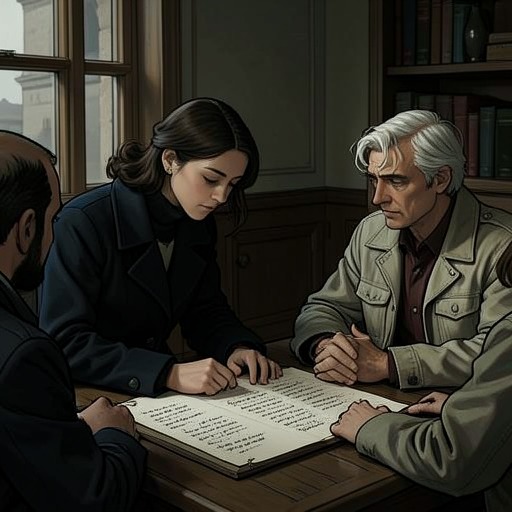
One is a tool, one a trap
The Rules of Werewolf“One is a tool, one a trap” is the central wording of the riddle exchanged between Hermione Granger and Draco Malfoy, and its decisive significance lies in how it recasts their attraction as a contest of interpretation. The phrase initially appears as a compact challenge, but its two-part structure gradually opens onto the pair’s shared struggle with power, desire, and emotional exposure: one object can be wielded against another person, while the other becomes dangerous precisely because someone chooses to enter it.
Form and First Appearance
The expression is presented as a deliberately incomplete couplet: “One is a tool, one a trap.” The wording establishes a binary without identifying either half, compelling Draco Malfoy to search for the missing meanings rather than receive a direct declaration. The book later repeats the same formulation in Hermione Granger’s note, where the separation between “One is a tool” and “One a trap” gives the riddle a measured, almost symmetrical shape. The clipped syntax matters. It makes the note sound less like an explanation than an invitation to continue reading, and it turns the recipient’s act of interpretation into part of the flirtation.
The riddle is also framed by the language of books and reading that surrounds Draco Malfoy’s response to Hermione Granger. He watches her with intense concentration among the library shelves, recognizing how completely she is absorbed by books, while his own desire is displaced into the wish to be read by her. In that context, the riddle operates as a text within the larger romance: Hermione Granger does not state her meaning plainly, and Draco Malfoy must approach her through wit, inference, and the possibility of getting the answer wrong.
The Two Halves of the Riddle
Hermione Granger’s note develops the first half through the image of an instrument that can be used against another person: “Wield the first, and you can take someone's soul.” She adds that Draco Malfoy has undoubtedly used it before, then sharpens the threat by writing, “Wield the first and I may cloud your head.” The first object therefore carries both literal danger and interpersonal force. It suggests a tool capable of domination, but in the immediate exchange it also points toward the mental disturbance produced by desire, provocation, and uncertainty.
The second half is defined through surrender rather than control. Hermione Granger writes that falling into the trap may allow another person to take one’s soul, and that the second answer may elude Draco Malfoy even more than the first. Her final formulation turns the riddle openly toward intimacy: “Express the second and I’ll never leave your bed.” The trap is consequently not only a threat; it is a condition of attachment. To solve it, Draco Malfoy must recognize that the language of capture has become inseparable from the possibility of remaining together.
The contrast between wielding and falling is the expression’s governing tension. The first half belongs to deliberate action: an object is taken up and directed. The second describes an involuntary or vulnerable movement into danger. That opposition mirrors the developing relationship between Hermione Granger and Draco Malfoy, whose exchanges retain the surface form of combat even as the underlying stakes change. A taunt can function as a weapon, but it can also disclose the person using it; a trap can threaten freedom, yet it can equally name the desire to stay.
Interpretation and Seduction
When Draco Malfoy brings the note to Pansy Parkinson, he treats the riddle as a serious problem requiring assistance. Pansy Parkinson quickly reads its erotic intelligence, telling him that the woman behind it is a book waiting to be devoured and invoking Draco Malfoy’s known pleasure in reading. Her interpretation joins the text’s two principal metaphors: Hermione Granger is both a difficult written work and an object of appetite. The riddle therefore does not merely conceal an answer; it creates a scene in which decoding becomes a form of pursuit.
Pansy Parkinson advises Draco Malfoy to approach the danger rather than remain outside it, describing the next encounter as entry into the lion’s den and promising that she has a plan. The exchange preserves the vocabulary of strategy and threat while redirecting it toward courtship. Draco Malfoy’s earlier mental pursuit of Hermione Granger, in which he chases her attention like a Snitch just beyond reach, belongs to the same pattern. His attraction is repeatedly represented as a game of capture, but the riddle complicates that game by making him ask whether the pursuer or the pursued will ultimately lose control.
The expression’s ambiguity also permits Hermione Granger to control the pace of disclosure. She can provoke Draco Malfoy without naming her desire outright, leaving him to test the boundaries of her meaning. His response follows the same indirect method: rather than confessing immediately, he relies on teasing, daring her to sustain eye contact and suggesting that she may be saving him for last because she enjoys torturing him. Their speech acts as both shield and revelation. Each person can preserve deniability on the surface while making the emotional charge increasingly unmistakable.
From Riddle to Emotional Reckoning
The expression ultimately acquires its clearest meaning when the game-like language surrounding Hermione Granger and Draco Malfoy is tested against what they actually feel. Draco Malfoy’s attraction has been shaped by pursuit, provocation, and imagined capture: he wants Hermione Granger’s attention as urgently as he once chased a Snitch just beyond reach, and even his private fantasies translate desire into an act of taking hold. Yet that vocabulary of control cannot contain the relationship’s emotional development. His confession admits that the connection began as a game and that provoking her was part of its appeal, but he then rejects the game’s supposed safety by telling Hermione Granger that it is no longer a game to him. The statement transforms the riddle’s opposition between tool and trap into a recognition of mutual vulnerability: what began as a device for teasing and seduction has become an emotional commitment neither can dismiss as mere strategy.
Significance of the Expression
“One is a tool, one a trap” endures because it makes interpretation itself part of the relationship between Hermione Granger and Draco Malfoy. Its language of wielding, pursuit, capture, reading, and entrapment initially allows desire to remain disguised as play, but the surrounding scenes progressively expose the cost of that disguise. Draco Malfoy’s need to recover Hermione Granger’s attention, his fantasies of physically taking hold of her, and his taunting suggestion that she is deliberately saving him for last all preserve the grammar of combat and control. At the same time, Hermione Granger’s riddle reverses that grammar: the person who appears to set the trap also risks being caught by the intimacy she has invited. When Draco Malfoy finally acknowledges that their exchange began as a game but is no longer one to him, the expression reaches its emotional resolution. The tool is no longer merely a weapon for provoking or clouding another person’s thoughts, and the trap is no longer simply a danger to avoid; together they describe the point at which wit, attraction, and strategic concealment give way to mutual exposure.