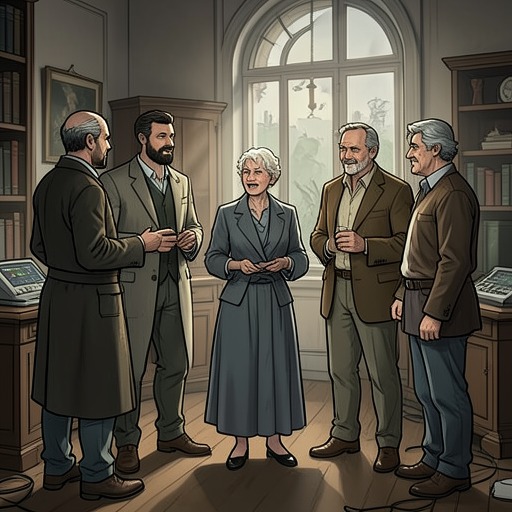
Pansy Parkinson
The Rules of WerewolfPansy Parkinson is one of the story’s most effective social catalysts. At the Witch Weekly photo shoot, Theodore Nott’s birthday party, and the Werewolf game that becomes the party’s central performance, she manages appearances with confidence while observing the emotional currents beneath them. Her wit is rarely neutral: she uses teasing, choreography, and selective disclosure to keep other people moving toward revelations they might resist making directly.
Identity and Public Persona
Pansy appears as a polished, self-possessed figure who understands how influence is manufactured. At the photo shoot, she tells Draco Malfoy that his presence is justified because donating his galleons automatically makes him influential, then pours him Prosecco and urges him to loosen up. Her manner treats status as both spectacle and practical currency. She is comfortable near the craft-service station, comfortable correcting Draco, and comfortable brushing imaginary lint from his impeccably tailored jacket while he complains about being there.
Her public identity extends beyond aristocratic presentation. Hermione Granger recognizes that Pansy is now a published author, and Pansy identifies The Disappointing Purebred Debutante as a bestseller popular in feminist circles. The exchange places her in a changing post-war social landscape where old pure-blood credentials coexist with literary success and arguments about equality. Pansy does not present this achievement modestly; she makes it part of her social authority, recommending that Hermione would probably enjoy the book precisely because of its politics.
At the shoot, Parvati Patil-Weasley directs the participants, but Pansy remains an important performer within that structure. She first poses alone with her book and then hooks her arm through Draco’s to pull him toward the modeling area. Her ease before the camera contrasts with Draco’s boredom and resistance. She knows how to inhabit a role without appearing trapped by it, while Draco’s performance of indifference repeatedly reveals that he is watching Hermione Granger instead.
Social Direction and Manipulation
Pansy’s strongest skill is the management of collective attention. At Nott Manor, she interrupts the party by clanking a champagne glass and announcing that Theodore Nott’s birthday requires a game. She proposes Werewolf, distributes the role papers, and establishes the rules: there is one werewolf, one healer, and a group of villagers; the werewolf may use legilimency for the game; each full moon brings a proposed victim; and the players must identify the werewolf before three wrong guesses end the werewolf’s opportunity to win.
Her moderation is deliberately theatrical. The role papers are charmed to vanish with Incendio, and a jinx forces the players’ eyes shut during the full-moon phases because she does not trust them to keep them closed. The healer may name someone to save, but the voice is altered so the identity remains hidden. Pansy therefore creates an atmosphere of controlled uncertainty: information is restricted, bodies are positioned, and the group is compelled to perform suspicion while she alone preserves the overall structure of the game.
She also knows how to answer moral objections without allowing them to derail the evening. When Hermione objects that the game reinforces the false idea that werewolves are inherently violent and should be feared, Pansy dismisses the complaint as excessive seriousness and calls for someone to get Hermione a cocktail. The response is not an argument about the representation of werewolves; it is a tactic for restoring the party’s rhythm. Pansy protects the game by converting critique into another social joke.
The Werewolf Game and Draco Malfoy
Pansy’s moderation creates the conditions in which Draco’s private interest in Hermione Granger can surface under cover of play. The rules authorize legilimency only for the werewolf, making mental access part of the game’s formal machinery. Draco is initially assigned the role of villager, but his behavior toward Hermione quickly becomes conspicuous. During a darkened round, he approaches her physically and speaks her first name in a whisper; in another round, he casts Notice Me Not and asks what she wants while the limited time of the game intensifies the encounter.
Pansy recognizes what Draco is doing before Hermione fully interprets it. After the game, she tells him that she knew he had figured it out when he made a move on Hermione in Round One. She and Ginny Weasley then deliberately helped him along. Once Pansy explained Draco’s conduct to Ginny, the two women extended their nights beyond what the game itself required, preserving the opportunity for the flirtation to continue. Her intervention turns the supposedly adversarial structure of Werewolf into an accomplice to intimacy.
The game’s rules also give Pansy a way to expose the difference between legitimate play and emotional evasion. When Hermione refuses to apply her intellect to the investigation, Draco publicly names Ginny as the werewolf and then uses the moment to suggest that certain couples need courage and that old eighth-year games might be revived. His final provocation asks Hermione whether she wants to meet him in a broom closet. Pansy’s earlier construction of the game makes this outburst possible, but it cannot control its consequences: Hermione is humiliated, furious, and storms away.
Pansy nevertheless treats the embarrassment as evidence of a successful reading of Draco’s intentions. Her later question about whether he abused his legilimency privileges is playful rather than accusatory, and she points out that Hermione was too absorbed in her own thoughts to notice what was happening. She also asks whether Draco really needed to provoke Hermione so harshly, acknowledging that Hermione already carries embarrassment about her eighth year. Pansy is therefore neither an innocent spectator nor a simple matchmaker. She facilitates the attraction, understands its risks, and judges Draco’s method even while enjoying the result.
Relationships and Private Alliances
Pansy’s relationship with Draco is marked by affectionate familiarity and permission to criticize. She calls him “Draco dear,” brushes his jacket, pours his drink, and physically steers him into the photo shoot. Her teasing assumes access to his vanity and his reluctance, while his willingness to follow her suggests a long-established friendship in which she can manage him without formal authority. She also sees through the distance he performs around Hermione, nudging him when his stare becomes obvious and recognizing that the encounter matters to him.
Her alliance with Ginny Weasley is especially important during the game. Together they monitor Draco’s attraction, conceal their cooperation, and prolong the rounds so that his charged encounters with Hermione can continue. This is a collective female intervention in a flirtation that Draco imagines he is directing alone. Pansy and Ginny understand the social mechanics more clearly than either participant does, and their shared amusement reveals that the game’s apparent information hierarchy has been quietly breached by observers working behind the scenes.
Pansy’s connection with Neville Longbottom develops in the same party environment. After the game, she emerges from the direction of the loos with Neville, adjusting the bottom tulle of her dress while he tightens his tie. The sight becomes material for Draco’s joke that Pansy is giving Neville an early birthday present, and her presence beside Neville links her own romantic or sexual play to the wider pattern of pairings that the party keeps bringing into view. The scene reinforces her role as both participant and commentator in a social world where flirtation is public entertainment and private negotiation at once.
Narrative Function and Significance
Pansy functions as the story’s backstage director. The photo shoot makes status visible, the birthday party gathers former rivals and friends into one room, and the Werewolf game supplies a rule-bound setting in which hidden intentions can be enacted under the excuse of play. Across these scenes, Pansy repeatedly controls thresholds between public performance and private knowledge. She moves Draco toward the camera, draws the group into a circle, distributes concealed roles, and later helps interpret the behavior that the rules have released.
Her importance lies less in a single decisive confession than in her ability to recognize patterns before the people involved can name them. She sees Draco’s interest in Hermione, informs Ginny, extends the game, and then questions whether his provocation has gone too far. When Draco follows Hermione toward the balcony after she leaves, the movement confirms that Pansy’s social experiment has produced a consequence beyond her direct control: the flirtation has become a confrontation, and the performance begins to give way to sincerity.
That transition clarifies Pansy’s thematic role. Draco later tells Hermione that what began as a game is no longer a game to him, and Pansy’s manipulation of the Werewolf structure is part of the pressure that brings him to that realization. She represents the intelligence of the social scene—the friend who reads bodies, timing, alliances, and evasions—while also exposing the danger of treating another person’s vulnerability as entertainment. Her humor keeps the party alive, but her best judgment appears when she notices the cost of the joke.