Post-war wizarding society
The Rules of WerewolfPost-war wizarding society is the book’s social condition of reconstruction and reconciliation after the Battle of Hogwarts. Its decisive feature is the gradual conversion of old divisions into ordinary cooperation: former rivals work together, former enemies attend one another’s parties, institutions are revised rather than merely preserved, and relationships cross the Gryffindor-Slytherin boundary. Reconciliation remains uneven and comic rather than fully resolved, but the expanding mixed network makes Hermione Granger and Draco Malfoy’s relationship socially imaginable.
From Wartime Division to Everyday Contact
The society shown after the war is not free of memory. Draco Malfoy still recognizes former schoolmates who would actively avoid him, and the people in the room know the reason for that avoidance. Yet the same gathering places him among colleagues, friends, published writers, Ministry figures, Gringotts representatives, and former classmates whose lives have moved beyond Hogwarts rivalries. The important change is therefore not that the past disappears; it is that the past no longer determines every possible interaction.
Draco’s own history embodies that uneven transition. Four years before the events described, both of his parents died after contracting Cerebrumous Spattergroit. In the post-war years, the Malfoy family had rebuilt a relationship that had been fractured by the war, and Draco remembered those years as a foundational period in his adult life. His grief remains sharp, but his response to the damaged world is practical: he devotes himself to his work, maintains friendships with Theodore Nott, Blaise Zabini, and Pansy Parkinson, gives money to worthy charities, and tries to rebuild what was broken in his youth. Private repair and public reconstruction thus appear as parallel processes.
The social network also broadens through deliberate invitations. Hermione Granger insists that Harry Potter and Ron Weasley attend Theodore Nott’s party with Ginny Weasley and Neville Longbottom because they are friends and should once again go out as a group. Her insistence treats mixed socializing as a test of peace in ordinary life, even while Ron still says that he does not trust Draco. Harry, by contrast, describes Draco as a friend, or at least as someone with whom he is friendly and works well. The distinction between trust, cooperation, and friendship is left visible, making reconciliation a process of negotiated degrees rather than a simple declaration that everyone is healed.
Institutions and the Meaning of Influence
The post-war order is also defined by changes in how achievement is recognized. At a Witch Weekly event, Pansy Parkinson explains that Draco is considered influential because donating his galleons automatically qualifies him for that status. Draco resents the implication that wealth, rather than his work as an Auror, is what makes him worthy of attention. His discomfort exposes a society in which public influence is assembled from several forms of capital: money, professional service, media visibility, and institutional contribution.
Hermione’s achievement offers a sharper alternative to inherited status and charitable wealth. She has spent the previous few years reworking the Trace because its treatment of Harry Potter’s situation had never seemed right to her. Her revision can distinguish between magic performed by an underage witch or wizard and magic merely performed in that child’s presence, and the Wizengamot has recently approved it. The reform turns a personal objection into a legitimate institutional change. Hermione is not simply benefiting from post-war society; she is helping redesign its rules so that legal authority can respond more precisely to lived circumstances.
Other scenes place formal authority beside privately created systems of permission. Hermione enters her Ministry office through a locked door opened by a whispered cypher spell and a precise wand movement, then clears the wards before beginning confidential work. At Theodore Nott’s birthday gathering, Pansy Parkinson establishes a temporary system with its own roles, information restrictions, and penalties: the Werewolf game has one werewolf, one healer, and villagers; the werewolf may use legilimency only for the game; players must keep their roles secret; and three wrong guesses end the werewolf’s full-moon phases and secure its victory. These rules are playful, but their structure echoes the wider society’s concern with who may know, who may act, and who has the authority to interpret conduct.
Mixed Gatherings as Social Laboratories
The strongest evidence of reconciliation appears in rooms where old categories are forced into proximity. At Nott Manor, Draco and Theodore Nott conduct a final walkthrough of the candle-lit library before the party. Draco insists that the host should complete that inspection, invoking his mother’s example while checking the Firewhiskey supply; Theodore notes that Pansy and the house-elves have handled most of the preparations. The scene places a former pure-blood household inside a new social function: the manor is no longer only a symbol of an old faction but a venue where a mixed group can meet.
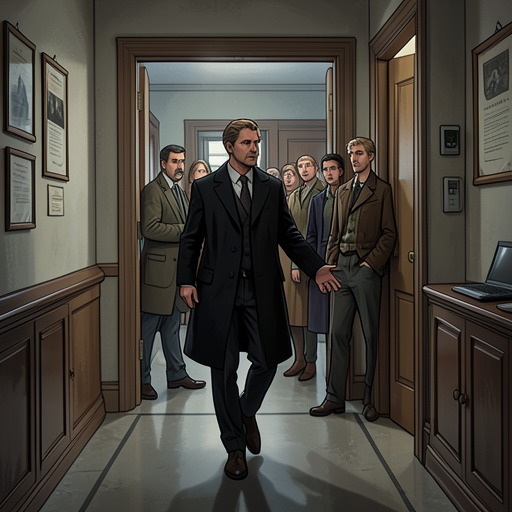
When Harry opens the double doors, Hermione immediately sees a room containing Theodore, Pansy, Daphne Greengrass, Blaise Zabini, and Pucey, with Draco somewhere nearby. The gathering is socially mixed before the central romance fully develops, and its atmosphere is organized around books, drinks, games, and observation rather than political allegiance. Harry and Ron occupy a corner playing chess while others wait for the board, creating several overlapping forms of interaction instead of one unified camp. The party’s structure makes former boundaries negotiable through shared leisure.
Pansy’s Werewolf game intensifies that temporary suspension of hierarchy. She distributes burning role slips, closes the players’ eyes with a jinx because she expects them to cheat, and turns fear of the werewolf into a controlled party ritual. Hermione objects that the game reinforces the false idea that werewolves are inherently violent and should be feared; Pansy answers that it is only a party game and asks someone to give Hermione a cocktail. The disagreement preserves a real ethical argument while converting it into banter. Reconciliation here does not require the characters to think alike. It allows disagreement to occur without reopening the war.
The later scene at Nox shows that the mixed network has become durable. Hermione and Draco arrive together, and she scans the crowded bar for their friends. Blaise Zabini has his arm around Ginny Weasley, while Theodore, Harry Potter, Astoria, and Daphne stand together by the window. Harry and Theodore have become good mates, and Harry’s shy attention to Daphne suggests another emerging connection across the former social divide. The pub is not merely a backdrop for romance; it is a visible map of relationships that the pre-war world would have treated as improbable.
Reconciliation, Romance, and Continuing Friction
The relationship between Hermione Granger and Draco Malfoy develops within this changed society but does not erase the antagonism that gives it energy. At the Witch Weekly shoot, Hermione challenges Draco about whether her achievement means she is no longer riding Harry’s coattails. Draco is astonished by her professional accomplishment and privately finds her infuriatingly impressive. He has also become preoccupied with her after their sparring, searches Ministry records for her employment history, and uses a favor owed by an Employment Resources officer to get a note into her office. His methods are ethically dubious, but they belong to a society where his recent corruption is described as bribery rather than wartime violence, and where the possibility of a different future remains open.
Their eventual intimacy confirms that reconciliation is enacted through repeated contact rather than announced as a moral conclusion. After Theodore’s party, their relationship takes off. Hermione recalls that Draco is gentler than she expected beneath the continuing snark, and that their banter now rarely becomes a full argument unless one of them feels genuinely wronged. Their sexual relationship is described as exceptionally fulfilling, but its social significance lies in the change of register: hostility becomes wit, vigilance becomes attention, and an old rivalry becomes a committed private bond that can exist openly within a widening circle of friends.
The society nevertheless retains resistance. Ron Weasley continues to call Draco a ferret and says that he does not trust him, while Hermione has to reassure both Ron and herself that she can handle Draco. Draco, for his part, remains conscious of the people who avoid him and of the reputation attached to his family name. These tensions prevent the post-war order from appearing magically cleansed of history. The new social world is credible precisely because acceptance is partial, performed in stages, and tested in public settings.
Reconstruction as a Practice of Care
Reconstruction extends beyond friendship and romance into attempts to repair harm through technical and medical work. Hermione’s research into the Forget Me Potion begins from concern about how witches and wizards behave under the pressure of a strong love potion. She rejects Obliviate as too powerful and looks for a workaround, while the increasing rarity of Ashwinder eggs forces her to investigate substitutions. Her work joins ethical responsibility to material limitation: a safer remedy is needed, but even its ingredients are becoming difficult to obtain.
This pattern resembles the broader social movement from blunt authority toward differentiated response. The reworked Trace avoids treating every nearby magical act as the same offense; Hermione’s potion research seeks an alternative to a spell whose power can erase too much; and the social groups repeatedly test whether people can be judged by present conduct rather than inherited labels. None of these efforts guarantees justice, but each imagines repair as careful adjustment rather than simple punishment.
Post-war wizarding society therefore functions as both setting and argument. Its parties, workplaces, offices, charities, friendships, and romances show old enemies sharing space before they fully share trust. Its most meaningful victories are modest and repeated: an invitation accepted, a professional achievement recognized, a family relationship rebuilt, a former enemy treated as a colleague, or a crowded bar in which Gryffindors and Slytherins no longer occupy separate worlds. The book presents reconciliation not as the cancellation of conflict but as the creation of enough ordinary life for people to choose different relations to the past.