Werewolf game rules
The Rules of WerewolfWerewolf game rules are the improvised procedures Pansy Parkinson uses to organize a party game at Theodore Nott’s birthday gathering in Nott Manor. They give the guests a contest of concealed identities, timed eliminations, and collective guesses; as the rounds unfold, Draco Malfoy uses the game’s darkness and uncertainty to pursue Hermione Granger, so its rules become both a structure for play and a cover for intimacy.
Definition and Setup
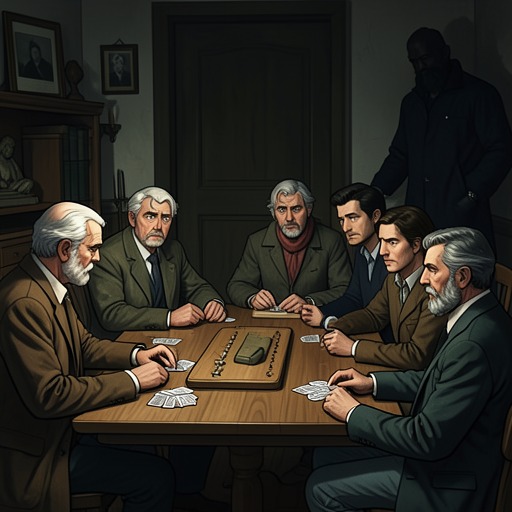
At the birthday gathering, Pansy Parkinson proposes Werewolf as a game in which the players receive hidden roles and try to identify the werewolf. She moderates the proceedings, distributes a slip of paper to each participant, and tells them to memorize its contents before the paper vanishes by Incendio. The destruction prevents the role assignments from remaining available as physical evidence, leaving the players to infer identities from conduct and accusations.
The game’s central roles are one werewolf, one healer, and villagers for everyone else. Draco Malfoy discovers that he is a villager. The werewolf may use Legilimency for the purposes of the game, an unusual magical privilege that turns private thought into part of the contest’s information system. The rules do not explain how the players are assigned, nor do they establish additional powers for villagers; the emphasis is on secrecy, deduction, and the moderator’s control of each round.
Hermione Granger objects to the premise because she considers a game built around a violent werewolf to reinforce a harmful narrative about werewolves. Pansy Parkinson treats it as party entertainment and moves the group back to the instructions. The exchange establishes an early tension between the game’s fictional threat and the real people represented by its creature: Hermione takes the imagery seriously, while the game’s structure depends on turning it into a playful role.
Night Rounds and Powers
Each round includes a period called the full moon. During it, the werewolf privately tells Pansy Parkinson whom they wish to kill. The healer may name someone aloud to try to save them, but the healer’s voice is magically altered so that the other players cannot identify the speaker. The secrecy protects the role while making the healer’s decision audible as an action without making its author known.
Pansy Parkinson also closes the players’ eyes with a jinx during these phases. She explains that the brief spell is intended to prevent cheating, since the group cannot be trusted simply to keep their eyes shut. The jinx formalizes the central information gap: participants know that choices are being made around them but cannot watch who makes them. After the hidden actions, Pansy Parkinson reverses the effect with Oculus Reseratus and announces the result.
The first revealed victim is Theodore Nott. Because a player who is dead must leave the game, he is removed from the circle and sent to the bar, despite protesting that it is his birthday. The rule makes elimination immediate and visible: a hidden choice becomes a public absence, and the remaining players must continue without the person they have just lost.
Guesses, Elimination, and Victory
After each round, the players guess who the werewolf is. The group has three wrong guesses before the werewolf’s full-moon phases end and the werewolf wins. The rule gives the villagers a limited margin for error: every accusation risks using up one of their chances, while a wrong answer also discloses who the group suspects without exposing the hidden role.
The players eventually agree that Draco Malfoy is the werewolf. Pansy Parkinson reveals that the accusation is incorrect; Draco Malfoy is not the werewolf, so the game continues into another nightfall. The false identification is important because it demonstrates the difference between suspicion and knowledge: even a united group can spend one of its limited guesses on the wrong person. Draco Malfoy’s actual villager role also makes his later conduct in the dark distinct from the game’s authorized werewolf power.
The healer’s intervention provides a second form of concealed action. During one night phase, the healer names Ginny Weasley as the villager to save, and Ginny Weasley reacts with a laugh when the altered voice is heard again. Later, Pansy Parkinson announces that the healer has been eliminated and that there is therefore no one left to save. The rule’s protection is thus conditional: it can preserve a player during a round, but it does not survive the healer’s removal from the game.
Rule Boundaries and Dramatic Function
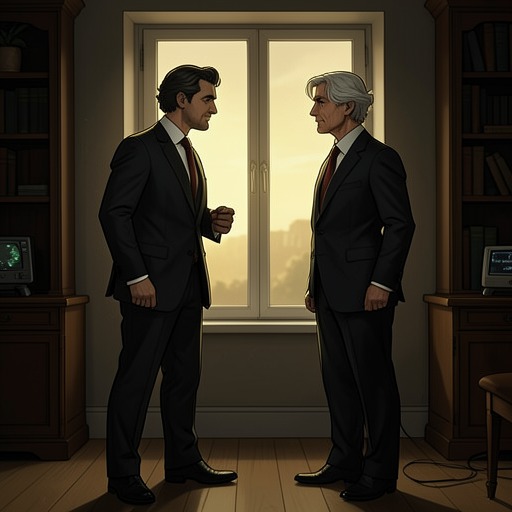
The enforced darkness creates an opening for a second contest that is not part of Pansy Parkinson’s stated rules. After the group has wrongly accused Draco Malfoy, Hermione Granger waits in the dark for someone to approach. Draco Malfoy touches her hand and stands close behind her, addressing her by her first name; she reminds him that the game has rules. The scene converts the round’s enforced blindness from a safeguard against cheating into cover for an encounter the rest of the circle cannot see.
During a later dark phase, Draco Malfoy tells Hermione Granger that he has cast a Notice Me Not, then asks what she wants while they have time. His concealment spell intensifies the separation between the public game and their private exchange. The rules establish a werewolf’s limited Legilimency privilege, but Draco Malfoy is a villager; the narrative does not present his flirtation as a legitimate use of that role. Instead, his conduct exploits the conditions created by the game—closed eyes, short rounds, and uncertainty about what others can observe—without being one of its formal moves.
The game’s public guesses eventually give way to a different kind of provocation. With four players left and the healer already eliminated, Draco Malfoy accuses Ginny Weasley of being the werewolf, then turns the discussion toward the couples in the room and asks Hermione Granger whether she will meet him in a broom closet. Hermione Granger, frustrated by the tension he has created in the dark and by his public insinuation, storms out before the game reaches a reported resolution. The rules therefore remain more than a self-contained puzzle: they set up repeated moments in which secret roles and public performance can be manipulated, while the outcome of the party game itself is left secondary to the attraction it has enabled.