Air pollution
The Running ManAir pollution is not merely background atmosphere in the novel. It is a pervasive material condition that shapes where people may live, how they move, what they can know, and how long their bodies are expected to endure. Its most decisive significance lies in the connection between environmental damage and political concealment: the polluted air of 2025 sickens poor communities, while official institutions suppress measurements, disguise causes of death, and offer entertainment in place of protection.
Definition and Material Presence
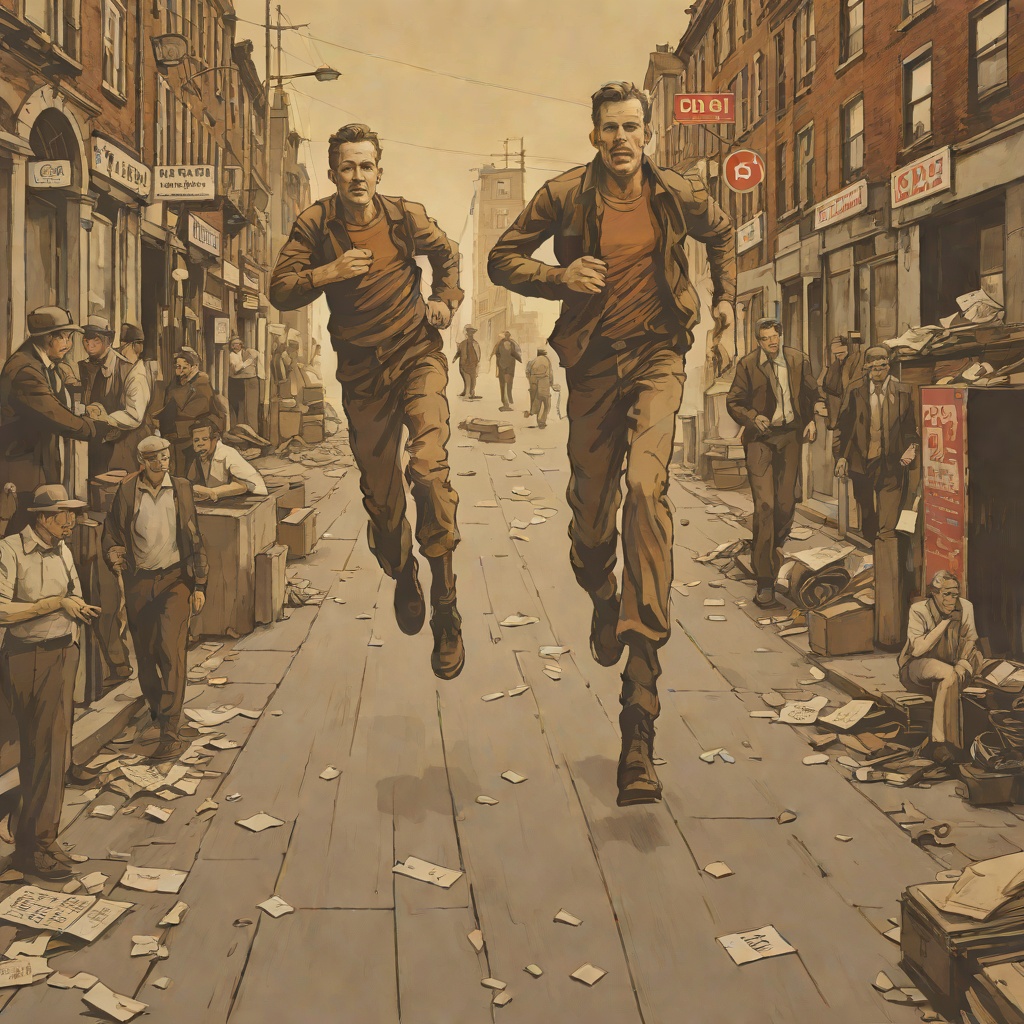
Air pollution appears first as a feature of the divided city. South of the Canal, Co-Op City is a landscape of stripped vehicles, deserted shops, garbage, rats, cycle gangs, and broken infrastructure. The air is described as sulphurous and thick, while the neighborhood is surrounded by the decaying reek of 2025. When Ben Richards crosses the Canal toward the Network Games Building, the spatial contrast becomes unmistakable: the southern district is abandoned and exposed, whereas the uptown district is clean, guarded, brightly maintained, and organized around the Games.
The contrast is infrastructural as well as social. Free-Vee cables are safely buried beneath the streets, and the dream machine operates continuously on the far side of the Canal, but only employed people possess the New Dollars required to use it. The same city that distributes entertainment through a protected communications network leaves four million people, most of them unemployed and living south of the Canal, to breathe dangerous air. Pollution therefore helps produce a geography of exclusion rather than simply coloring it. The Canal marks a political boundary between those who can purchase distraction and those who bear the environmental cost.
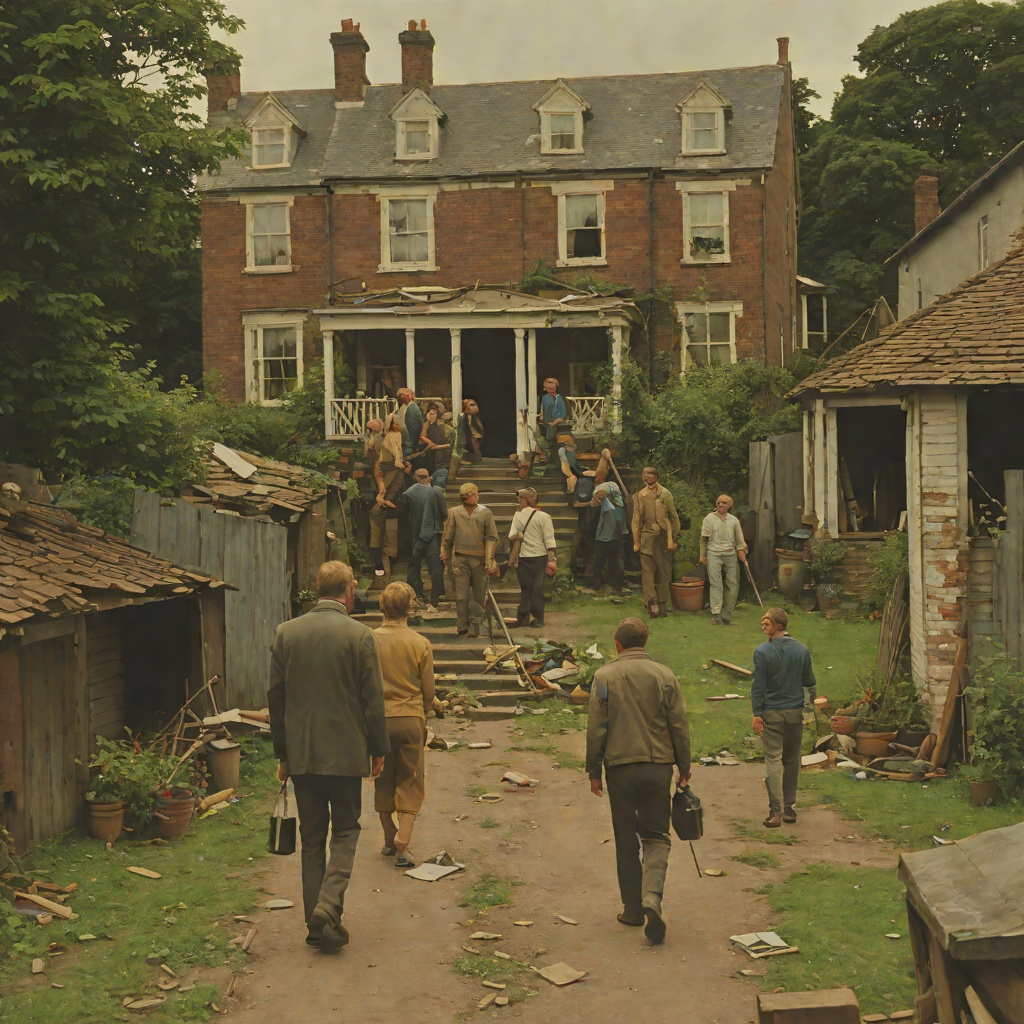
The abandoned Super Pine Tree Mall extends this damaged environment beyond the city. Its construction stopped at least two years earlier, leaving miles of half-built stores, rusted steel, foundation pits, discarded pipe, Quonset huts, and overgrown vegetation. The site is not untouched nature: industrial waste has made the nearby river sulphurous, while unfinished development has become a maze and rat warren. Both urban Co-Op City and the failed mall show landscapes in which economic systems continue to impose their presence even after their visible projects have collapsed.
Disease and Slow Violence
The novel gives pollution its most intimate form through Cassie, Bradley Throckmorton’s five-year-old sister. She has cancer in both lungs, and the disease has spread upward into her throat and downward into her belly. Her screams and sudden silences from the far bedroom turn an abstract environmental statistic into a child’s daily suffering. The illness is especially shocking because it violates ordinary expectations about childhood disease; Bradley cannot accept that a five-year-old should have lung cancer, yet the surrounding air makes the impossible ordinary.
Bradley explains that Boston’s pollution count is twenty on a good day, equivalent to smoking four packs of cigarettes a day simply by breathing. On a bad day it can rise to forty-two, and older people collapse throughout the city. Asthma appears on death certificates even when the deeper cause is the air. The bureaucratic label converts a collective industrial condition into an apparently private medical failure, preventing the death from identifying the factories, policies, and owners responsible for it.
This harm unfolds as slow violence rather than as one spectacular disaster. People inhale contaminated air day after day; children develop cancer; adults suffer asthma and emphysema; and the dead are recorded under diagnoses that conceal the environmental cause. Ben Richards’s own history reinforces the pattern. His mother died of syphilis, his brother Todd was killed in an accident, and the Municipal Crematorium consumed them both, but the city’s air remains the final medium into which the poor are returned. The crematorium’s smoke stacks and the industrial smokestacks form a grim continuity: the city processes both laboring bodies and polluted air through the same machinery of disposal.
Suppressed Knowledge and Improvised Science
Air pollution is also a crisis of knowledge. Bradley tells Ben Richards that official pollution counts stopped appearing with the weather in Harding long ago, and that Boston ceased publishing them in 2020 because authorities were afraid to do so. Richards does not possess a nose filter, while Bradley has made one for Stacey and others in his circle. The unequal distribution of protective equipment makes scientific knowledge materially consequential: knowing the danger does not guarantee the ability to escape it.
Bradley and his friends respond by producing knowledge outside authorized institutions. They steal or borrow a library card because access requires a family member with a guaranteed income of five thousand dollars a year. They take turns visiting the library in a gang uniform, first reading sexbooks and then researching pollution, impurity counts, smog levels, and nose filters in the reserve section. A wax blank provides a key to the restricted materials. Their reading is therefore an act of trespass against both class barriers and information control.
Their improvised pollution counter makes this counter-knowledge tangible. Rich and Dink Moran build it from coffee cans and materials taken from cars after Dink copies a design from a book. Hidden in an alley, the device measures a danger that official sources refuse to display. Bradley also recalls that an older federal pollution scale ran from one to twenty and required factories and other pollution-producing operations to shut down when the count reached twelve. The law remained in force until 1987, when the Revised Congress rolled it back. The historical comparison reveals that the crisis is not technologically inevitable: society once possessed standards and enforcement mechanisms, then deliberately weakened them.
Industry, Protection, and Propaganda
General Atomics embodies the unequal political economy of pollution. Cheap commercial nose filters are described as nearly worthless, consisting of two pieces of screen with metholated cotton between them. Effective filters from General Atomics cost six thousand New Dollars, placing them beyond the reach of the people most exposed to contamination. Bradley’s homemade filter costs ten dollars and uses an atomic nugget recovered from a hearing aid bought in a hockshop for seven dollars. The contrast between a six-thousand-dollar industrial product and a ten-dollar improvised device exposes protection as a commodity rather than a public right.
The Network’s response is not to eliminate the hazard but to manage public perception. Bradley understands Free-Vee as a sedative that keeps people indoors and politically inactive while they breathe themselves to death. Ben later records a message for the television audience stating that the Network is poisoning the air and denying cheap protection even though nose filters could be manufactured for six dollars each. He anticipates censorship and instructs viewers who can read lips to spread the message, turning the broadcast medium against the institution that controls it.
The government’s treatment of pollution information follows the same logic. During his stay in Manchester, Ben reads available material in a locked library cubicle and finds very little later than 2002. The newer information contradicts or sits badly beside the older record, suggesting that official discourse has been repeatedly revised to accommodate present policy. Pollution thus generates two opposed archives: an official record that withholds, alters, or mislabels evidence, and a clandestine record assembled by unemployed readers, homemade instruments, and smuggled videotapes.
Class, Space, and Environmental Justice
The burden of air pollution follows class lines throughout the narrative. Co-Op City lies south of the Canal, where unemployment benefits have already been spent, public transport requires tokens, streets are patrolled by cycle gangs, and police rarely venture. Uptown, by contrast, has clean skyscrapers, expensive shops, city cops on every corner, guarded parks, and the Network Games Building. The environmental division is inseparable from policing and consumption: poor residents are left in a hazardous district, then treated as suspicious when they cross into protected space.
Richards’s confrontation with Amelia Williams makes the moral structure explicit. She possesses a six-thousand-New-Dollar car while his daughter is dying of the flu, and he connects her comfort to the wider system that allows industrial pollution to continue. He condemns the exclusion of workers who refuse General Atomics jobs that may make them sterile, the need for a wife to earn grocery money through prostitution, and the Network’s killing of millions through air pollutants while it could manufacture inexpensive nose filters. His argument links workplace danger, household poverty, reproductive harm, respiratory disease, and consumer privilege as parts of one system rather than separate misfortunes.
The environmental setting also affects the meaning of flight and pursuit. The Games, police, and media convert social desperation into spectacle, while polluted districts become both the source of expendable bodies and the spaces through which those bodies must move. Even the empty mall, with its unfinished commercial promises and industrially fouled river, functions as a refuge only because abandonment has made it invisible. Air pollution is consequently a force that organizes vulnerability before the televised hunt begins: it determines who is protected, who is watched, and whose suffering can be dismissed.
Narrative and Political Significance
The novel repeatedly makes air visible through physical sensation, numerical measurement, disease, and institutional silence. Sulphurous air, buried cables, rats, smog-covered towers, nose filters, hidden counters, and a child’s lung cancer form a material vocabulary that refuses to let pollution remain an abstract policy issue. The Network’s polished spectacle depends on keeping that vocabulary out of public circulation, yet the suppressed facts return through Bradley’s research and Richards’s recordings.
Air pollution also supplies the novel’s clearest example of how violence can be both ordinary and organized. A thrown piece of asphalt is immediate and visible; contaminated air is diffuse, cumulative, and difficult to assign to a single moment. Nevertheless, its distribution is structured by industrial decisions, class geography, withdrawn regulations, unequal access to protection, and manipulated death certificates. The air becomes a form of governance: it helps exhaust a population while propaganda supplies the illusion that nothing fundamental is wrong.
By carrying the pollution story from Co-Op City to Boston, from Bradley’s hidden library research to the abandoned mall, and from Cassie’s body to Richards’s attempted television testimony, the narrative turns environmental injury into a political accusation. The decisive conflict is not only between a fugitive and the institutions hunting him. It is between a society that treats breathable air as a purchasable privilege and the people who, through reading, measurement, homemade technology, and testimony, insist that the damage has an identifiable cause and a human cost.