Ben Richards escapes the Boston YMCA
The Running ManBen Richards escapes the Boston YMCA at the moment when pursuit, publicity, and physical confinement converge. Tracked as a contestant in The Running Man, he must keep moving while the Network presents him as an urban predator. His escape depends not on superior force but on composure, local knowledge, improvisation, and his willingness to make the pursuers believe he has died in a fire. The route carries him from a public building into its hidden infrastructure, and then into the dangerous anonymity of Boston’s underground water system.
Pressure of the Manhunt
The escape begins after Richards has been publicly transformed into an object of fear. On The Running Man broadcast, Bobby Thompson presents a retouched portrait of him in a baggy gray workshirt, giving his face a lowered forehead, deepened eyes, shadowed cheeks, and a deliberately curled mouth. The image makes him appear like an “angel of urban death,” a primitive and threatening figure rather than a frightened man trying to survive. Thompson announces that a verified sighting will earn one hundred New Dollars and that a sighting resulting in a kill will earn one thousand, converting every passerby into a possible informer or executioner.
The broadcast also weaponizes Richards’s family. A distorted image of Sheila Richards is introduced as the woman who will receive his reward if he is brought down, while the television audience is encouraged to treat both husband and wife as parts of a sensational spectacle. When Richards protests that the image is a fake, the studio crowd drowns him out. Thompson then asks how long he expects to hold out, making survival itself a public contest whose rules are controlled by the host and the Network. The escape from the Boston YMCA therefore takes place inside a larger system that has already defined Richards as guilty before any reliable account of his actions can circulate.
The Basement Diversion
When Richards notices that he has been bracketed by watchers, he walks rapidly toward the bathroom while forcing himself to remain calm. His terror is acute, but he understands that panic will make him die quickly. The building’s ordinary rooms offer no safety, so he relies on a trick learned in childhood: using the newspaper stores in the basement as fuel for a fire. The escape is consequently built from the same discarded material that surrounds him, a small act of ingenuity against a heavily organized pursuit.
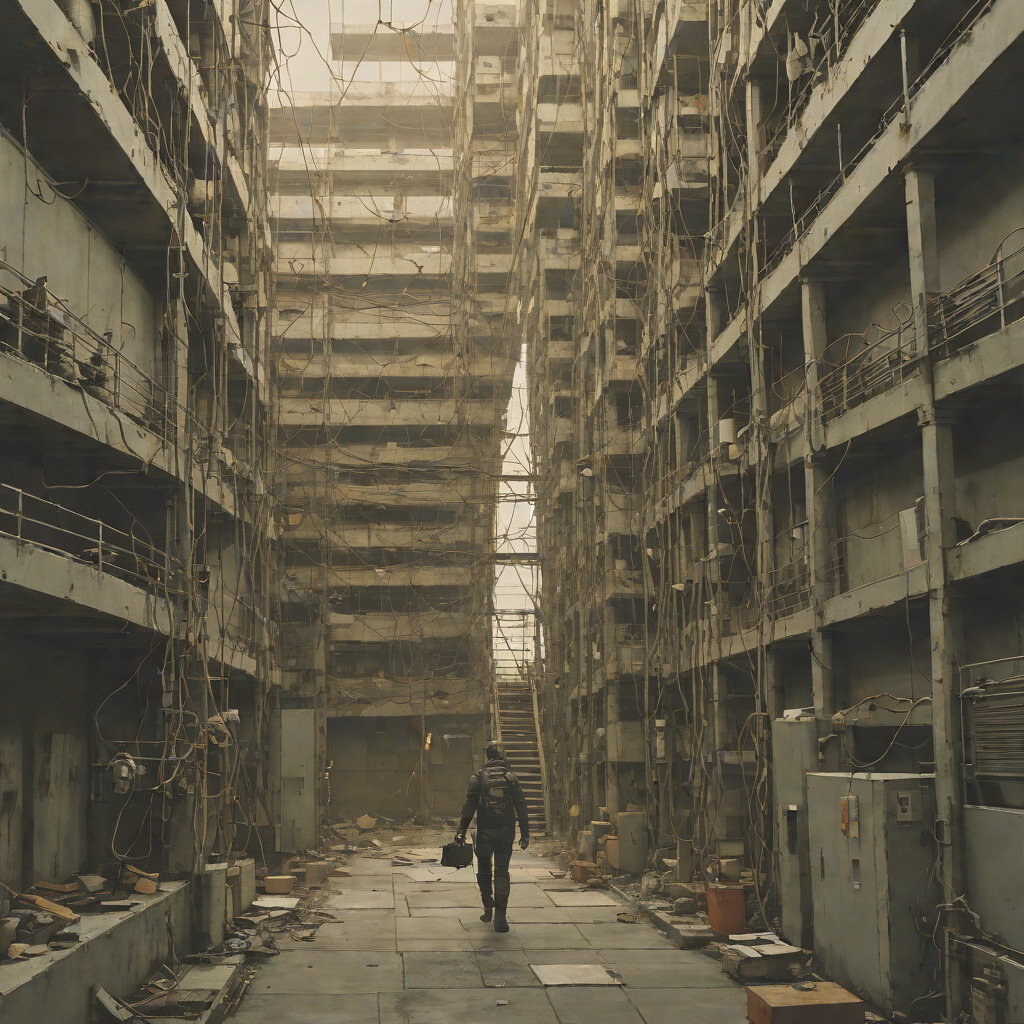
In the cellar, rusted heating pipes crawl across a cobwebbed ceiling, and thousands of newspapers lie stacked and tied with string. Rats have nested in them, whole families staring from the paper drifts as Richards enters. He takes a crowbar from a litter of tools behind a large fuse box and locates the main storm drain, a vented steel structure roughly three feet across. The crowbar opens the cover and reveals a pipe slanting downward at a forty-five-degree angle, with a bore of no more than two and a half feet. The passage is almost too narrow to breathe in, but it is the only route that offers even a chance of escape.
Richards first prepares the exit by turning the drain cover so that he can grip it from beneath. He then breaks the fuse-box padlock and considers pulling the fuses, but the fire offers a more convincing solution. He searches the folded, dog-eared matchbook that he has been using for cigarettes and finds only three matches. The first gutters in a draft; the second slips from his trembling hand and dies on the damp concrete. The third remains alight long enough for him to ignite a paper spill and place it in a fissure in the chest-high wall of newspapers. He waits until the flames are spreading before entering the drain, making the fire a delayed signal that can be mistaken for the end of his flight.
Through the Hidden Infrastructure
As the fire takes hold, Richards backs into the pipe. He makes slow, molelike progress for about fifty yards through the horizontal section, moving blindly and retreating from the direction of the explosion. The oil tank in the Y’s basement then blows with a roar powerful enough to set up sympathetic vibrations in the pipes and nearly rupture his eardrums. A yellow-white flash becomes a rosy reflected glow, followed by a blast of heated air that strikes his face. The violence above him is not merely a backdrop: the building itself becomes an instrument of destruction, and the escape route becomes increasingly lethal.
The tape camera in Richards’s jacket pocket swings and bounces as he tries to move faster. Heat travels through the pipe from the explosion and fire, threatening to bake him alive in the confined passage. Sweat mixes with black streaks of ordure on his face, while the pipe walls become hot to the touch. The scene reverses the public image imposed on him by television. The broadcast depicts an almost mythic killer stalking the city; the hidden passage reveals a man crawling backward through filth, dazzled by reflected fire, trying not to die.
The pipe eventually ends above another channel. Richards’s feet suddenly dangle in the air, and he has to slide his knees over the edge without being able to see what lies below. His shoes strike cold water, shocking after the heat. The new pipe runs at right angles to the first and is large enough for him to stand, though only bent over. Thick, slowly moving water rises above his ankles. For a moment he looks back toward the tiny pipe and its circle of reflected fire. Seeing the glow at that distance tells him that the explosion must have been enormous, while also confirming that the pursuers may assume he has perished in the inferno.
From Suspected Death to Pursuit
Richards recognizes that the investigators will probably first assume he is dead in the Boston Y.M.C.A. basement. They may not discover the drain route until the fire is under control, giving him a narrow interval in which to move. Yet the escape is not clean or final. He has previously assumed that his enemies could not trace him to Boston, only to find that the assumption was unsafe; the same uncertainty follows him into the sewer. Survival depends on remaining ahead of what others think they know.
The first human consequence of the escape appears when Richards emerges from a manhole and encounters Bradley Throckmorton and Stacey. Bradley produces a switchblade and asks whether Richards is armed. Stacey immediately identifies him as the man seen on Free-Vee and claims that Richards “offed the Y.M.C.A. on Huntington Avenue.” The accusation has already been inflated: the men have heard that he fried five cops, and Bradley remarks that the real number probably means fifteen. Stacey says that Richards came out of the manhole, while Bradley decides not to cut him and instead closes the blade. The underground flight thus delivers Richards into an unstable refuge, where recognition is possible but judgment has not yet hardened into violence.
The Escape as Public Falsehood
The fire gives the Network a story more useful than the truth. Later, Bobby Thompson tells viewers that five policemen went to a “blazing, agonized death” in the basement of the Boston Y.M.C.A. at Richards’s hands, describing him as a wolf who set a clever and merciless trap. The broadcast asks where he is and urges the public to look for him, replacing the uncertain facts of the escape with a complete moral tableau: Richards is the killer, the policemen are innocent victims, and the audience is an authorized force of pursuit.
The same machinery edits Richards into a still more dangerous figure. A television clip shows his face and then his John Griffen Springer disguise, followed by fabricated or manipulated audio in which his image appears to threaten the public, the Games Commission, and every policeman he sees. Thompson declares that Richards would mobilize malcontents to rape, burn, and overturn the streets, and accuses him of lying, cheating, and killing. The escape therefore produces a paradoxical result. It succeeds materially because the fire obscures his route, but it strengthens the ideological case against him because the destruction can be narrated as deliberate mass violence.
That contradiction is central to the event’s significance. Richards’s actions in the basement are specific and constrained: he finds a crowbar, opens a drain, uses three matches, starts a fire, and crawls through pipes filled with heat and water. The official account erases these circumstances and substitutes a simplified identity, the “wolf” who murders police. The event demonstrates how a desperate act can be converted into propaganda when the authorities control the camera, the vocabulary of guilt, and the public’s access to competing testimony.
Structural Stakes and Aftermath
The escape also exposes the material conditions behind Richards’s rebellion. In Bradley Throckmorton’s apartment, Richards encounters Cassie, a five-year-old with cancer in both lungs that has spread into her throat and belly. Bradley and his friends have built a pollution counter from coffee cans and salvaged automobile parts after studying library books about impurity counts, smog levels, and nose filters. Boston’s pollution count is described as twenty on a good day and as high as forty-two on a bad day, while factories continue operating around the clock. The cheapest General Atomics nose filter costs six thousand New Dollars, placing effective protection beyond the reach of people already living with illness and scarcity.
This background changes the meaning of the basement fire. Richards is fleeing an immediate police hunt, but the world around him is also being damaged by a slower violence that rarely receives the drama of a televised death. Cassie’s cancer, the polluted air of Boston, the poverty of Bradley’s household, and the crowd’s appetite for spectacle belong to the same social order. The Network offers Free-Vee as distraction while pollution, disease, and class exclusion remain difficult to see as crimes. The escape cuts through that order physically, but it cannot prevent the order from reclaiming the event through its preferred story.
Richards later tells a hostile woman that it is disgusting to be blackballed for refusing a General Atomics job that would make him sterile, to watch his wife earn grocery money on her back, and to know that the Network is killing millions through air pollutants while filters could be manufactured cheaply. His account connects private desperation to institutional decisions about labor, health, and information. In the same way, Dan Killian later insists that the Network had nothing to do with the deaths of Sheila Richards and Catherine Sarah Richards and calls them an accident; Richards suspects the explanation because it sounds too much like a lie, yet he knows that returning to Co-Op City would let him learn the truth. The YMCA escape is therefore an early model of the larger conflict: Richards can evade physical capture, but every fact surrounding his survival is vulnerable to official reframing.
The event belongs to the main narration and is narrated through impersonal third-person prose closely aligned with Ben Richards’s perceptions. Its immediate category is combat conflict rather than a simple flight, because the escape is a tactical contest between one pursued man and an institution that has made the entire city part of the hunt. Its enduring narrative force comes from the collision between bodily fact and public fiction: beneath the image of the murderous wolf is a man using a crowbar, three matches, and a flooded pipe to remain alive.