Bradley Throckmorton shelters Ben Richards
The Running ManBradley Throckmorton shelters Ben Richards at the point when Richards’s escape stops being a solitary flight and becomes a shared act of resistance. The refuge is not simply a hiding place: it is a fragile domestic and political network in which Bradley, Stacey, and Bradley’s mother make room for a hunted man, while Richards learns that evasion depends on trust, disguise, postal strategy, and the willingness of ordinary people to challenge the story imposed on him by the Network.
Identity and First Contact
Bradley’s intervention begins in the cramped, dangerous space where Stacey has been keeping watch. The boy, seven years old and smoking a cigarette, notices movement around a rising manhole cover before Richards emerges from below. Richards initially treats the encounter as a possible threat, but the exchange quickly acquires an uneasy human scale. When Stacey objects that he is not a little kid, Richards responds with a dented grin and asks his name. The answer, “Stacey,” gives the fugitive a first point of personal recognition in a world that has reduced him to a wanted face and a money value.
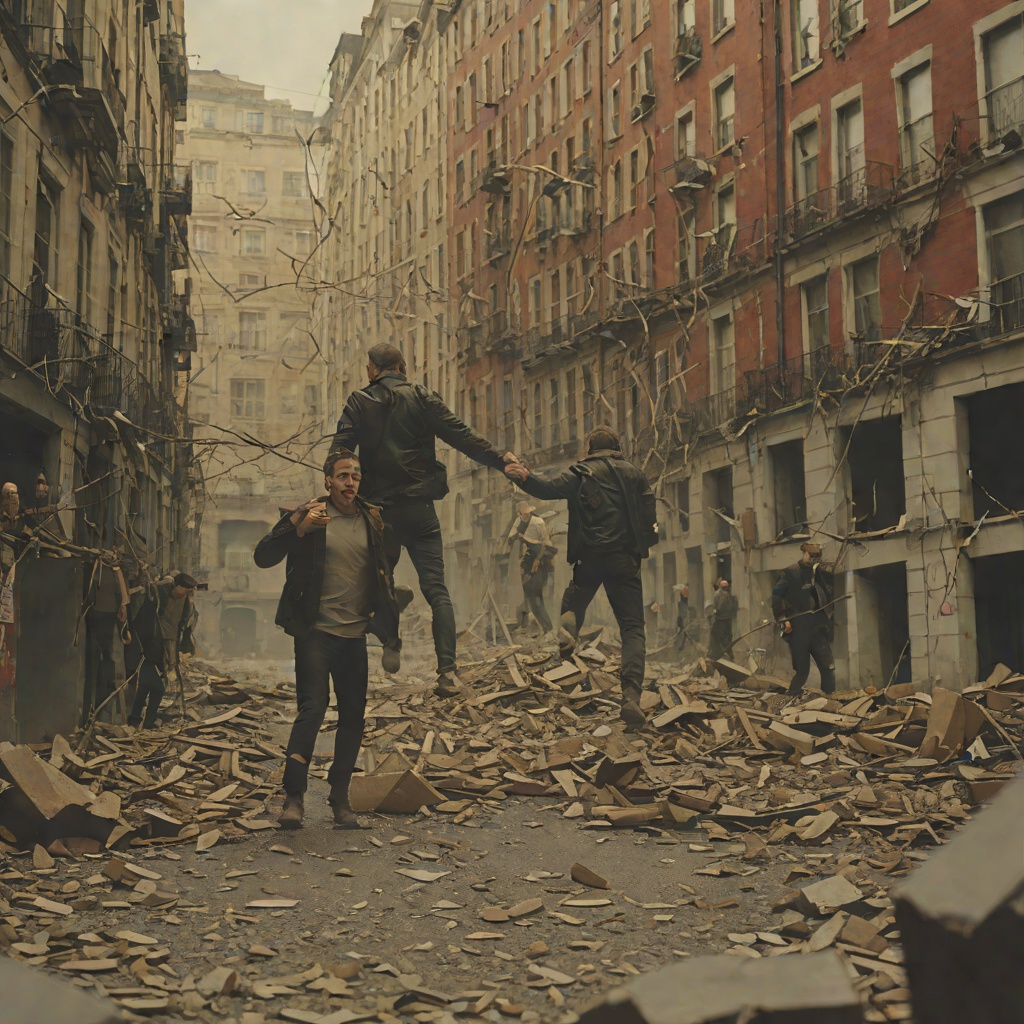
The next interruption makes the danger unmistakable. Stacey is violently shushed as another young black man appears at the entrance, wearing a cycle jacket and regarding Richards with both hostility and interest. A switchblade flashes in Bradley’s hand, and he tests whether Richards is armed. This is not a sentimental rescue scene; Bradley begins by controlling the room and assessing the stranger. His caution reflects the conditions of life around him, where police patrols are active and an unknown man can bring danger to everyone nearby. Yet the knife does not become an instrument of betrayal. Bradley uses it to establish terms under which shelter may become possible.
The Refuge and Its Immediate Purpose
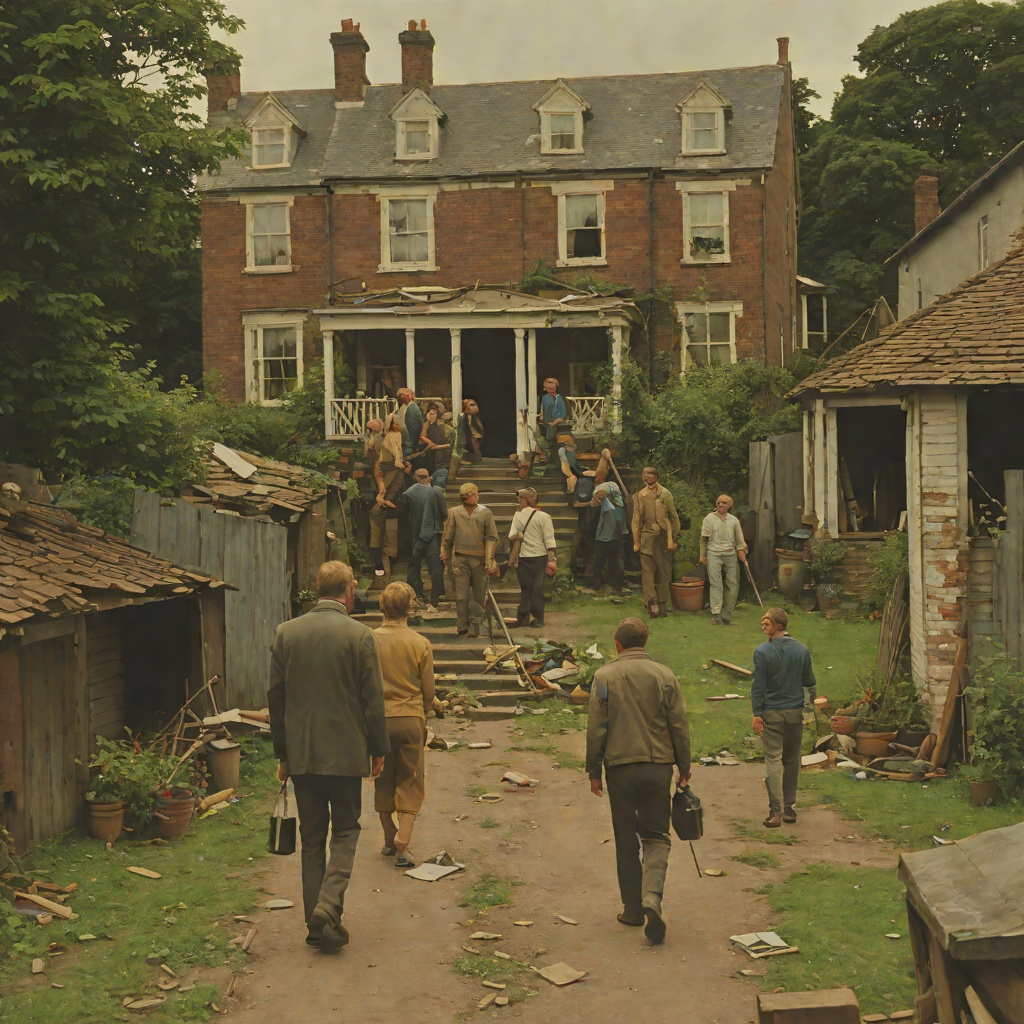
When Richards says that he must get out of Boston but does not know where to go, Bradley offers a concrete alternative: Richards should come home with him and Stacey, where they can talk somewhere less exposed. The route is taken through the back way because, as Bradley explains, the police are cruising that night. Shelter therefore begins as a spatial decision. Bradley does not merely sympathize with Richards; he moves him from an exposed alley into a household whose ordinary appearance can conceal an extraordinary risk.
At home, Bradley’s mother is present and working at the vegetables, an image of domestic routine set against the pursuit outside. Bradley tells Richards that he, his wife, and his little girl could be on easy street if Richards accepted the money already attached to his capture. The offer is cruelly revealing: the state and the Network have converted Richards’s family into part of the bounty system, and Bradley understands that poverty makes such pressure effective. Richards refuses the logic. The game is rigged, and his family’s survival cannot be secured by allowing the Network to purchase his destruction.
The practical crisis is the Games’ forfeit clause. Richards explains that he must mail two items every day before midnight or lose the money promised to his wife and child. He also suspects that the authorities have traced him to Boston through a postmark. Bradley’s shelter consequently becomes an operations center. The household protects Richards’s body while helping him remain technically alive in the contest, preserving the payments that may sustain Sheila Richards and Catherine Sarah Richards even as the Network hunts him.
Bradley’s Escape Plan
Bradley’s assistance expands from concealment into organized evasion. Later, while driving Richards across town, he explains that Richards’s suitcase contains a box of gummed mailing labels marked for Brickhill Manufacturing Company in Manchester, New Hampshire. Rich and another associate produced the labels using a press at the Stabbers’ headquarters on Boylston Street. Richards is to send his two tapes to Bradley in boxes bearing those labels; Bradley will mail them to the Games from Boston through Speed Delivery. The method is designed to defeat the postmark trail by separating Richards’s apparent location from the point at which the material enters the system.
The plan also requires Richards to abandon any fixed identity. Bradley warns him not to drive out of Manchester unless he changes his disguise and tells him that he must be a chameleon. That advice follows Richards’s earlier purchase of a limited disguise from Molie: gray hair, spectacles, mouth wadding, plastic buck-teeth, and a small limp. With the wallet cards of John Griffen Springer, a forty-three-year-old widower from Harding, Richards is not simply hiding his face; he is manufacturing a socially legible person. Bradley’s route depends on the same principle. Survival requires controlling what strangers see, what documents confirm, and which place a transaction appears to belong to.
Bradley’s work also answers the Network’s production of Richards as an image. On The Running Man television broadcast, a hidden-camera portrait has been retouched so that Richards appears more brutal, primitive, and threatening than the man standing behind the studio’s spectacle. The program presents him as a dangerous figure whose face should be recognized for profit, while a falsified image of Sheila Richards turns her into a greedy caricature and makes the family part of the entertainment. Bradley’s protection offers an alternative visual and social frame: Richards is not an urban monster but a tired fugitive whose wife and child are being used as leverage.
Solidarity Against the Official Story
The alliance is especially significant because Bradley belongs to a community already marked by racial contempt and institutional neglect. At the Brant Hotel, a clerk responds to a young black boy’s complaint about a lost nickel with an openly racist fantasy of cages and exclusion. The incident shows how quickly a minor dispute becomes a declaration about who may occupy public space. Bradley’s household exists within that same order, yet it refuses to reproduce the Network’s categories of respectable citizen, criminal, and disposable poor person.
Richards asks Bradley why he is doing so much. Hiding him is one thing, Richards says, but Bradley must have endangered or damaged his club’s position. Bradley answers that the others did not mind because they understand the score. His response places the rescue within collective knowledge rather than private heroism. The Stabbers’ resources, the improvised printing arrangement, the family home, and the driving route all become parts of a distributed resistance. The shelter is therefore both intimate and political: an act of care carried out through practical cooperation.
That cooperation also complicates the Network’s claims about violence. Bobby Thompson’s broadcast calls Richards a wolf who walks among the public, accuses him of killing police officers, and presents him as a man who would mobilize malcontents to rape, burn, and overturn the streets. The rhetoric turns a contestant into a national enemy by selecting only the facts that support fear and excluding the conditions that produced his flight. Richards’s own televised image is similarly falsified, with edited sound making him appear to threaten everyone. Bradley’s assistance counters that frame not through a competing broadcast but through conduct: he shelters the alleged monster, devises a postal diversion, and carries him toward Manchester.
Consequences and Narrative Significance
The shelter gives Richards time, mobility, and a way to protect the financial forfeits attached to his family. It also changes the emotional structure of his escape. Before Bradley appears, Richards must interpret every opening as a possible trap; after Bradley’s offer, he can act through a temporary alliance whose risks are openly acknowledged. The refuge does not remove danger. It relocates danger into the household, the club, the postal system, and the roads leading out of Boston. Bradley’s family and associates become vulnerable precisely because they accept the truth behind the official story.
The episode also establishes Bradley as a counterforce to the Network’s cold calculation. Richards has been treated as a dinosaur, a throwback, and possibly a danger because he does not fit the compliant social order that surrounds him. The Network calculates around such small disruptive particles, expecting them to be isolated and contained. Bradley prevents that isolation. His shelter allows one supposedly obsolete man to become connected to other people, other spaces, and other methods of action.
The alliance’s later significance is sharpened by the continued machinery of pursuit. Evan McCone, the Chief Hunter, is presented as a figure intended to inspire fear and as the personification of the Network’s coercive power. Against that institutional hunter stands Bradley’s informal intelligence: back routes, concealed rooms, club equipment, altered identities, and a delivery system that exploits bureaucratic assumptions. The contrast is not between power and powerlessness in the abstract. It is between a centralized system that turns visibility into a weapon and a precarious network that survives by sharing shelter and manipulating visibility.
Bradley Throckmorton shelters Ben Richards, then, as an event of material rescue and political reclassification. The hunted man is publicly named a wolf, but within Bradley’s household he is treated as a person with a wife, a child, exhaustion, obligations, and a claim to help. That reversal does not defeat the Games by itself, yet it makes the later escape possible and gives the narrative one of its clearest demonstrations that solidarity can interrupt the Network’s control over identity, movement, and truth.