General Atomics
The Running ManGeneral Atomics is the book’s most pervasive industrial presence: a corporation encountered through dangerous labor, unaffordable protective equipment, sophisticated weapons and aircraft systems, and the infrastructure that turns social crisis into organized spectacle. It is not merely a background employer or technology supplier. Through the lives of Ben Richards and Jimmy Laughlin, General Atomics makes corporate power tangible as bodily injury, infertility, unemployment, respiratory disease, surveillance, and finally the destructive hardware that carries Richards toward the Games Building.
Industrial Power and Labor
General Atomics first appears through Jimmy Laughlin, a former engine wiper who had worked there until he was fired for joining a sit-down strike against leaky radiation shields. The company’s response left him unemployed and, as he states, sterile. His injury was compounded by a withered arm that made finding new work still harder, while his wife became bedridden with severe asthma. General Atomics therefore defines employment not as stable protection but as an exchange in which workers risk their bodies for seven New Dollars a day and can be discarded when they protest the conditions of that exchange.
Ben Richards’s history confirms that Laughlin’s experience is structural rather than exceptional. Richards quit General Atomics in 2018 because every shift behind the company’s leaking old-style lead shields reduced his chances of ever having children. When the foreman demanded an explanation, Richards openly condemned the company and the shields, and the confrontation ended in a savage scuffle. Afterward, General Atomics blackballed him: in its own employment language, Richards had been Shown Red. The label followed him through later work, helping turn principled refusal into long-term precarity.
Pollution and Unequal Protection
General Atomics also governs the boundary between public health and private affordability. Bradley Throckmorton explains that air pollution in Boston can reach a level comparable to smoking four packs of cigarettes a day merely by breathing, while the major smokestacks continue operating around the clock. The cheap nose filters available to ordinary people are described as little more than screens and metholated cotton; the effective versions are made by General Atomics and cost six thousand New Dollars. The company’s technology thus appears as a solution that exists, but only for those wealthy enough to purchase it.
Bradley and his allies respond by making a homemade filter for Stacey from a book, using an atomic nugget taken from a hearing aid bought for seven dollars in a pawnshop. The improvised device is a material counterpoint to General Atomics’ commercial equipment: the same technological world that makes protection expensive also supplies discarded components from which poor people must construct survival. When Cassie’s terminal illness is likely to be recorded as asthma rather than lung cancer, the company’s pollution becomes inseparable from the concealment of its consequences. General Atomics is implicated not only in harmful production but in a social order where the evidence of harm is routinely misnamed.
Technology, Security, and the Games
The corporation’s reach extends from the factory into the entertainment and policing systems surrounding The Running Man. The Games are presented as a Network instrument for eliminating potential troublemakers, while General Atomics supplies some of the technical means that make the spectacle and its surrounding coercion possible. Its name is associated with leaky radiation shields and nose filters at one end of the social order, and with advanced triggers, aircraft systems, and security technology at the other. The contrast exposes a hierarchy in which precision engineering is available for control and destruction more readily than for public health.
During Richards’s bluff at Voigt Airfield, he claims to carry twelve pounds of Dynacore Hi-Impact plastic explosive, the variety called Black Irish, with a General Atomics imploder ring attached. He describes the ring as a gold device about two inches in diameter, resembling a keyring, with a slim rod and a General Atomics trigger mechanism. Whether or not the threat is genuine at that moment, the device’s imagined operation is enough to move police and civilians through panic. General Atomics technology consequently possesses political force before it is even activated: its reputation makes the threat credible and converts a lone fugitive’s words into mass flight.
The same corporate technological vocabulary appears aboard the hijacked Lockheed jet. The aircraft’s automatic pilot, Otto, is described as extraordinarily sophisticated, using a point of destination and Voice-Radar so that the pilot becomes largely unnecessary except during takeoff, landing, or trouble. General Atomics is connected to the imploder ring and trigger system, and the aircraft’s wider environment is saturated with military-grade equipment and airport security. In this network, transportation, automation, surveillance, and explosive force belong to one material assemblage. Systems designed to make movement efficient can also make pursuit, coercion, and catastrophe efficient.
Corporate Power and Narrative Framing
General Atomics is rarely represented through a formal corporate speech; it is reconstructed from consequences. Laughlin’s sterility, Richards’s blackballing, Cassie’s cancer, the price of protective filters, and the availability of sophisticated explosive hardware form a broken corporate portrait. This indirect method gives the organization an almost infrastructural character. It is present in the walls, the air, the labor market, the airport, and the language used to classify dangerous workers, even when no executive appears to accept responsibility.
The Network’s broadcasts attempt to reorganize these facts into a simpler story about an individual criminal. Bobby Thompson presents Richards as a wolf, displays manipulated portraits, announces rewards for verified sightings and killings, and describes the Boston Y.M.C.A. deaths as the work of a merciless enemy. Later broadcasts splice Richards’s words into a violent threat and present him as a figure who will mobilize disorder. Against that official frame, the history of General Atomics supplies a different explanation: violence emerges from labor exploitation, environmental poisoning, institutional repression, and the conversion of desperation into entertainment. The company is therefore part of the novel’s larger struggle over who gets to define causation.
The Final Material Consequence
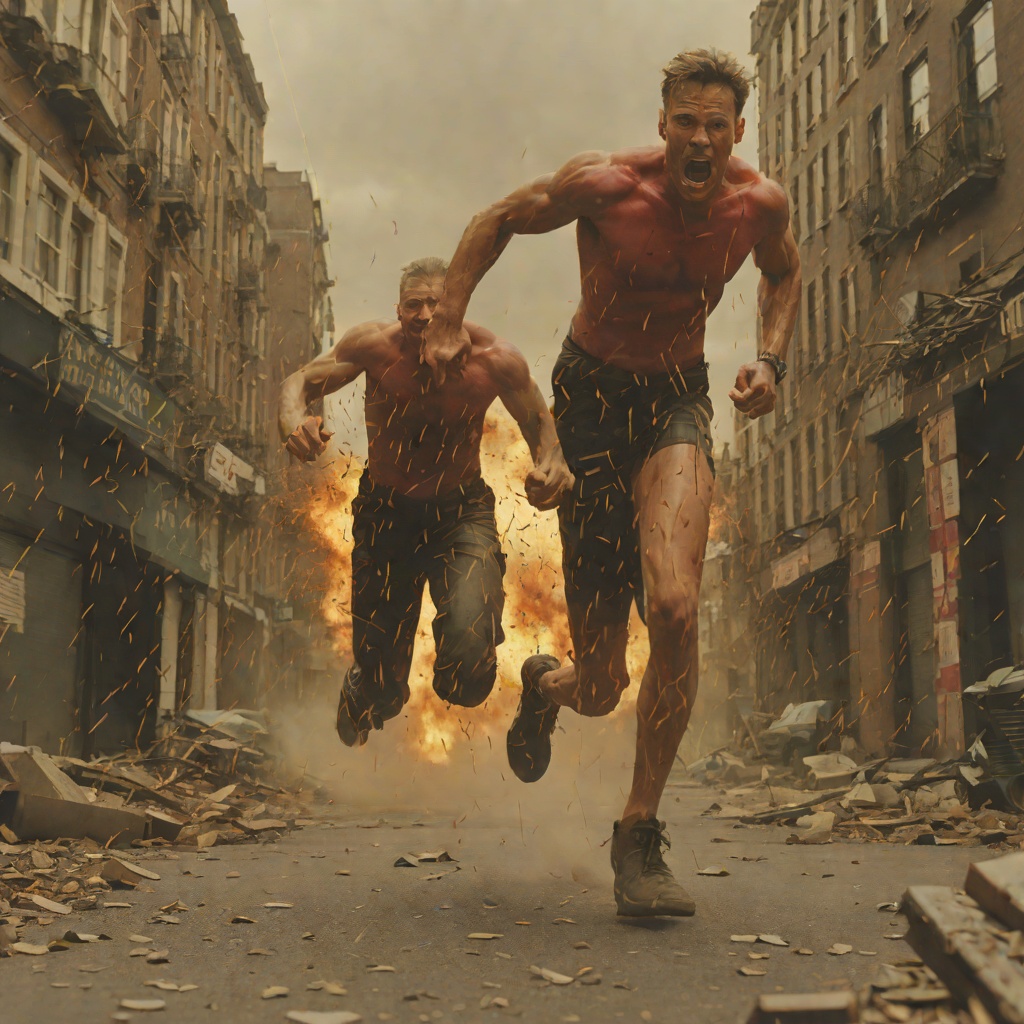
General Atomics’ technology culminates in the final flight toward the Games Building. Richards uses the threat of the imploder ring to force passage through the airport, while the Lockheed jet becomes the decisive physical instrument of his last act. The aircraft strikes the Games Building three quarters of the way up at slightly more than five hundred miles an hour, with its fuel tanks still more than a quarter full. The resulting explosion lights the night and sends fire twenty blocks away.
This ending does not turn General Atomics into a single, simple villain, because the corporation’s products have served radically different functions across the story: shields that leak, filters that are priced beyond ordinary reach, devices that can terrify a crowd, automatic systems that reduce human intervention, and an aircraft capable of obliterating a building. Yet the accumulation is unmistakable. General Atomics embodies a society that invests immense technical intelligence in production, control, and destruction while leaving workers exposed and families unable to breathe. Its final significance lies in that totality: private industrial power is not separate from the Games’ spectacle or from the state’s violence, but one of the material conditions that makes both possible.