Lockheed TriStar
The Running ManThe Lockheed TriStar is both a machine of escape and the decisive weapon of the story’s ending. It belongs to the technological infrastructure controlled by the Network and the Games Authority, yet Ben Richards turns that infrastructure against its owners. The aircraft’s transformation from transportation into a guided projectile gives the climax its brutal logic: the system that has tracked, displayed, and hunted him becomes the means by which he reaches the center of its power.
Appearance and Technological Setting
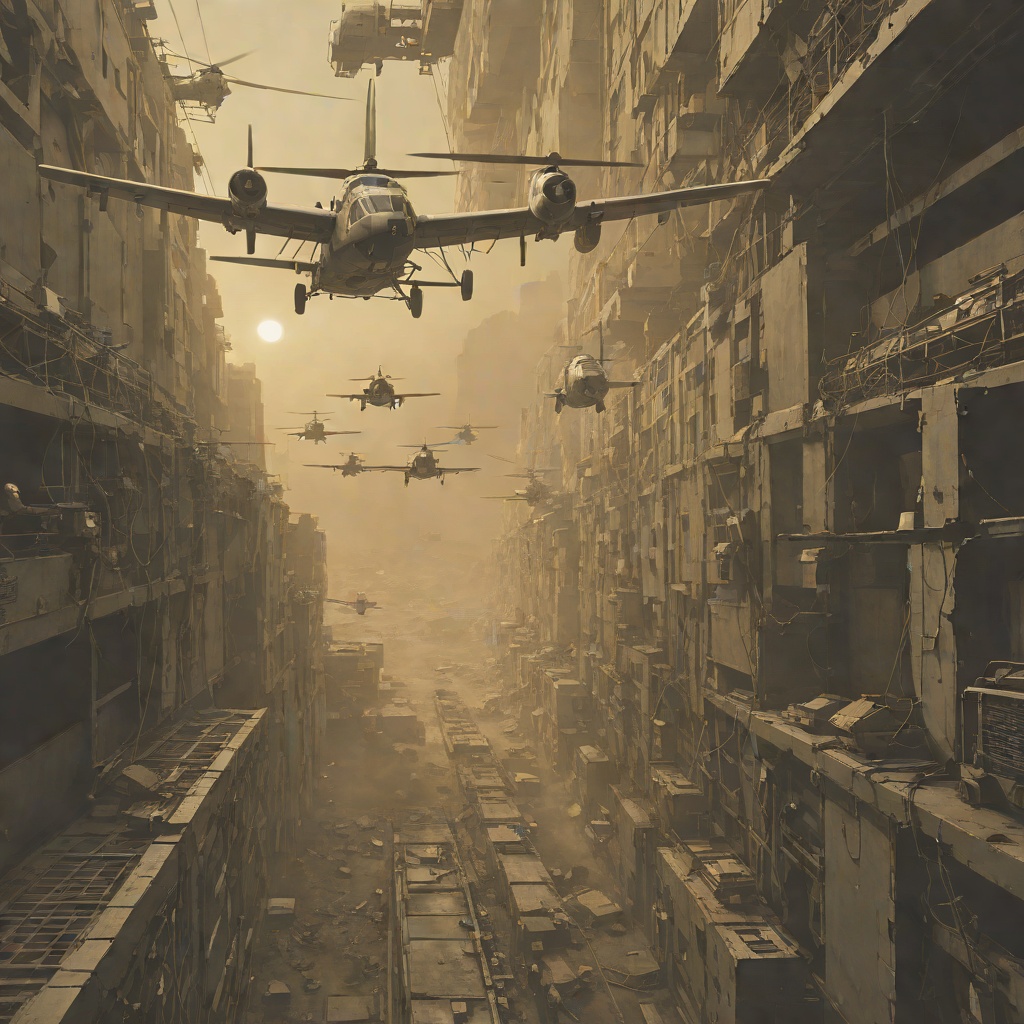
The Lockheed TriStar first appears at the Northern States Terminal as a huge white jumbo jet with a dozen turbine engines softly grumbling beneath its body. It is waiting beyond the service ramp, among high-octane tanker trucks and small private planes, while police line the approach with equipment ranging from Mace-B and tear gas to heavy armor-piercing weaponry. Its roll-up stairway is being positioned by four workers in coveralls, and to Ben Richards the stairs resemble those leading to a scaffold. The aircraft therefore enters the narrative under the sign of execution rather than ordinary travel: its scale and whiteness suggest modern power, while the armed perimeter reveals that mobility is inseparable from surveillance and coercion.
The aircraft also belongs to a world in which transport systems are highly automated. During the flight, Otto, the automatic pilot, directs the controls through an intricate routine. Holloway explains that once a destination is locked in, Otto takes over with Voice-Radar, leaving the pilot largely unnecessary except during takeoffs, landings, or trouble. The contrast is central to the aircraft’s function. It is sophisticated enough to reduce human agency to a technical remainder, but the final crisis depends on a human passenger forcing himself into the narrow space where that agency still exists.
Seizure and Flight
Ben Richards does not board the Lockheed TriStar as a normal passenger. He reaches it after a sequence of flight through controlled spaces and takes possession of the aircraft as part of his attempt to return to New York. Earlier, he has used a speed shuttle from Boston to New York under routine identification procedures, disappearing into the city after landing. The TriStar reverses that earlier movement: instead of offering anonymous passage through a functioning transport network, it becomes the vehicle of a deliberate breach in the Network’s security order.
Once Ben Richards is aboard, the aircraft’s automatic systems continue to operate even as the human situation inside it collapses. Holloway describes Otto as extremely sophisticated and dependable, but the machine’s safety does not protect the people around it. At the end of the flight, Ben Richards lifts his head only with tremendous effort and watches the twin controls perform their dance. Otto is humming and singing the birthday boy to sleep, an automated calm that makes the impending violence more horrifying. The plane continues its course while exhaustion, injury, and death reduce the human occupants around the controls.
From Vehicle to Weapon
The Lockheed TriStar’s decisive change occurs when Ben Richards redirects its existing capacity for movement toward the Games Building. Below the aircraft, Co-Op City spreads out like a giant broken carton. The image reconnects the plane to the impoverished landscape through which Ben Richards has traveled: the rat-filled, polluted district south of the Canal, where unemployment, abandoned shops, stripped vehicles, and the constant Free-Vee system define everyday life. The aircraft rises above that landscape, but it does not escape the social order that produced it. It is coming toward the Network Games Building, the one-hundred-story headquarters whose upper half disappears into cloud and smog.
The plane’s descent turns distance into countdown. The narration marks the approach with “Minus 002 and COUNTING…” and then “Minus 001 and COUNTING…,” converting the aircraft’s flight into the same kind of spectacle that has structured the Games. Its speed, trajectory, and fuel are no longer neutral technical facts; they become the measurable components of an attack. The Lockheed TriStar is now an extension of Ben Richards’s decision, but its automated precision also means that the technological system supplies the terrifying certainty of the final act.
Impact and Consequences
The aircraft strikes the Network Games Building three quarters of the way up. Its tanks are still more than a quarter full, and its speed is slightly above five hundred miles per hour. These details make the destruction an engineered collision rather than an accidental crash. The impact is direct, and the explosion lights the night with extraordinary force, sending fire raining twenty blocks away.
The destruction of the Games Building gives the Lockheed TriStar its final symbolic role. The Network has presented violence as entertainment, used Free-Vee to keep the population distracted, and treated The Running Man as a method for eliminating troublesome contestants; the aircraft answers that mediated violence with an act that cannot be contained within a studio or broadcast frame. The plane carries the logic of the spectacle back to its source. Its collision does not restore the damaged society below, but it makes the infrastructure of entertainment physically vulnerable and turns the most advanced instrument of controlled mobility into an unmistakable act of destruction.
Narrative Significance
The Lockheed TriStar embodies the contradiction of the novel’s technological society. The same systems that provide speed, automation, communication, and access are organized by class and authority. Poor residents of Co-Op City confront polluted air, unreliable public conditions, and restricted movement, while the Network commands aircraft, surveillance, police forces, and broadcast power. The TriStar belongs to the latter world, yet Ben Richards’s seizure demonstrates that infrastructure cannot be perfectly separated from the people who operate or occupy it.
Its role also intensifies the book’s critique of crisis as spectacle. Illness, pollution, social unrest, and manhunts are repeatedly absorbed into news and entertainment, while suffering in places such as Co-Op City remains part of the background. The final flight refuses that arrangement by making the privileged center itself the scene of visible consequence. The Lockheed TriStar is not merely the object that carries Ben Richards to the conclusion; it is the material form of a reversal in which a system built to manage danger becomes the danger it can no longer manage.