Manhunt
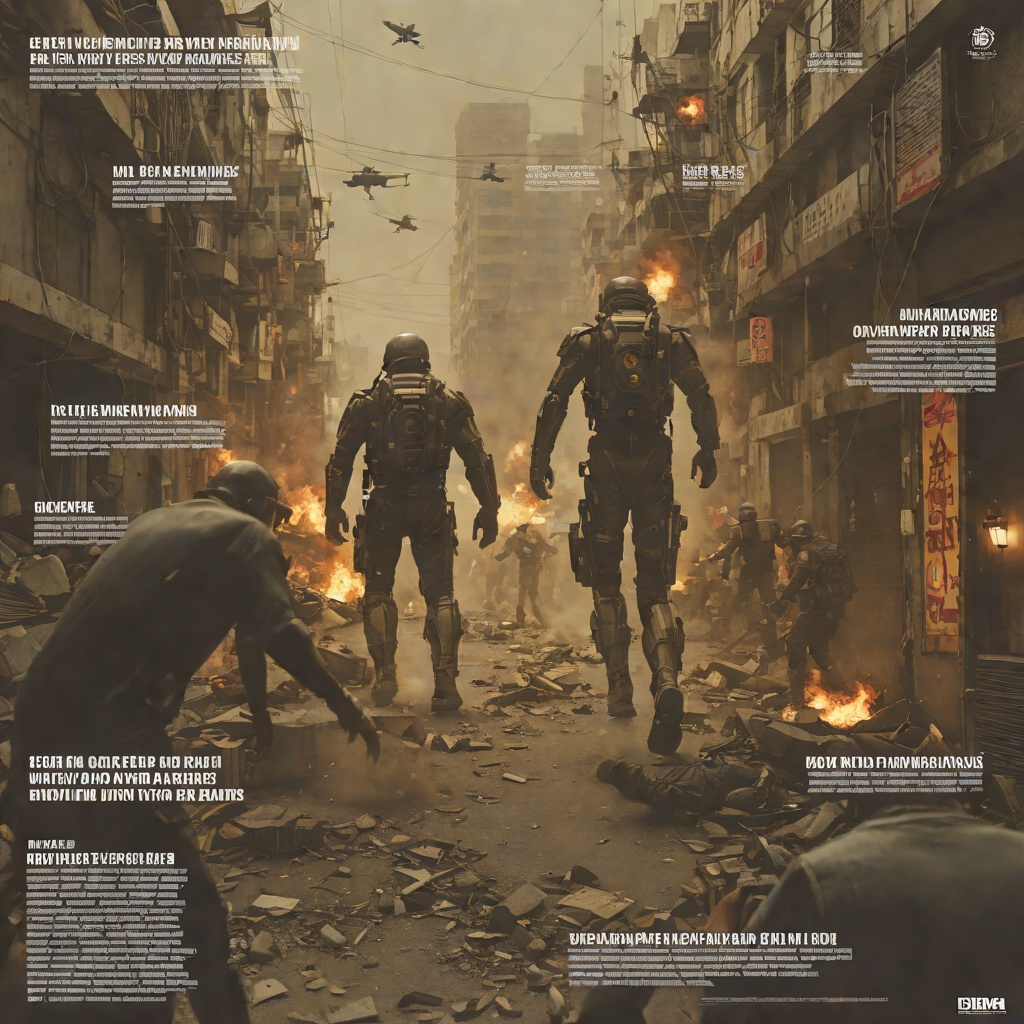
The Running ManManhunt is the organized condition that governs Ben Richards’s flight after he enters The Running Man. It is not merely a police search. The Games Authority turns pursuit into a national broadcast, gives the public a financial reason to report or kill him, supplies a succession of images that define him as a public enemy, and places him under pressure from both the Hunters and ordinary citizens. Its decisive significance is that it converts a human being into a moving target whose visibility, danger, and possible death can be priced, edited, and consumed.
Definition and Operating Rules
The manhunt begins as a formally regulated game administered by the Network and Games Authority. Dan Killian explains that the program has run for six years without a survivor and that the contestant receives a twelve-hour head start. The reward is calculated by time: Ben Richards, or his surviving family, is promised one hundred New Dollars for every hour he remains free, with forty-eight hundred dollars advanced on the assumption that he can evade the Hunters for forty-eight hours. The unspent portion is refundable if he falls earlier, while surviving thirty days earns the Grand Prize of one billion New Dollars. These provisions give the pursuit the appearance of a contract, but the contract makes continued life the unit of payment and death the condition that completes the spectacle.
The rules also require continual production of evidence. After leaving the studio unarmed, Richards is given a compact tape machine weighing six pounds and sixty tape clips, equipment designed to fit inside a coat pocket. He must deposit two clips per day through the postal system, allowing the Network to edit his material for that night’s broadcast; failure to do so constitutes legal default of payment. The hunt therefore measures not only where Richards is and whether he survives, but also whether he continues to furnish the program with usable images and speech. The participant is simultaneously pursued object, performer, and obligated supplier of content.
The reward structure extends the violence beyond the official Hunters. Killian tells Richards that an additional one hundred dollars will be paid for any Hunter or representative of the law he dispatches. The Network also offers one hundred New Dollars for a verified sighting, one thousand for a sighting that results in a kill, and at least ten dollars per foot to independent cameramen. The distinction between official enforcement and public participation consequently collapses: police, bounty seekers, informants, viewers, and freelance photographers all become possible components of the same apparatus. The manhunt does not simply locate its target; it distributes the target’s pursuit among a population trained to profit from his exposure.
Broadcast Construction of the Target
The broadcast supplies the manhunt with its emotional reality. Before Richards is released, Bobby Thompson introduces him as a dangerous figure from south of the Canal and displays a hidden-camera portrait altered by an airbrush. The image deepens his eyes, lowers his forehead, shadows his cheeks, and gives his mouth a curled, jeering expression. The resulting figure is presented as an urban predator: brutal, unintelligent, and possessed of primitive cunning. The technical manipulation matters because the public is not asked to recognize Richards as he is; it is given a preprocessed face designed to make fear appear like observation.
The same process is applied to Sheila Richards. A still image of her is altered until her ordinary, vulnerable face seems greedy and sexually degraded. Richards reacts violently when he sees the counterfeit portrait and insists that it is not his wife. The manhunt thus reaches into private identity before it reaches the streets. It places his family inside the reward system and makes their representation part of the campaign against him. The public is encouraged to imagine that killing Richards will benefit the woman displayed on screen, even though the image has already falsified her.
When Thompson asks how long he expects to hold out, Richards answers that he expects to last the full thirty days and doubts that the Network has anyone capable of taking him. His defiance becomes another broadcast commodity. Thompson closes the segment by urging viewers to remember Richards’s face and imagine him nearby on a bus, in a jet plane, at a three-dimensional magazine rack, or outside a home. The geographic range of the warning is deliberately expansive: Harding, New York, Boise, Albuquerque, and Columbus become interchangeable points in a single imagined field of suspicion. The crowd’s shouted willingness to report him confirms that the televised appeal has converted spectators into potential agents.
Escalation from Pursuit to Public Violence
The hunt’s rhetoric intensifies after the Boston Y.M.C.A. deaths. The Running Man segment presents Thompson in a brilliant column of light against darkness and describes Richards as one of the wolves walking among ordinary people. It displays his face, then a second image showing him in the John Griffen Springer disguise, and accuses him of setting a clever trap that killed five policemen. The program refuses the possibility that the event might have another explanation; it selects a complete moral frame in which Richards is already a murderer before the audience hears his account.
The edited clips attributed to Richards make the framing still more extreme. One clip urges viewers to storm libraries and investigate books about air and water pollution, but another is made to sound like a stream of threats against police, the Games Commission, and anyone Richards might encounter. Thompson then describes him as a man who would mobilize malcontents to rape, burn, overturn, lie, cheat, and kill. The broadcast does not merely announce a search. It constructs a social emergency in which hostility toward Richards can be experienced as self-defense and civic duty.
The public accusation is reinforced by arithmetic. Thompson announces that Richards has received one hundred dollars for each hour he has remained free, now totaling fifty-four hours, along with an additional five hundred dollars for the five dead policemen. The program divides the supposed blood money among five wives and nineteen children, reducing grief to a calculation of seventeen dollars and twenty-five cents per person. Images of young policemen at a Police Academy graduation, followed by the sound of Taps, give the numbers an emotional setting. The effect is to make every viewer a creditor of Richards’s death and to transform a disputed event into a personal claim against him.
The Hunt as Live Crisis Management
The manhunt can suddenly change from edited television into a live international crisis. At Voigt Airfield, Richards uses a bullhorn to claim that he carries twelve pounds of Dynacore high-impact plastic explosive, identified as Black Irish, with a General Atomics imploder ring pulled to half-cock. He threatens to destroy everything within a third of a mile and possibly the jetport fuel tanks unless the police follow his instructions. The immediate response is panic: people flee across roads and fields, stream through gates, and climb the cyclone fence, while the police lose control of the crowd. No one visibly disbelieves him.
The cameras record the scene and transmit it on a live feed intended for broadcast across North America and much of the world. That transmission changes the tactical meaning of the bluff. Richards’s claim is not confined to the officers at the barricade; it is made before a vast audience whose attention can pressure authorities and preserve his account. Amelia Williams announces over the same public channel that Richards wants to surrender to the Airline Police and has been shot twice, presenting him as unstable and frightened. The live feed becomes a counter-instrument: the system that has hunted him also supplies the visibility through which he can force officials to respond.
Consequences and Narrative Significance
The manhunt produces a layered form of captivity. Richards is not only threatened by the Hunters, who are described as exceptionally effective, but also by the possibility that any passerby may recognize him, report him, photograph him, or attempt to kill him for money. The Network’s claim that viewers are good North American citizens rather than informers exposes the ideological vocabulary of the system: participation in surveillance is recast as civic virtue, while the target’s attempts to speak are recast as proof of criminality.
Its strongest consequence is the destruction of the boundary between fact and representation. The airbrushed portrait of Richards, the falsified image of Sheila Richards, the edited tape clips, the graduation photographs, the casualty arithmetic, and the live airport transmission all compete to define what the public is permitted to know. Even Dan Killian’s later assurance that the Network had nothing to do with the deaths of Sheila Richards and Catherine Sarah Richards is heard against this history of managed appearances. Richards suspects a lie precisely because the explanation sounds too much like a lie to be false, yet the uncertainty itself demonstrates the manhunt’s power: by the time he reaches the final revelation, truth has become inseparable from the institutions that edit and broadcast it.
The state of manhunt therefore functions as both plot mechanism and social diagnosis. It turns survival into a timed wager, speech into required programming, recognition into a bounty, and death into a public event with sponsors, witnesses, and numerical value. Its apparent openness conceals a severe asymmetry: Richards must remain visible enough to satisfy the program while hidden enough to avoid capture, whereas the Network can alter images, splice words, mobilize viewers, and distribute blame at national scale. The pursuit is presented as entertainment, but its deepest operation is disciplinary. It teaches the public to see a marked man everywhere and to mistake participation in his destruction for ordinary citizenship.