Network Games Building
The Running ManThe Network Games Building is the monumental headquarters of the Games and the central machine through which the Network turns pursuit, fear, and death into mass entertainment. Rising above New York City, it first appears as an immense, polished skyscraper that dominates the boundary between impoverished Co-Op City and the guarded prosperity uptown. It later becomes the site where Ben Richards is processed, packaged, and broadcast as a public enemy, before serving as the target of the hijacked Lockheed TriStar’s final approach. Its destruction is therefore both a physical catastrophe and the decisive collapse of the institution that has tried to make Richards into an image.
Setting and Architecture
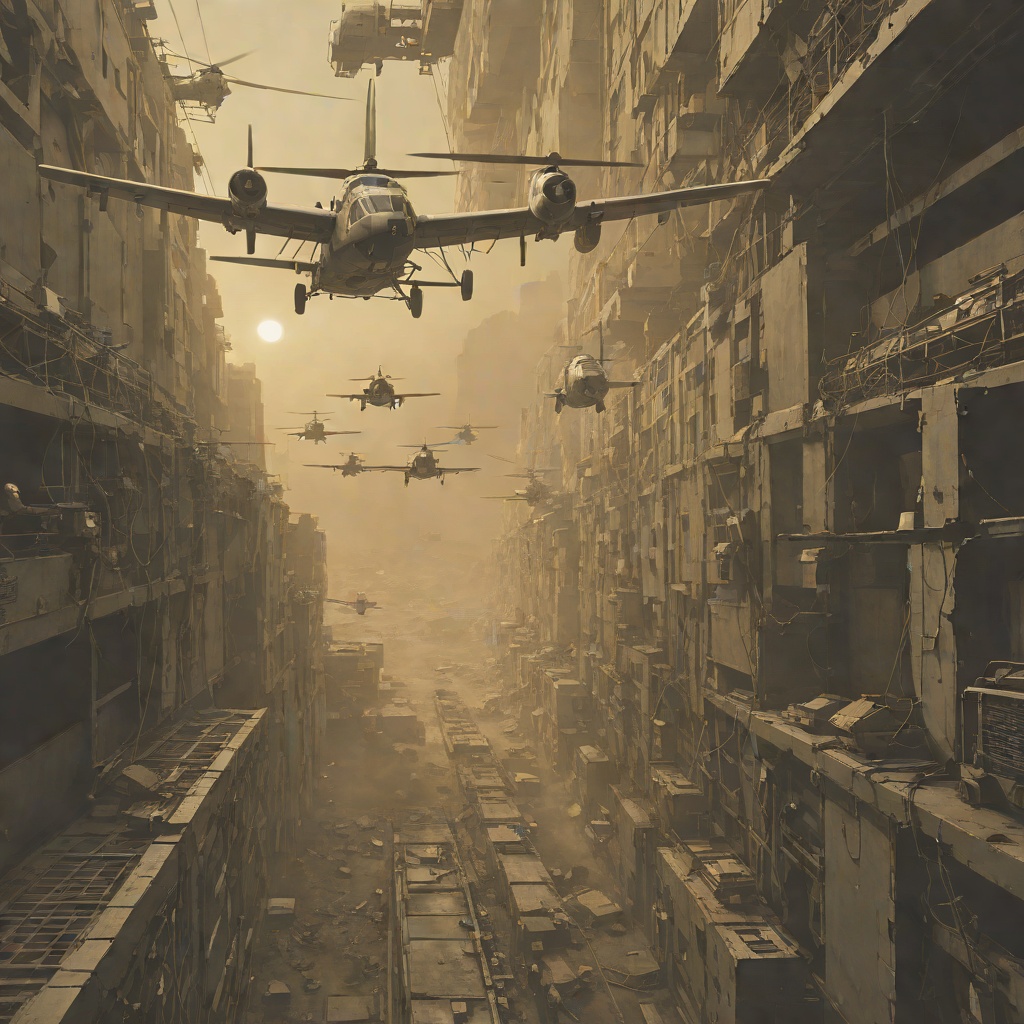
The building is one hundred stories high, with its upper half buried in cloud and smog cover. From the south side of the Canal, Ben Richards fixes his eyes on it while walking through a city divided by class, money, and police presence. The structure’s height makes it seem less like an ordinary office block than an unreachable vertical order: below are the unemployed millions of Co-Op City, while above are polished stone surfaces, rising tiers of office windows, and the controlled world of the Games.
Crossing the Canal brings Richards closer to the building but not closer to freedom. Police watch him as he approaches, prepared to drive him along or arrest him for loitering. In the uptown district, a man in baggy gray pants, with a cheap bowl haircut and sunken eyes, is legible only as a prospective Games contestant or threat. The building thus extends its authority beyond its walls. Its architecture is reinforced by surveillance, and its social meaning is produced by the police who guard the route toward it.
The Games Building stands beside spaces designed to regulate public visibility. The People’s Fountain Park offers a tiny, protected glimpse of pleasure behind chain-link fencing, with police at either side of the gate; the Games tower rises beyond such managed leisure as its more powerful counterpart. The building’s clean height contrasts with the garbage, liquor stores, smoke shops, and overcrowded poverty south of the Canal, making the city’s inequality visible as a spatial arrangement rather than merely an economic statistic.
Broadcast Headquarters and Institutional Machinery
The qualifying examinations bring Richards into the building’s orbit, and the line of candidates stretches for blocks beneath its shadow. Police stand along the queue with hands on gun butts or move-alongs, smiling with anonymous contempt. The building is not simply where applicants are tested; it is the destination that gives the entire procession its meaning, converting people from the poor districts into potential performers in a state-sanctioned spectacle.
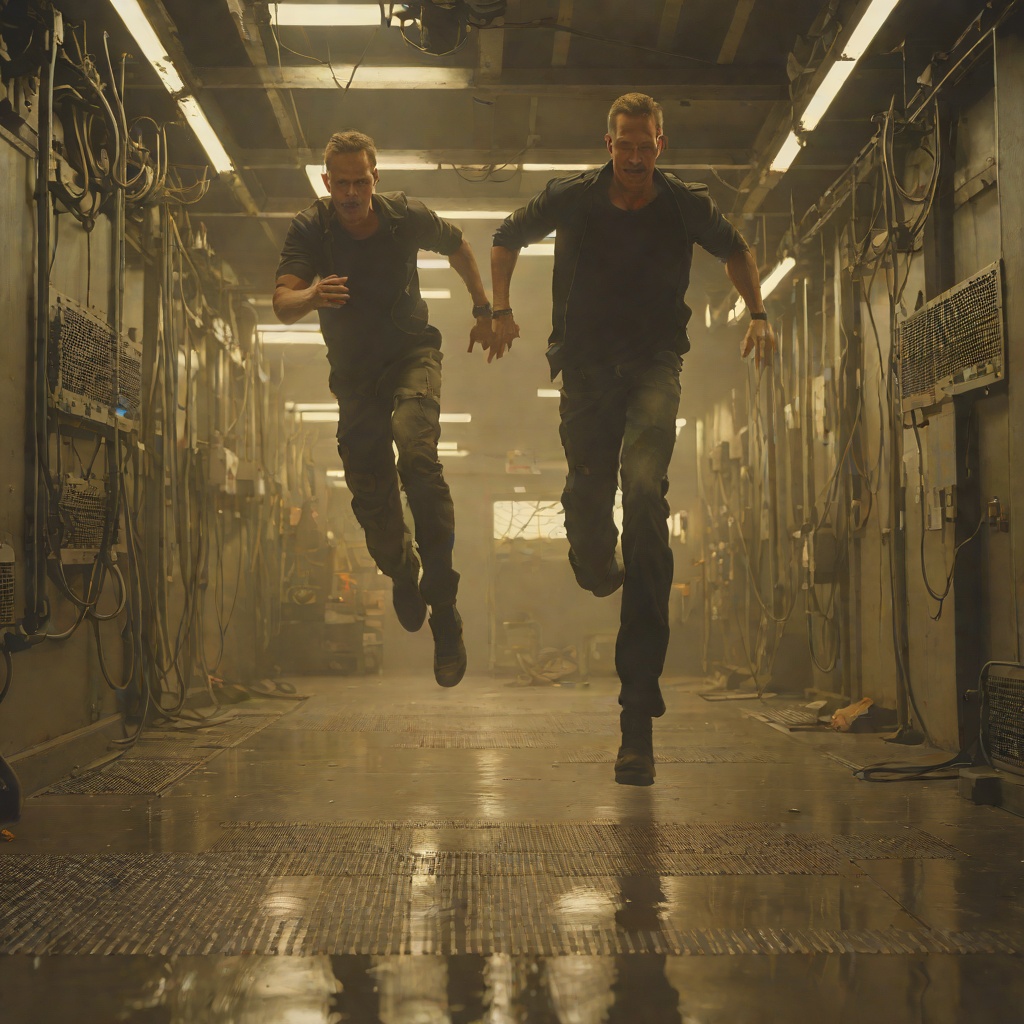
Richards is taken to the tenth floor, where the fiction of upward mobility ends. The lower lobby may suggest that anyone can rise through the system, but the tenth floor is the highest level to which he is permitted access, and it is the broadcast facility. Its wide, white, stark hallways are crossed by bright yellow go-carts powered by General Atomics solar-cell motors, carrying Free-Vee technicians toward studios and control rooms. The contrast between the building’s technological efficiency and the human beings being processed there makes the institution’s hierarchy concrete: machines and technicians move freely, while the contestant moves only along an assigned route.
Within this facility, Dan Killian tells Richards that he has been selected for The Running Man, the Network’s largest, most lucrative, and most dangerous program. The building houses the contracts, dossiers, studios, and commercial calculations that define the contest. Richards is promised one hundred New Dollars for every hour he remains free, an initial running allowance of forty-eight hundred dollars based on an expected forty-eight-hour evasion, and a billion-New-Dollar Grand Prize if he survives thirty days. The numerical precision gives the spectacle the appearance of fairness while reducing survival, pursuit, and death to an accounting system.
The institution’s rules continue beyond the contestant’s body. Richards receives a compact tape machine and sixty short tape clips, with the requirement that two clips be deposited each day; failure to do so constitutes legal default of payment. The equipment can be dropped into any mailslot and sent express to the building, allowing the Network to convert Richards’s flight into a continuing supply of broadcast material. The building is therefore not only a destination or studio. It is a collection point for images, testimony, and contractual evidence, connected to the fugitive through the postal system even while the fugitive remains outside its physical reach.
The building also places a price on violence by promising an additional one hundred dollars for any Hunter or representative of the law Richards dispatches. At the same time, its public-facing apparatus pays citizens one hundred New Dollars for a verified sighting, one thousand for a sighting resulting in a kill, and independent cameramen ten dollars a foot or more for usable footage. These rules make the building the unseen center of a distributed game: viewers, informers, police, Hunters, and freelance photographers become participants whose actions are measured and rewarded by the Network.
The Building as a Factory of Public Images
The broadcast facility does not merely report Richards’s actions; it manufactures the identity through which the public is expected to understand him. Before his first appearance, a hidden-camera portrait is retouched so that his eyes look deeper, his forehead lower, and his cheeks more shadowed. His mouth is altered into a jeering expression, producing the image of an urban predator who is brutal, unintelligent, and equipped with primitive cunning. The building’s studios turn an ordinary unemployed man into the uptown audience’s boogeyman.
The same treatment is applied to Sheila Richards. Her photograph is airbrushed until her face appears avaricious and sexually degraded. The distortion is not incidental decoration; it assigns guilt and contempt to the family awaiting the prize money. When Richards sees the image and lunges forward, the building’s police restrain him, demonstrating how its visual lies are backed by physical force. The studio audience’s screams and hostility complete the process, making the building a place where representation becomes an instrument of confinement.
Bobby Thompson’s presentation turns the building into a national courtroom without the procedures of one. Richards is introduced as a dangerous man from south of the Canal, and the broadcast asks viewers to recognize his face because a sighting may earn them money. Later, Thompson presents him as a wolf walking among ordinary people and attributes the deaths of five Boston policemen to him. The rhetoric selects its facts, assigns responsibility, and excludes Richards’s account before he can speak effectively. Even when he tries to tell viewers that the image of his wife is a fake, the audience drowns him out.
The building’s power grows through editing as well as live performance. Clips of Richards asking viewers to investigate libraries and read about air pollution and water pollution are followed by falsified or spliced speech that makes him sound eager to kill police and mobilize an army of rioters. Thompson then places the invented confession beside still photographs of Richards and young policemen, ending with the sound of Taps. The building’s narrative method is cumulative: a contestant becomes a murderer, a murderer becomes a public menace, and a public menace becomes an enemy of the whole social order.
Siege, Destruction, and Aftermath
The building remains the object toward which Richards’s escape gradually turns. After seizing control of the aircraft, he approaches it from the night sky while Co-Op City lies below like a broken carton. The plane crosses the Canal and heads directly toward the tower, reversing the building’s earlier function as a vertical destination that Richards could approach only on foot and under police observation. The institutional center that once watched him now becomes the thing he watches and chooses to strike.
As the aircraft nears, the Games Building’s windows become the field of a final confrontation. Dan Killian looks up from his desk toward the wall-to-wall window forming one entire side of his room. The city vista has vanished, replaced by the oncoming Lockheed TriStar. Through the glass, Killian sees Richards’s blood-smeared face and burning black eyes; Richards is grinning. The building’s transparent modernity, which has displayed the city and projected images outward, now exposes its occupants to the direct return of the spectacle they created.
The destruction is prepared as a reversal of the Network’s own logic. Richards has threatened that the explosive in his coat could destroy everything within a third of a mile and probably ignite the jetport fuel tanks, and he has used that threat to force the airport crowd and police to obey him. The Network’s world of measurable risk, public panic, and technological control is turned against its central structure. The final weapon is not a broadcast clip or a paid report but a mass of fuel, speed, and impact that cannot be edited into safe entertainment.
The Lockheed strikes the Games Building three quarters of the way up at slightly more than five hundred miles an hour, with its tanks still more than a quarter full. The explosion lights the night and rains fire twenty blocks away. The building’s fall is consequently not a minor interruption to programming but a spectacular material consequence of the system’s attempt to contain Richards. It ends the institution at the same point where its propaganda has reached its most polished form: the tower that made him a monster is destroyed by the man it tried to turn into one.
Narrative and Political Significance
The Network Games Building concentrates the novel’s major structures of power in one location. It is an office tower, a broadcast plant, a contract bureau, a surveillance node, and a theater of public punishment. Its elevators, tenth-floor studios, technicians, cameras, payment schedules, and police escorts make domination appear procedural. Violence is not presented as an exceptional breakdown of the system; it is incorporated into the system’s rules and sold as entertainment.
Its height also gives physical form to the divide between the unemployed population south of the Canal and the employed, protected public uptown. Richards can see the tower before he can enter it, and when he does enter, he is allowed only into the level where his life can be packaged for transmission. The building’s promise of upward mobility is exposed as a controlled fiction: movement upward is available as spectacle, not as social advancement.
The building’s final destruction completes that contrast. For most of the story, it is the Network’s fixed point, the place from which images, rewards, accusations, and pursuit radiate across the city and the nation. At the end, it becomes a stationary target confronted by a moving human will. The Games’ institution has treated visibility as control, but Richards makes himself visible on his own terms for one last instant. The tower’s collapse reveals the limit of a system that can price a life, edit a voice, and organize a hunt, yet cannot fully control what its captive learns to do with the spectacle it has built.