Otto
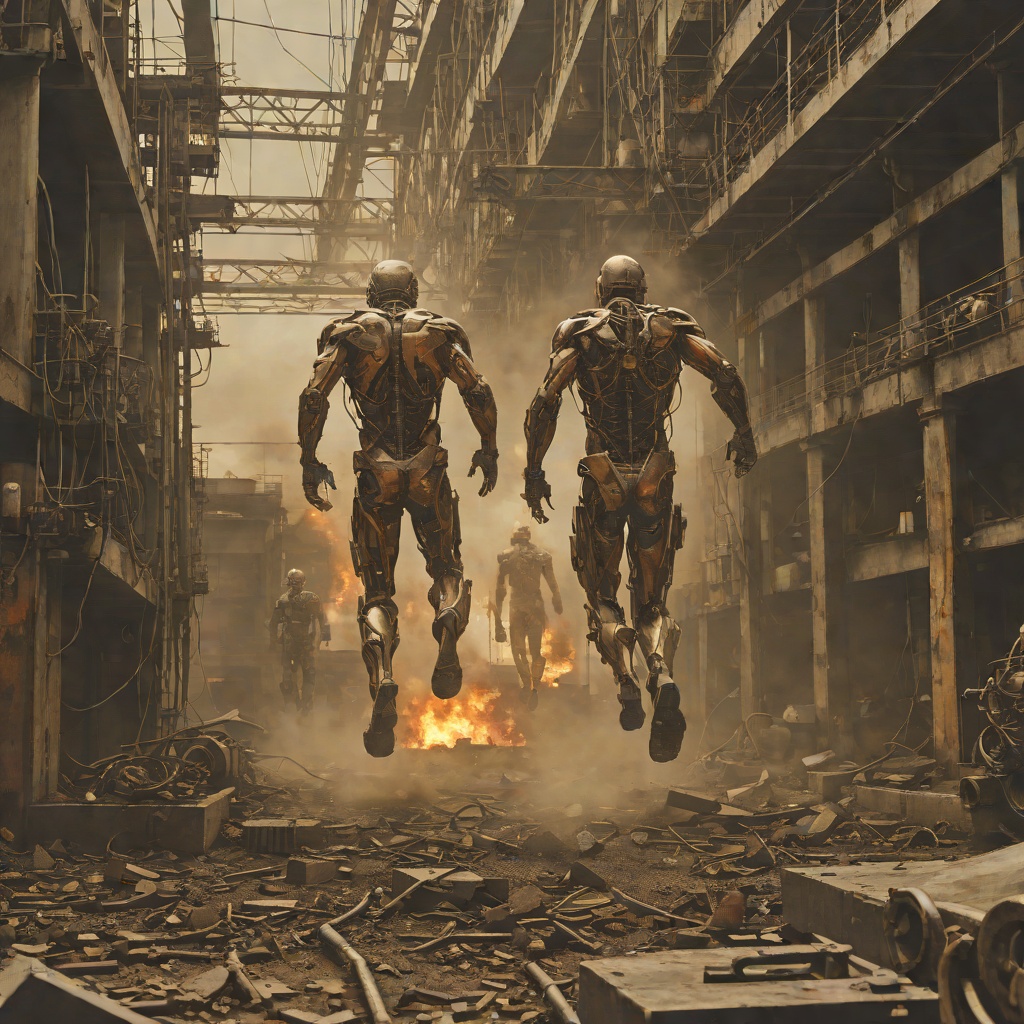
The Running ManOtto is the aircraft’s automatic pilot and one of the clearest embodiments of the book’s technological infrastructure: a system designed to make movement efficient, monitored, and nearly independent of human judgment. In the aircraft carrying Ben Richards, Otto is both a marvel of safety and a source of unease. Its reliability reduces the pilot’s role to a narrow set of exceptions, but that same reduction leaves the controls available for a desperate passenger to appropriate.
Definition and Operation
Otto is introduced as the mechanism driving the aircraft while the human crew is absent from active control. Ben Richards enters the pilot’s compartment and finds the twin control consoles unattended, yet the aircraft continues to swerve, tip, and turn. Dials swing and lights flash as though responding to invisible hands and feet, creating the uncanny impression that the plane is being operated by an unseen presence. When Richards asks who is driving, Duninger identifies the system as Otto, calling it Otto the automatic pilot.
The name is accompanied by a deliberately poor joke, which gives the machine a casual human label without making it human. Otto is treated as familiar equipment by the crew, but to Richards its activity initially resembles ghostly agency. The contrast matters: the staff experience automation as routine, while the fugitive experiences it as a startling displacement of human action. The machine therefore enters the narrative not through a technical diagram but through a scene in which its effects appear before its identity is explained.
Technical Authority and Human Redundancy
Holloway explains that Otto has been in use for twenty years and still unsettles him, although he considers it completely safe. He describes the system as extraordinarily sophisticated, to the point that an older automatic pilot would seem primitive beside it. Otto operates after the pilot locks onto the P.O.D., or point of destination, and remains assisted by Voice-Radar throughout the journey. Under those conditions, the human pilot becomes largely superfluous, retaining importance mainly during takeoff, landing, and emergencies.
This division of labor places Otto inside a broader network of modern transport and surveillance. Elsewhere, airthrusters carry passengers through traffic, airport identification checks proceed routinely, and the speed shuttle moves travelers between cities with little visible friction. Otto belongs to the same world of automated passage: a world in which infrastructure quietly performs the central work while people merely authorize, monitor, or endure its operation. The system promises safety by removing improvisation, but it also concentrates power in mechanisms that ordinary passengers cannot inspect or challenge.
Encounter with Ben Richards
Otto’s importance changes when Ben Richards reaches the cockpit. The machine is still guiding the aircraft, and Richards must negotiate a dense field of controls while moving with difficulty and nursing a serious wound. His approach to the console is not a triumphant mastery of technology; it is a physically painful, uncertain attempt to act inside a system built to make individual intervention unnecessary. The controls appear numerous and complex, while Otto continues its “endless, complex tandem,” maintaining the flight beneath him.
That moment converts Otto from background equipment into a practical obstacle and an opportunity. As long as the automatic pilot remains in command, the aircraft follows an established route and the crew’s institutional plan. Richards’ movement toward the controls marks a contest between personal agency and automated continuity. The machine does not need to threaten him or speak to him. Its very competence creates the pressure of the scene: he must discover how to intervene before the flight’s momentum carries him beyond the point at which intervention can matter.
Narrative and Thematic Significance
Otto makes technological control visible by making human control invisible. The aircraft can continue through darkness while the consoles register constant input and output “to no one at all,” a phrase that turns automation into an eerie image of power without a visible operator. The system’s apparent autonomy is not freedom. It is the extension of a preprogrammed destination, supported by radar and institutional knowledge, and it remains safe only within the assumptions built into its design.
The automatic pilot also sharpens the book’s recurring contrast between mobility and confinement. Advanced transport can move people rapidly across great distances, yet access to that movement is structured by identification systems, security personnel, and the larger apparatus pursuing Ben Richards. Otto offers frictionless travel to the authorized passenger while becoming part of the locked environment through which Richards must fight for agency. Its promise of safety therefore has a double edge: it protects the aircraft from ordinary error, but it can also make the human beings inside it passive, trackable, and dependent.
By the time Richards reaches the controls, Otto has already demonstrated why the crew trusts it and why its presence unsettles them. It is “dead safe” precisely because it is more consistent than a person, but that consistency does not guarantee justice, understanding, or humane judgment. The machine can maintain a course; it cannot decide whether the destination itself is acceptable. Otto’s quiet competence thus becomes a structural counterpart to the institutions surrounding the flight: technically advanced, operationally efficient, and dangerously indifferent to the individual caught inside its system.