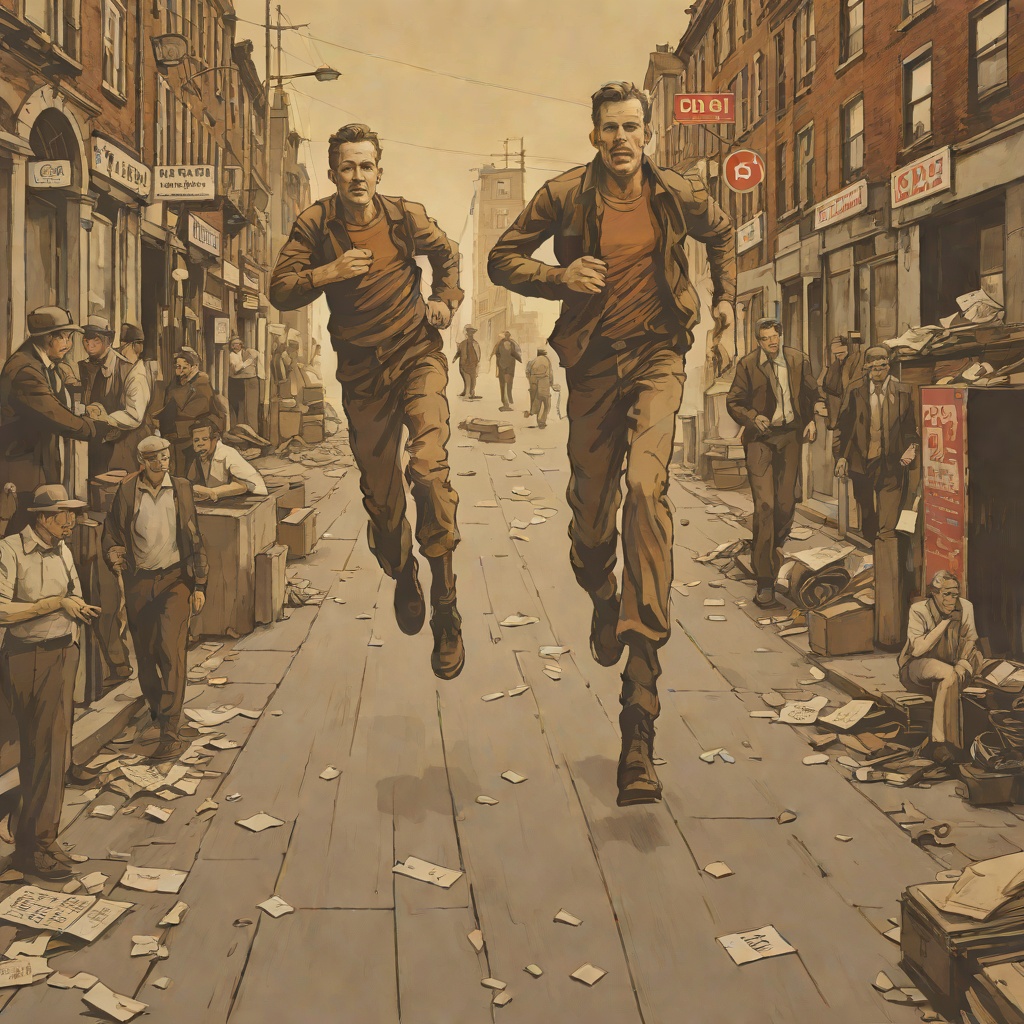
Running Man tape clips
The Running ManRunning Man tape clips are the portable recording medium supplied to Ben Richards after he leaves the studio, and they give the televised hunt its most important double function: the fugitive must survive in physical space while continuously producing material for the audience watching him. The clips promise a channel of self-expression, but their real force lies in the contract attached to them. Richards is not merely hunted; he is required to document himself for the institution that profits from his pursuit.
Definition and Physical Design
The clips are cartridges used with a small tape machine issued to Richards as he exits the stage. The machine is described as roughly the size of a popcorn box, weighing six pounds, while sixty clips, each about four inches long, accompany it. The entire apparatus is designed to fit inside a coat pocket without producing a bulge, a detail that makes the technology practical for a man who must remain mobile and conceal his equipment. The Games Authority presents this compactness as a triumph of modern technology, but the apparent convenience also makes the device an unobtrusive instrument of surveillance and production carried constantly on the contestant’s body.
The clips are not optional souvenirs or private records. Richards is instructed to deposit them in mailslots so that they can be delivered express to the Games Authority and edited for broadcast that same night. The medium therefore connects three spaces that would otherwise remain separate: the fugitive’s hiding place, the postal system through which the material travels, and the studio where the Network converts it into television. A four-inch cartridge can cross the distance between private fear and mass entertainment, but only after passing through an institutional process that controls its selection and presentation.
Contractual Function in the Game
The recording requirement is tied directly to payment. Richards must submit two clips per day before midnight; failure to do so constitutes legal default and threatens the payment arrangement attached to his participation. The rule makes the clips a form of compulsory labor. The contestant’s time, movement, voice, and danger are all monetized, and the recording schedule continues even though he is simultaneously being pursued by the Hunters. Survival alone is insufficient: he must remain productive while under threat.
This obligation sharpens the apparent generosity of the Games rules. Richards or his surviving family is promised one hundred New Dollars for every hour he remains free, with forty-eight hundred dollars advanced as running money on the assumption that he can evade the Hunters for forty-eight hours. The unspent balance is refundable if he falls earlier, and thirty days would bring the Grand Prize of one billion New Dollars. Against these figures, the two-clips-per-day requirement appears administratively small, yet it is the condition that allows the Network to keep converting his ordeal into nightly programming. The clips are thus the production quota hidden inside the survival contest.
The larger broadcast system adds further financial pressure. The program may interrupt scheduled broadcasting when a resourceful contestant approaches his personal Waterloo, while independent cameramen are paid by the foot of usable film and members of the public receive money for verified sightings or sightings that result in a kill. The clips belong to the same economy: danger becomes content, content becomes payment, and payment encourages every participant to treat Richards as both a person and a marketable event.
Postal Risk and Institutional Control
Richards quickly recognizes that mailing the clips may expose him. Envelopes in his hotel room bear the hotel’s name and address, and he doubts the assurance that the Games Authority will not reveal his location through postmarks or return addresses to Evan McCone and the Hunters. Yet the obligation leaves him no safe alternative. The postal drop by the elevators becomes a point of acute risk: he places the clips in the out-of-town slot with profound misgivings, aware that postal authorities may not qualify for Games money for reporting contestants but unable to trust that this makes the system harmless.
The scene reveals how the clips bind Richards to the same infrastructure that threatens him. He cannot simply disappear into private space, because silence means default; he cannot safely communicate, because every transmission may create a trace. The medium that seems to preserve his independence instead forces him to advertise continued existence through a chain of institutions controlled or observed by the authorities. His flight is therefore organized by a contradiction: the clips are small and mobile, but the obligation to send them makes his movement legible.
Bradley Throckmorton helps Richards understand that the game is rigged, and Richards explains the requirement after having given materials to Stacey to mail while Stacey and his mother are out for groceries. The possibility of using intermediaries briefly separates the contestant from the act of transmission, but it does not remove the structural burden. Whether Richards, Stacey, or another person handles the envelope, the rule still demands a regular, traceable performance on behalf of the program.
Editing, Framing, and Counterfeit Speech
The clips acquire their most sinister significance when Richards watches The Running Man lead-in. Bobby Thompson appears in a brilliant field of darkness and introduces Richards as one of the wolves living among the public. The program displays a blowup of Richards’s face and then dissolves to a photograph of him in the John Griffen Springer disguise, presenting images from different circumstances as parts of a single threatening identity. The clips are not shown as transparent testimony; they are placed within a visual grammar that has already decided what the contestant means.
One broadcast sequence uses Richards’s recorded appeal to viewers to storm libraries, demand cards, and investigate books about air pollution and water pollution. The substance of his challenge is political and investigative, but the program surrounds it with material that makes him appear obscene and homicidal. His image is made to seem to utter a violent harangue assembled from spliced audio, and the resulting performance is attributed to him as evidence of murderous intent. The clip’s apparent immediacy cannot protect it from editorial manipulation. Once returned to the studio, the recording becomes raw material that can be rearranged until a demand for public inquiry resembles a threat to society.
The broadcast then places Thompson’s face beside a still photograph of Richards and calls viewers to behold a man who would mobilize malcontents to run riot through the streets. It announces that Richards has remained free for fifty-four hours and adds five hundred dollars for the five policemen whose deaths are attributed to him. This arrangement converts elapsed time, alleged killings, and the contestant’s recorded presence into a single moral spectacle. The clip is valuable to the Network precisely because it can be detached from its original circumstances and made to confirm the official frame.
The same logic governs the televised introduction of Richards. A hidden-camera portrait of him in a baggy gray workshirt has been retouched to deepen his eyes, lower his forehead, shadow his cheeks, and give his mouth a jeering expression. The resulting figure is presented as an urban boogeyman before he can speak for himself. Even the still image of Sheila Richards is brutally altered, turning her into a caricature of greed and sexual vulgarity. Against such imagery, the clips offer a possible countervoice, but the program’s editing apparatus determines whether that voice reaches the public as testimony, obscenity, or confession.
Narrative and Political Significance
The Running Man tape clips expose the program’s central method: it does not merely report a hunt but manufactures a framework through which every fact must be interpreted. Richards is simultaneously labeled contestant, killer, social menace, and family provider, while the Games Authority presents itself as a neutral distributor of rules and rewards. The clips make that framework portable and repeatable. Each cartridge can carry a fragment of the fugitive’s reality into the broadcast system, where the Network can preserve, cut, splice, juxtapose, and relabel it.
Their material modesty intensifies their symbolic power. A few inches of tape, carried in a pocket and dropped into an ordinary mailslot, sustain a national spectacle involving hundreds of millions of viewers. The object compresses the entire political economy of the game: a working man’s body supplies the labor, the postal service supplies circulation, the studio supplies interpretation, and the public supplies attention, money, and sometimes violence. The clips promise Richards a voice while ensuring that his voice remains dependent on the institution that can distort it.
That dependence also explains why the cartridges remain important even after their immediate operational purpose fades. When Dan Killian later claims that the Network had nothing to do with the deaths of Sheila Richards and Catherine Sarah Richards and calls them a horrible accident, Richards’s understanding is shaped by the same problem of mediated truth. The offered account sounds too much like a lie not to be true, yet Richards knows that accepting the Games Authority’s proposed employment would send him first to Co-Op City, where direct investigation could reveal what happened. As with the tape clips, the issue is not simply whether a statement exists, but who controls its circulation, editing, and verification. The cartridges are therefore the physical form of the novel’s larger conflict over whether experience can survive the machinery that packages it for public consumption.