Shown Red
The Running Man“Shown Red” is a social and institutional warning label in the world of the novel, signifying that a person has been marked as dangerous and should be avoided. Its decisive force lies in how little formal procedure the phrase requires: once Ben Richards is designated in General Atomics’ internal parlance, the judgment follows him into unemployment, public suspicion, disguise, and eventually the mass-mediated hunt that makes his supposed identity visible everywhere.
Definition and First Application
Shown Red enters the narrative as the practical name for blacklisting. Ben Richards quits his job at General Atomics in 2018 after years spent behind leaking old-style lead shields, deciding that continued exposure threatened his chances of having children. When the foreman demands an explanation, Richards answers with an uncompromising denunciation of the company and ends it with an obscene invitation involving the foreman’s gamma shields. The exchange becomes a short, savage scuffle; although the foreman is brawny and looks tough, Richards makes him scream.
The immediate physical confrontation is brief, but the institutional consequence is extensive. The blackball begins to roll through the employment system: Richards is described as dangerous, prospective employers are told to steer clear, and even a desperate employer is advised to hire him for only a week before getting rid of him. In General Atomics’ language, Richards has Shown Red. The expression therefore converts an act of workplace resistance into a portable reputation, one that can be reproduced by employers who did not witness the original dispute and need not investigate its circumstances.
Work, Poverty, and Social Visibility
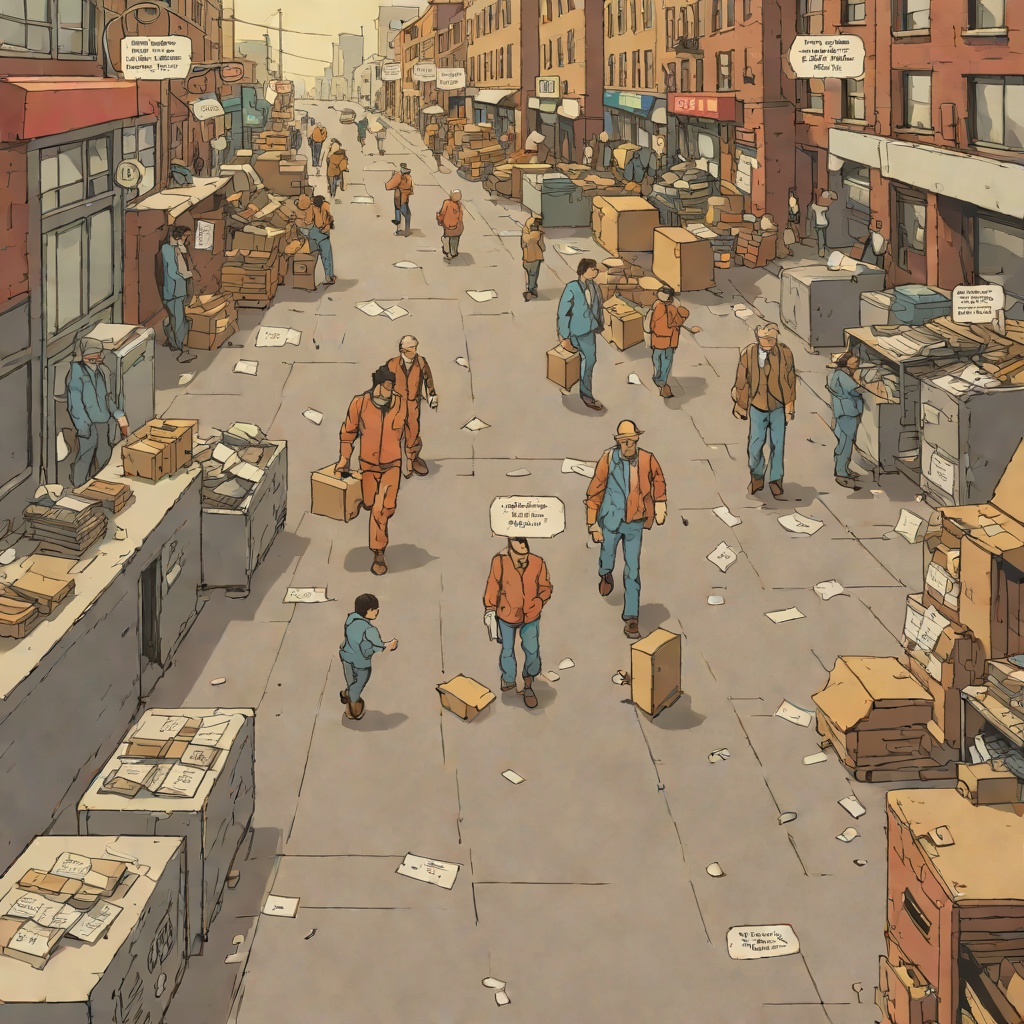
After the designation, Richards spends the next five years loading and rolling newspapers, but the work first thins and then disappears. The Free-Vee has effectively killed the printed word, while his attempts to find other employment lead to intermittent day-labor jobs. The phrase is thus connected not only with moral suspicion but with material exclusion: Richards is repeatedly moved along, pounding the pavement and taking whatever short-term labor remains available.
His isolation is intensified by the broader social order around him. The great political movements of the decade pass him by like ghosts, and he learns about the Housewife Massacre only after his wife tells him that police armed with tommy guns and high-powered Move-alongs turned back women marching on the Southwest Food Depository, killing sixty. He regards protest and violence as ineffective and concentrates on finding work, including jobs cleaning jellylike slime from under piers and in sump ditches. Shown Red gives this personal history a structural meaning: the label does not merely describe a troublesome worker; it helps produce the precarious, disposable condition in which a man must accept degrading labor while being denied stable reintegration.
Concealment and the Reversal of the Label
Because Richards is publicly hunted, the need to manage visibility becomes literal. At Molie’s, he spends twelve hundred New Dollars on a limited but effective disguise: gray hair, spectacles, mouth wadding, plastic buck teeth that alter the line of his lips, and a deliberately understated limp. Molie advises him to avoid attracting attention and to remember that he can cloud men’s minds if he uses the power. New wallet cards identify him as John Griffen Springer, a forty-three-year-old widower and text-tape salesman from Harding.
The disguise reveals the instability beneath Shown Red. The institution treats identity as a fixed, transferable status, yet Richards can temporarily escape recognition by changing the visible signs through which strangers classify him. Elsewhere he signs a hotel register as John Deegan from Michigan, showing that concealment requires not one replacement identity but continual adjustment. The label’s power depends on recognition; if the face, voice, documents, and behavior no longer align with the image circulated by the authorities, the warning can be delayed. At the same time, the need for false identification papers confirms the violence of the system: ordinary movement has become possible only through manufactured identities.
From Employment Warning to Public Enemy
The Network later enlarges the logic of Shown Red from an employment classification into a nationwide moral panic. Bobby Thompson tells the television audience that Richards will be led from the stage and urges viewers to remember his face, warning that he might appear beside them on a bus, in a jet plane, at a three-dimensional rack, or outside their homes. The audience is asked to report him wherever he is found. Richards answers by raising both middle fingers, provoking a genuine rush toward the stage and forcing his removal before the crowd can tear him apart on camera.
The broadcast then edits and reframes him as a killer and an organizer of social disorder. A clip makes him appear to threaten police, the Games Commission, and anyone he encounters, while Thompson describes him as a man who would mobilize malcontents to rape, burn, and overturn the streets. The presentation is not simply an account of Richards’s conduct; it is a manufactured identity assembled from altered images, spliced audio, accusation, and repetition. Thompson invokes five dead policemen, five wives, and nineteen children, reducing the alleged human cost to a calculation of seventeen dollars and twenty-five cents per victim while claiming that Richards has been paid blood money.
The audience is instructed to raise every hand against him, and hatred rises into a steady roar. The public is not encouraged to hand him over for neutral judgment but to destroy him on sight. In this transformation, Shown Red becomes the grammar of the entire hunt: a prior institutional mark is amplified by television until the marked person appears to be self-evidently monstrous. The Network, the police, and the crowd occupy different positions, but together they make classification circulate as common sense.
Consequences and Narrative Significance
The expression also describes the contagious effect of the system’s judgment on people who come into contact with Richards. Amelia Williams, after enduring the violence and spectacle surrounding the chase, is no longer the ordinary woman who once stopped at a routine sign thinking about meals, meetings, clubs, and cooking. She has Shown Red as well. The phrase here suggests psychological and social damage rather than a literal employment record: exposure to the hunt places her outside the reassuring identity she previously inhabited, and the narrative imagines drugs and therapy awaiting her as an attempt to restore that damaged normality.
Shown Red therefore links several forms of exclusion that the story keeps placing beside one another: the worker who becomes unemployable, the dissenter who becomes dangerous, the traveler who must disguise himself, the racial hatred expressed by the hotel clerk, and the fugitive whom television offers to a crowd as prey. Its irony is that the mark claims to reveal an inherent danger while the evidence shows a process of manufacture. Richards’s refusal to submit to workplace authority produces the initial designation; economic collapse sustains it; media editing magnifies it; and public fear completes it. The expression names not an inner essence but a social mechanism that makes a person legible as a threat and then treats the consequences of that classification as proof that the threat was real.