The Blue Door
The Running ManThe Blue Door is the derelict house at 94 State Street in Portland, a supposed refuge that becomes one of the most dangerous reversals in Ben Richards’s escape. Its faded entrance, heavily secured locks, and isolated neighborhood embody a world in which shelter is never separate from exposure: Richards reaches it injured and desperate, but the house offers no stable protection before the police are summoned.
Setting and Appearance
The address appears on the note Bradley Throckmorton leaves for Ben Richards: “94 State Street, PortlandTHE BLUE DOOR, GUESTSElton Parrakis (& Virginia Parrakis).” The cramped writing identifies both the place and the people expected to receive him, making the house part of Bradley Throckmorton’s escape route to Portland. Richards approaches it after driving north from Portsmouth, carrying crutches and a head wound, while a police unit briefly brackets his car on the turnpike. The journey produces a temporary sense of relief, but that relief fades as he enters the city and realizes that the authorities could be anywhere—or nowhere.
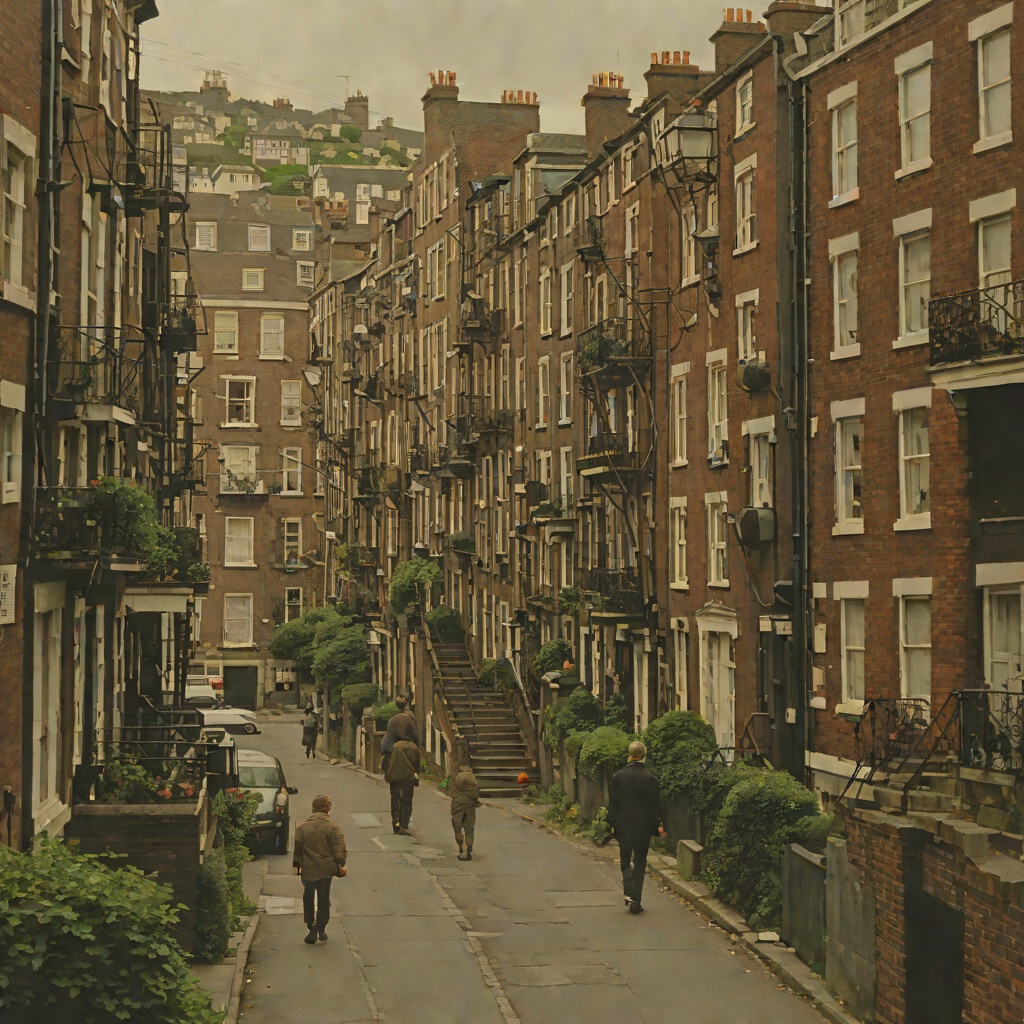
State Street is a blasted district of ancient brownstones near an overgrown, junglelike park. Richards associates the area with muggers, lovers, drug users, and thieves, and regards it as a place where no one would venture after dark without a police dog or a large group of gang members. Number 94 is a crumbling, soot-encrusted building with old green shades drawn over its windows. Its appearance suggests not merely neglect but arrested life: the house resembles an old man who has died with cataracts over his eyes.
The door itself once had blue paint, but the color has faded and peeled until it resembles a tired desert sky. The doorbell has been removed with a cold chisel, leaving the entrance dependent on knocking rather than any ordinary civic or domestic mechanism. This is the material detail that gives the location its name and its force. The Blue Door is not an inviting emblem of passage; it is a worn boundary in a neighborhood where access, safety, and abandonment are all uncertain.
Arrival and Refuge
Richards reaches the house while using crutches and is immediately vulnerable to the street. A boy attempts to kick one crutch from beneath him, and Richards swats the boy’s bottom with the other before making his way slowly up the pitted stone steps. The encounter establishes that even the approach to the supposed refuge is hostile. The abandoned cars outside reinforce the danger: Richards expects any unattended vehicle to attract local boys who would first examine its tools and then strip it down to a carcass within an hour.
He knocks once and receives no answer, then knocks again as the October cold rises through the street. When the door finally opens, Virginia Parrakis stands before him. She is tall, physically worn, arthritic, and visibly caught between fear and fury; her apparent confusion borders on insanity, though Richards later understands that she is muddled and frightened rather than simply hostile. She identifies herself as Elton Parrakis’s mother and tells him to come in. The house therefore fulfills its immediate function as a hiding place, but the welcome is fragile from the beginning, conditioned by a household already strained by fear.
Virginia does not recognize Richards immediately. Recognition comes only after she has led him into the kitchen to make tea, shifting the encounter from anonymous intrusion to an acknowledgment of the connection named on Bradley Throckmorton’s note. The kitchen briefly turns the outlaw’s flight into an ordinary domestic visit, yet the ordinary action cannot erase the circumstances outside: Richards is injured, hunted, and dependent on a family whose own security is precarious.
Elton Parrakis and the Betrayal
The Blue Door is also the home of Elton Parrakis, whose relationship to Richards is mediated by the larger hunt surrounding the Games. The location’s promise of concealment depends on Elton’s willingness to protect him, but Elton admits that Evan McCone has an intelligence network extensive enough to threaten any hiding place. His evasiveness makes the house feel penetrable even before the decisive confrontation occurs.
The reversal comes when Virginia opens the door again and says that she has called the police, adding that Richards must leave. Her arms are crossed and she is smiling, but her eyes are haunted. The contrast between the controlled posture and the haunted expression leaves open the emotional pressure behind her action without removing its consequence. Elton’s face drains pale, and he calls her a liar. Richards, already injured and dependent on the household, rises abruptly and pauses to listen, recognizing that the danger has moved from the street to the threshold itself.
The Blue Door thus converts hospitality into betrayal, or at least into the appearance of betrayal. The house had been presented as a named destination, complete with hosts, yet the same domestic entrance becomes the point at which official pursuit is invited inside. Its locks and bolts had suggested defense; the later call to the police reveals that defenses can also become instruments of confinement, controlling who may enter and who must flee.
Urban Space and Social Exposure
The location’s meaning depends on its position within a sharply divided city. In Co-Op City, south of the Canal, Richards walks through deserted shops, stripped vehicles, rats, garbage, and failing lights because unemployment has left him without money for a pneumo-bus token. Crossing the Canal brings him toward the Network Games Building, where police watch men in poor clothing because, uptown, such a man has only one recognized purpose: the Games. The Blue Door lies elsewhere, in Portland’s decayed State Street, but it belongs to the same spatial order in which poverty determines mobility, visibility, and risk.
The house’s isolation is therefore not romantic secrecy. It is produced by urban abandonment. State Street’s ruined brownstones, dangerous park, abandoned air cars, and absence of ordinary police protection make concealment possible only because the district has been left outside the city’s secure center. At the same time, that neglect makes the refuge unstable: criminalized residents, opportunistic boys, and state pursuit occupy the same landscape, while Richards cannot know which form of surveillance will reach him first.
Other spaces in Richards’s flight repeat this pattern. The Boston Y.M.C.A. is described as the skeleton of a murdered idea, a huge and blackened remnant of an earlier city. The unfinished Super Pine Tree Mall becomes a rat warren of abandoned foundations, rusted steel, Quonset huts, and overgrown construction debris. Voigt Airfield, by contrast, is crowded with police, civilians, tanks, fences, terminals, and a departing Lockheed/G-A Superbird. Against these locations, The Blue Door is a smaller and more intimate version of the same geography: a deteriorated structure briefly appropriated for escape, then reclaimed by the systems of pursuit.
Narrative Significance
The Blue Door is a threshold location in both the literal and structural sense. Richards enters it after surviving the exposed road and the hostile street, carrying physical injuries and the expectation that Bradley Throckmorton’s arrangement may give him time to recover. Instead, the house intensifies the central uncertainty of his journey: every apparent solution may be a trap, and every private relationship may be forced into the public machinery of the hunt.
Its strongest image is the ruined blue entrance. The color survives only as a faded trace, just as the idea of sanctuary survives only as a trace within the building. The locks, the missing bell, the guarded neighborhood, Virginia Parrakis’s haunted smile, and Elton Parrakis’s sudden pallor all make the doorway a mechanism of suspense. The Blue Door does not simply contain an episode in Richards’s flight; it dramatizes the collapse of the distinction between home and prison, welcome and exposure, refuge and betrayal.