The Canal
The Running ManThe Canal is the physical and political boundary dividing the impoverished south side of Co-Op City from the guarded, prosperous world of the Network Games Building. Ben Richards’s crossing of it is not merely a change of neighborhood: it marks passage between incompatible social systems, one abandoned to unemployment, pollution, rats, and gang rule, the other organized around police surveillance, paid entertainment, and the Games.
A Polluted Urban Boundary
The Canal lies within a landscape of urban abandonment. South of it, Co-Op City forms a radiating maze of parking lots, deserted shops, Urban Centers, and paved playgrounds where the police seldom venture and cycle gangs exercise practical authority. A rat moves across cracked pavement near the stripped skeleton of a 2013 Humber, while rain, garbage, broken lights, and decaying buildings make the district appear less like a functioning city than a battlefield after its population has withdrawn. The air is sulphurous and thick, and the district carries the reek of the year 2025.
The Canal also divides access to the city’s basic systems. In Co-Op City, the week’s twenty-dollar unemployment allotment has already been spent, leaving Richards unable to buy a pneumo-bus token. Free-Vee cables run safely beneath the streets, but the dream machine they carry is available without charge only in the sense that it is free to watch; farther across the Canal, it operates continuously on New Dollars, a currency available only to employed people. The Canal therefore separates not just two views of the city but two economies of mobility, information, and attention.
The Class Frontier
Richards approaches the Canal on foot from the south, passing liquor stores, smoke shops, cycle gangs, and increasingly commercial streets before the city’s skyline rises cleanly ahead. The one-hundred-story Network Games Building becomes visible through cloud and smog, and his fixed gaze upon it gives the Canal a destination as well as a border. Once he crosses, the atmosphere changes sharply: expensive movie houses and ungrilled smoke shops replace the heavily protected businesses of the south, Rent-A-Pigs stand outside, and a city cop occupies every corner.
The contrast is spatially enforced. People in the People’s Fountain Park watch their children play on astroturf behind chain-link fencing, with a police officer stationed on each side of the gate, while Richards arrives in baggy gray pants, a cheap bowl haircut, and sunken eyes. Uptown, the authorities recognize only one legitimate purpose for such a man: the Games. The Canal thus functions as a sorting mechanism. It does not erase poverty when Richards crosses it; it turns poverty into a visible, policed identity that can be converted into entertainment.
Crossing into the Games
Richards crosses the Canal before joining the immense line for the qualifying examinations. The line stretches for more than a mile toward the Games Building, with police watching the applicants and resting their hands on gun butts or move-alongs. The crossing has changed his physical surroundings, but it has also brought him under a new form of control. South of the Canal, neglect and informal violence made movement dangerous; north of it, surveillance and institutional authority make movement conditional.
The Games later exploit this boundary as part of Richards’s public image. The Running Man television broadcast presents him as a threatening figure from south of the Canal, a local urban predator whose face is retouched into an image of primitive menace. Bobby Thompson’s presentation transforms geography into moral classification: the southern district becomes the implied source of disorder, while the uptown audience is invited to regard Richards as an enemy moving outward from it. The Canal is consequently not only crossed by Richards; it is reproduced in the broadcast as a division between respectable viewers and the supposedly dangerous population they fear.
A Route of Flight and Pursuit
The Canal remains important after Richards escapes the immediate custody of the Games. Dan Killian warns him to stay close to his own people and predicts that the heaviest heat will fall on Co-Op City when the truce breaks. Richards understands that the district is both refuge and trap: its neglected streets may conceal him, but they also expose him to concentrated police pressure and the violence of packs operating beyond ordinary law.
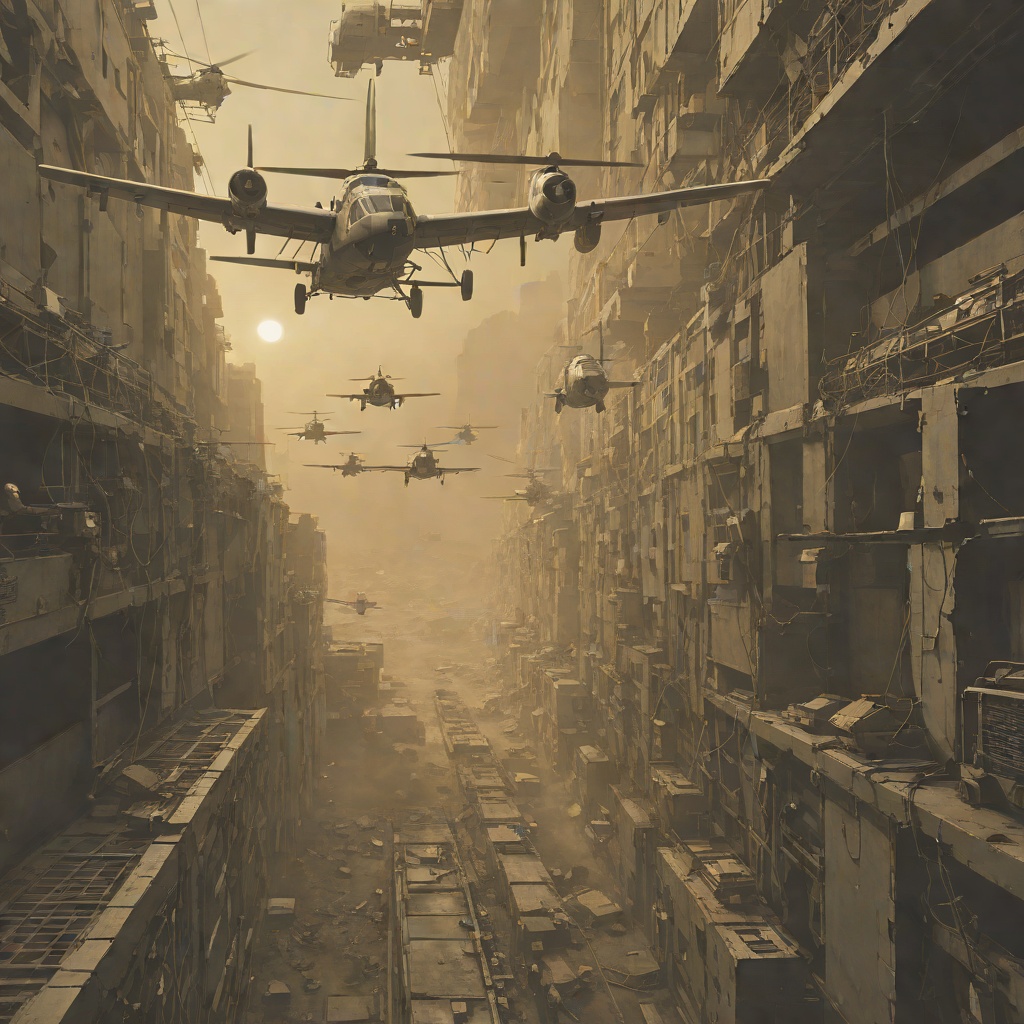
Later, the Canal becomes part of the visual and physical climax of Richards’s revolt. A jet cruises across it, giant and roaring, while a Push addict in a doorway interprets the aircraft as a hallucination or a dream of escape to a place where food is free and filth has been cleared away. Engines drive residents into doorways; show windows fall inward; litter spirals through the streets; and a policeman drops his move-along and screams while clutching his head. The aircraft’s passage turns the old class boundary into a spectacle of technological power directed against the city that has been abandoned below.
Narrative Significance
The Canal condenses the novel’s geography of inequality. Its southern side bears the accumulated effects of unemployment, neglected infrastructure, social violence, and air pollution, while its northern side displays cleanliness, commercial abundance, dense policing, and controlled access. The boundary is therefore produced by institutions, money, transport, communications, and surveillance as much as by water or pavement.
For Richards, crossing the Canal initiates a recurring movement between invisibility and forced visibility. In Co-Op City he is one impoverished man among four million people, almost all unemployed; uptown he becomes a numbered applicant, then a televised face, then a nationally hunted figure. When the aircraft crosses back over the Canal toward the Games Building, the direction of travel reverses the earlier journey. The boundary that once led Richards into the system of spectacle becomes the line over which he brings that system’s violence back to its center.