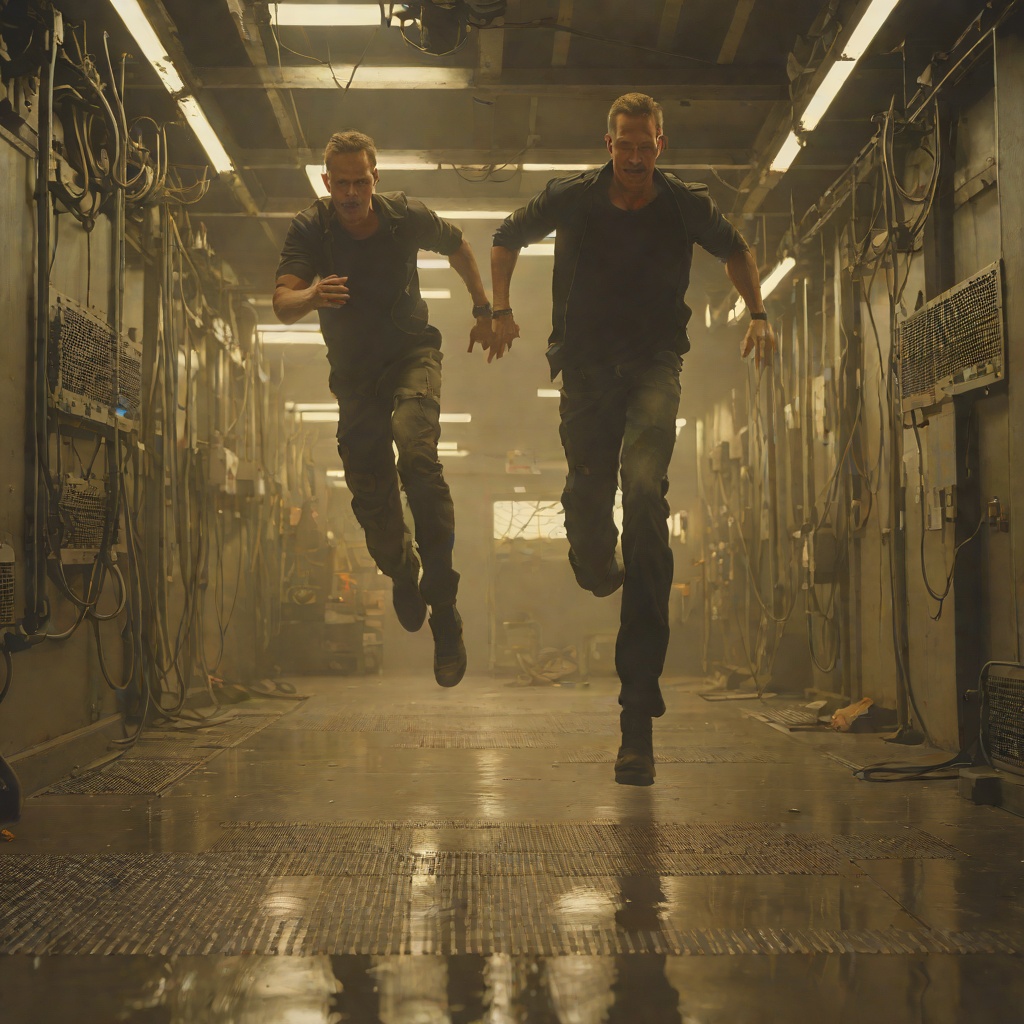
The Running Man television broadcast
The Running ManThe Running Man television broadcast is the Network’s most consequential public construction of Ben Richards: it presents a controlled entertainment program as a national emergency, recruits viewers into the hunt, and makes accusation appear more immediate and credible than evidence. Its decisive power lies in its ability to join studio performance, manipulated imagery, monetary incentives, and live crisis coverage into one continuous story in which Richards is not merely a contestant but a dangerous social type.
Production and Broadcast Form
The broadcast is introduced as a professionally managed television production rather than an improvised manhunt. Dan Killian identifies Fred Victor as the director of The Running Man and Bobby Thompson as its host and emcee. Victor shows Richards the set through left-right views on a bank of screens and explains that the program deliberately avoids a run-through because rehearsal would weaken spontaneity. Thompson is expected to improvise, while Games guards flank Richards onstage with riot guns, a weapon chosen as much for theatrical effect as for practical control. The production therefore depends on a carefully arranged contradiction: it must look immediate and dangerous while remaining technically organized from behind the cameras.
The studio audience supplies the first visible proof of the program’s social force. At 6:01, Richards waits in the wings between two policemen while the audience applauds Thompson frantically. Thompson introduces him as a resourceful man from south of the Canal in the city’s own home area, but the introduction quickly abandons ordinary biography for a threatening visual code. A hidden-camera portrait of Richards in a baggy gray workshirt has been retouched to deepen his eyes, lower his forehead, darken his cheeks, and give his mouth a jeering curl. The resulting image is not a neutral record but an invented figure: an urban death angel, primitive, brutal, and cunning, an alleged bogeyman for wealthier apartment dwellers.
Manufacturing the Enemy
Thompson’s language supplies the broadcast’s first governing frame. Richards is identified as Benjamin Richards, age twenty-eight, and viewers are ordered to know his face because a verified sighting earns one hundred New Dollars, while a sighting that results in a kill earns one thousand. The program turns recognition into surveillance and surveillance into a financial transaction. The distinction between seeing, reporting, and killing is preserved as a graduated reward structure, making violence appear to be the final and most valuable stage of ordinary civic participation.
The broadcast also extends punishment to Richards’s family. Thompson announces that the award will go to the woman connected with Richards if he is brought down, then displays a still of Sheila Richards that has been altered even more viciously than Richards’s portrait. Her face is transformed into a caricature of vanity and sexual greed, so that the program does not merely expose a family member to danger; it supplies viewers with an image designed to make her seem morally deserving of whatever follows. Richards recognizes the falsification and lunges toward the image, but powerful arms restrain him, turning his anger into another usable moment of televised spectacle.
When Thompson asks how long Richards expects to hold out, the question presents coercion as sport and endurance as a measurable public contest. Richards answers that he expects to go the whole thirty and doubts that the Network has anyone capable of taking him. The audience responds with screaming, shaking fists, and a thrown tomato. Thompson then announces that the hunt will begin at noon the next day and scatters possible sightings across ordinary spaces: a pneumo bus, a jet plane, a three-dimensional rack, or a local killball arena. The broadcast’s geography is deliberately intimate. The hunted man may be anywhere, and the viewer’s routine environment is recoded as a hunting ground.
Audience Participation and Editorial Power
The studio crowd is presented as a mass voice, but the scene exposes how that voice is managed. People attempt to get onto the stage while police hold them back, and some of the audience may have been paid to create the appearance of spontaneous outrage. Thompson waits for the noise to subside when silence will intensify his contempt, then resumes questioning. The program thus alternates crowd frenzy with host-controlled pauses, using both disorder and discipline as parts of its rhetoric.
Richards tries to answer the national audience directly, insisting that the image of his wife was a cheap fake. The crowd drowns him out. Thompson repeats the question after nearly a minute of waiting, and Richards’s cool response is followed by another eruption. At the close of the segment, Thompson urges viewers to remember Richards’s face and asks whether they will report him. The audience answers yes. Richards gives the audience both middle fingers, and the rush toward the stage becomes genuinely dangerous rather than simulated. He is hurried through the stage-left exit before the crowd can tear him apart on camera, depriving the Network of the more sensational footage it had expected to obtain.
The gesture becomes a small act of resistance precisely because it disrupts the broadcast’s planned escalation. Dan Killian laughs at it and calls it a fine performance, even wishing he could give Richards a bonus. His reaction reveals the Network’s capacity to absorb defiance as entertainment: an insult that momentarily rejects the spectacle is immediately evaluated as successful television. Richards can resist the script, but the production machine is prepared to convert even resistance into another attractive segment.
The National Accusation
A later broadcast expands the same method from studio humiliation into national political myth. Bobby Thompson appears deadpan in the center of a brilliant post surrounded by darkness and tells viewers to watch one of the wolves walking among them. Richards’s face is enlarged, followed by a second photograph showing him in the John Griffen Springer disguise. The sequence treats different appearances as proof of a single hidden predator, making disguise itself evidence of guilt.
Thompson then addresses the people of Boston and attributes the deaths of five policemen in the basement of the Boston Y.M.C.A. to Richards, describing the deaths as the result of a clever and merciless trap. The broadcast asks where Richards is and commands viewers to look for him, transforming an unresolved public event into a personalized hunt. Its structure is cumulative: image, accusation, local appeal, and demand for recognition replace investigation with instant certainty.
The program’s most elaborate fabrication is a sequence of edited clips. Richards’s recorded image appears to ask viewers to storm libraries, demand cards, and investigate books about air pollution and water pollution that Bradley Throckmorton had given him. The image then seems to utter obscenities and threats against police and the Games Commission, although Richards cannot tell whether the voice belongs to an imitator or has been assembled from spliced pieces of audio tape. The broadcast therefore manufactures not only what Richards looks like but also what he appears to say, using the authority of synchronized image and sound to erase the distinction between testimony and alteration.
Thompson’s split-screen declaration identifies Richards as a man who would kill and mobilize malcontents to riot, rape, burn, and overturn the streets. The rhetoric assigns him several mutually reinforcing identities at once: wolf, killer, organizer of disorder, liar, cheat, and murderer. The broadcast does not need to prove each accusation separately. It creates a total moral portrait in which every subsequent claim seems to confirm the others.
Death, Reward, and Public Memory
The broadcast places a precise monetary value on the deaths associated with its story. Thompson says that Richards has received one hundred dollars for each hour of freedom, now totaling fifty-four hours, plus an extra five hundred dollars for the five dead policemen. He then divides the figure among the dead officers’ families, reducing five wives and nineteen children to an arithmetic contrast with Richards’s supposed payment. The calculation is presented as moral outrage, but it also demonstrates how completely the program has transformed grief into a reward ledger.
Images of young policemen from a Police Academy graduation exercise appear on the screen while a trumpet begins to play Taps. Their freshness and vulnerability are emphasized, and Thompson’s accusation is surrounded by the visual language of bereavement. A woman in the audience calls Richards a killer and murderer, while Thompson urges that every hand be raised against him and repeats the command to behold the man. The audience’s fear and hatred rise into a steady roar. Richards understands that viewers will not simply report him; they will attempt to tear him apart on sight.
The broadcast’s later consequences show that its influence exceeds the studio. When Amelia Williams announces that Richards wants to surrender to the Airline Police, cameras record the scene for a live feed intended for North America and much of the world. Richards recognizes that the cameras may help him because public visibility makes an immediate disappearance or quiet killing more difficult. The same medium that has made him a national enemy becomes, for a brief moment, a protective witness.
The crisis is explicitly measured against a vast audience. During the standoff, the press appears uneasy, but the psychic pressure of five hundred million viewers is treated as a practical force. The spectacle has become larger than the people physically present at the airfield: officials, reporters, and police must act under the imagined gaze of the mass audience, while Richards uses that gaze to make demands for a fully fueled jet and a skeleton crew.
Final Spectacle and Significance
The broadcast finally joins its entertainment machinery to the destruction of the Games Building. As the hijacked Lockheed approaches, the Games authorities and the press remain within the field of cameras and public attention. The aircraft strikes the building three quarters of the way up at slightly more than five hundred miles per hour, with its tanks still more than a quarter full. The explosion lights the night like divine wrath and sends fire twenty blocks away.
The ending gives the broadcast its ultimate image: a system built to display the hunted man is itself struck by the object he has seized. The Running Man television broadcast has repeatedly claimed the power to define what viewers see, what they fear, and whom they should punish. Yet its final spectacle cannot contain the difference between the Network’s edited story and Richards’s physical act. The program’s lies, reward structures, and synchronized public emotions have made violence into entertainment; the destruction of the Games Building returns that violence to the institution that organized its display.