The betrayal at the Blue Door
The Running ManThe betrayal at the Blue Door is the collapse of Ben Richards’s first promised refuge after his escape from the Boston Y.M.C.A. Bradley Throckmorton has directed him to a Portland address identified as the Blue Door, where Elton Parrakis and Virginia Parrakis are supposed to receive him. Instead, Virginia summons the police and tries to turn her son’s aid to Richards into a claim for reward money. The event transforms a shelter into a trap, converts a private family household into an extension of the manhunt, and sends Richards and Elton running toward the abandoned Super Pine Tree Mall under the pressure of approaching sirens.
Refuge and Its Conditions
The betrayal begins with the appearance of a carefully prepared escape connection. On the paper Bradley Throckmorton leaves in Richards’s car, the Portland destination is recorded as “94 State Street, PortlandTHE BLUE DOOR, GUESTSElton Parrakis (& Virginia Parrakis).” The compressed notation makes the address look less like an ordinary home than a coded station in an underground route. Richards reaches the area after driving from Portsmouth, carrying the physical evidence of his recent flight: crutches beside him, a bandage wrapped around his skull, and the expectation that Portland will give him enough breathing room to add a neck brace.
The house initially offers the defensive architecture of a frightened household. When Richards arrives, locks, bolts, chains, and a heavy-duty TrapBolt are withdrawn one after another. Virginia Parrakis appears as an imposing, damaged, and unsettled woman: nearly six feet tall, with arthritic knees, huge knotted hands, and an intelligent face marked by fear or fury. She identifies herself as Elton’s mother and invites Richards inside. Her many locks suggest that danger is already part of the home’s daily life, but they also create the immediate impression that the Blue Door can keep danger out.
That impression is weakened by Virginia’s mental and emotional instability. She does not recognize Richards at first, even after admitting him, and later reacts to him as though he were the notorious fugitive whose name has entered the household through fear and public pursuit. The house therefore contains two incompatible meanings at once: it is a defended sanctuary selected by Bradley’s escape plan, and it is a frightened domestic space vulnerable to the state’s reward system and its own anxieties.
The Betrayal
Elton Parrakis tries to stabilize the situation by presenting Richards as a legitimate guest and as a friend of Bradley Throckmorton. He tells his mother that Richards will remain with them for a couple of days. The explanation is immediately dangerous because it places Virginia in direct contact with the truth of the refuge rather than allowing her to remain behind the protective fiction of an ordinary visitor. Her response is not quiet refusal but a panicked recognition of the consequences she believes Richards’s presence will bring.
The decisive reversal occurs when the door opens and Virginia stands there with folded arms and a smile, announcing that she has called the police and that Richards must leave. Her apparent composure contrasts with the terror that follows: Elton’s face drains pale, and he accuses her of lying. The Blue Door’s meaning changes in a single domestic gesture. The locks that once represented protection now become the locks of a place from which the police are about to take control.
Virginia then states the motive she has attached to her action. She says she called for Elton’s sake, claims that Richards has confused him, and proposes that they say Richards broke in so that they can obtain the reward money. The plan is not merely a denunciation; it is an attempted conversion of the fugitive into a profitable story. Richards’s presence is stripped of the facts of Bradley’s arrangement and Elton’s consent, while the family is invited to present itself as an innocent household endangered by a criminal intruder.
The betrayal thus operates through both fear and economic calculation. The reward is attractive because the surrounding society has already made money scarce and survival precarious. In Richards’s home, his daughter Catherine Sarah Richards is ill, the family has relied on inadequate help pills and fake milk, and the prospect of securing medical care has been tied to the desperate need for money. The Blue Door incident does not erase that larger poverty; it shows how poverty can make a police reward appear to compete with loyalty, hospitality, and truth.
Flight from the House
Elton reacts with terror and misery rather than with any confident plan. When Virginia seizes his arm and insists that she acted for him, he tries to break free. Her use of an intimate family name intensifies the humiliation and confusion of the moment, and Elton finally flings her away across the bed. The betrayal is consequently also a fracture in the Parrakis household: the mother who claims to be protecting her son becomes an immediate physical obstacle to his attempt to help Richards.
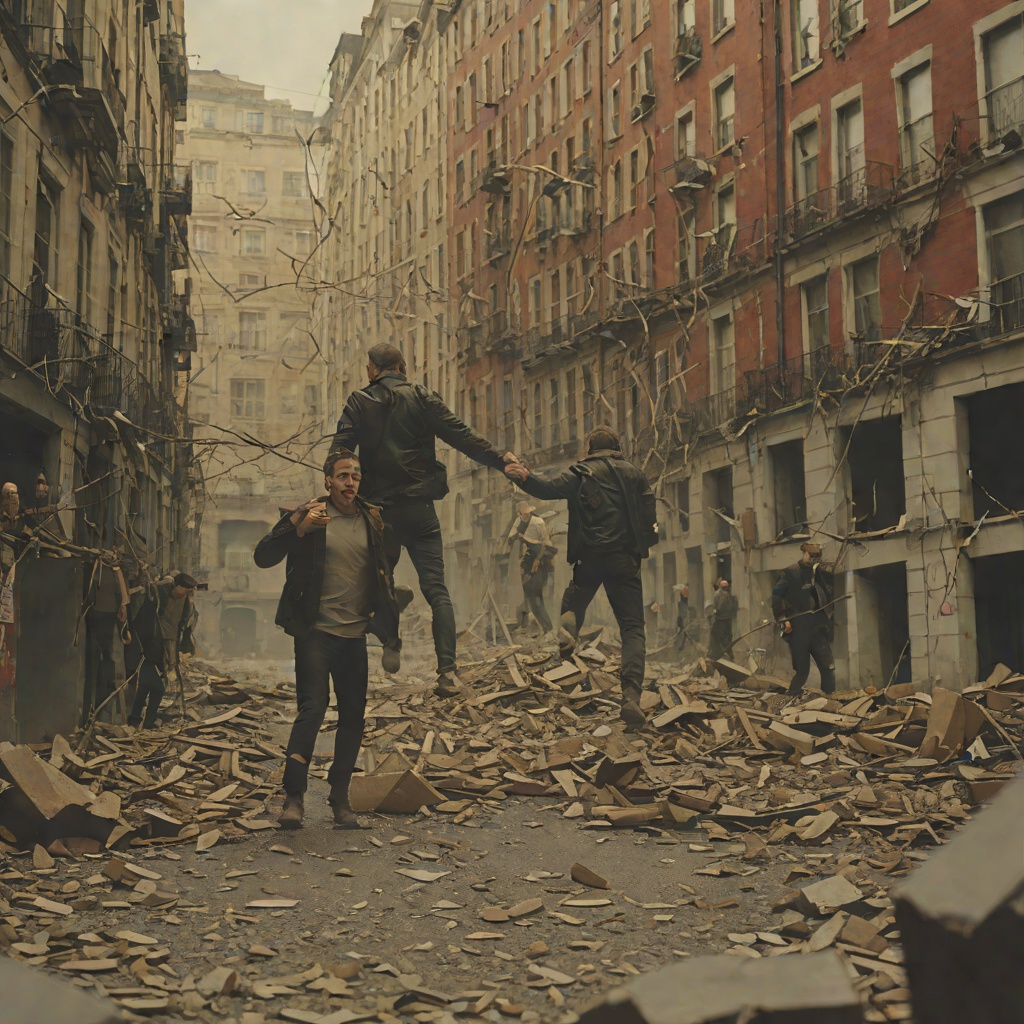
With the sirens growing louder, Elton urges Richards to come quickly. They crash down the stairs and out through the front door, while Virginia’s scream follows them from upstairs and blends with the approaching police vehicles. The escape has none of the controlled precision suggested by Bradley’s written directions. It becomes a panicked movement through a house whose defensive barriers have failed, followed by a flight in which Elton’s large body and labored breathing make their vulnerability unmistakable.
Outside, the police identify Richards by name. Their car stops roughly a hundred yards away, its blue lights flashing, while the fugitives’ shadows stretch and contract beneath the mesh-enclosed General Atomics streetlamps. The scene joins public surveillance to private betrayal: the police do not discover Richards through an accidental search alone, but arrive because a member of the refuge has supplied the household’s location and a usable accusation.
The Pursuit and Its Consequences
Elton directs Richards toward the Super Pine Tree Mall, an abandoned construction project that has become a maze of half-built stores, rusted steel, Quonset huts, foundation pits, pipes, cinderblock, and overgrown scrub. The unfinished complex offers concealment precisely because it was never completed as a functioning commercial space. Its failed development contrasts sharply with the polished, surveilled spaces that Richards has crossed elsewhere, including the wealthy side of the Canal and the Games infrastructure that turns pursuit into spectacle.
The choice of destination also reveals how the built environment shapes the fugitives’ options. In Co-Op City, poverty, stripped vehicles, rats, deserted shops, and cycle gangs make movement dangerous; across the Canal, police watch men who appear poor and unemployed, ready to drive them away or arrest them for loitering. At the Blue Door, even a private address proves permeable to state power. The abandoned mall becomes available because its economic failure has left behind a landscape that can shelter people whom ordinary urban spaces expose.
The betrayal has an immediate practical consequence: Richards loses the protected interval promised by Bradley’s network and is forced into another improvised escape before he can recover fully from his injuries. Elton, who had claimed responsibility for the arrangement, is pulled into the consequences of his mother’s decision. Their flight does not resolve the danger; it redirects it into the mall, where police pursuit, exhaustion, and the physical hazards of the ruins continue to close around them.
Narrative Significance
The Blue Door betrayal is a classic reversal of refuge into entrapment, but its force comes from the mundane form of the reversal. No grand conspiracy is needed. A written address, a defended front door, a frightened mother, a telephone call to the police, and the promise of reward money are enough to dismantle the escape route. The event makes the manhunt intimate: the system reaches Richards not only through patrols and official force but through the fears and material pressures of people near him.
It also complicates the moral geography of Richards’s flight. The contrast is not simply between a virtuous fugitive and uniformly evil pursuers. Virginia is frightened, confused, and materially tempted; Elton is compromised by his dependence on her even as he tries to help; Richards must judge the danger without time to investigate her motives. Yet the attempted false claim that he broke in demonstrates how quickly public labels can override private knowledge. The fugitive is made into an intruder, the hosts into prospective victims, and the reward into a substitute for justice.
As a narrative hinge, the event converts Richards’s escape from a sequence of planned contacts into an increasingly exposed chain of emergency decisions. The Blue Door was supposed to extend Bradley Throckmorton’s escape route to Portland; Virginia’s call instead drives Richards toward the Super Pine Tree Mall and the next stage of pursuit. Its lasting significance lies in that reversal: wherever Richards seeks human shelter, the institutions and incentives surrounding the manhunt can enter through the household itself.