The destruction of the Games Building
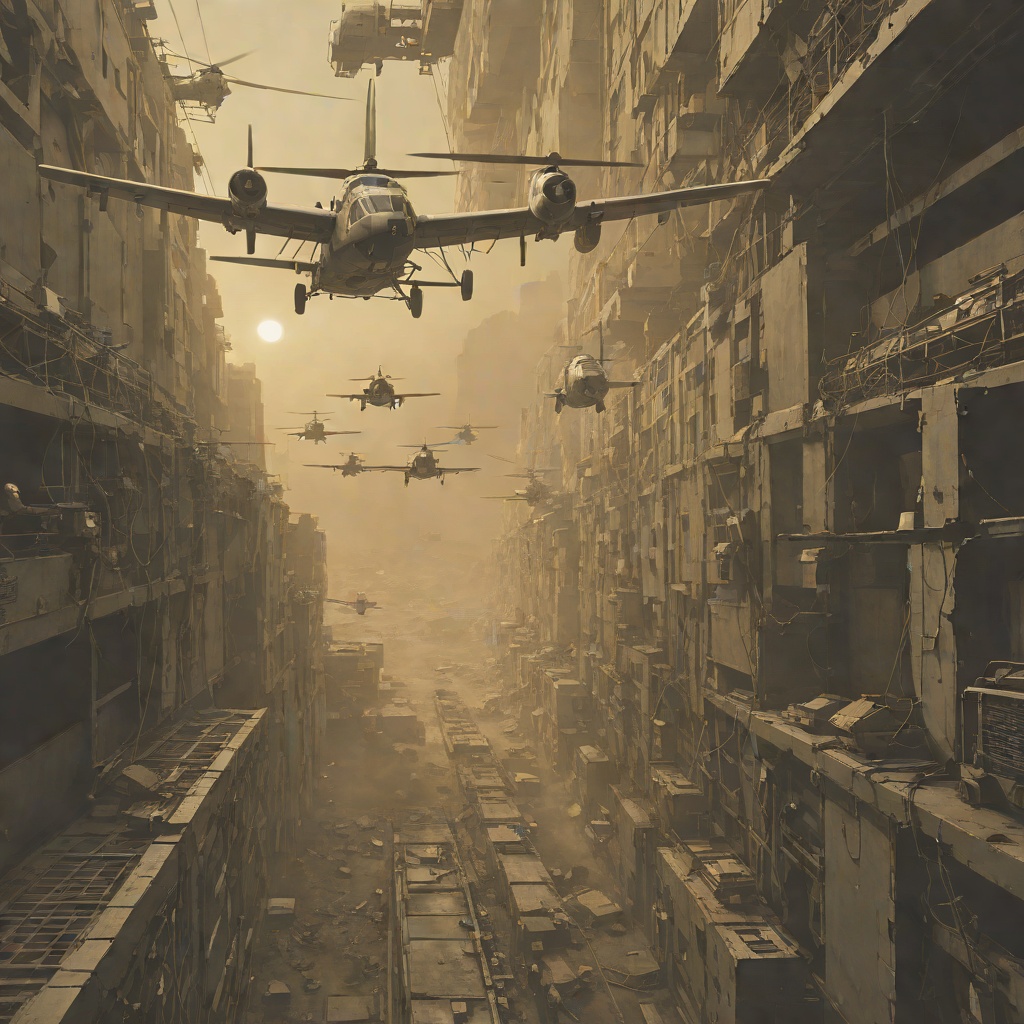
The Running ManThe destruction of the Games Building is the climactic attack in which Ben Richards turns the Network’s machinery of pursuit against itself. Near the end of a night flight, exhausted and badly injured, he guides a Lockheed TriStar toward the building that houses the Games, then strikes it at high speed. The crash destroys the Games Building in a fireball visible across the city and gives the story’s manufactured spectacle a literal, terminal collision with the reality it has concealed.
Causes and Background
The building’s destruction is prepared by a system that makes crisis profitable and dissent televisable. The Network presents The Running Man as the largest attraction on Free-Vee, promising viewer participation while using the program to eliminate “embryo troublemakers.” Dan Killian, its executive producer, describes the program as having produced no survivals in six years. The claim makes the contest’s structure plain: the participant is not being offered a genuine chance at public recognition but is being placed inside an organized mechanism of pursuit and elimination.
The broadcast repeatedly converts evidence into propaganda. Bobby Thompson introduces Richards as a dangerous man from south of the Canal, displaying a retouched portrait that lowers his forehead, deepens his eyes, darkens his cheeks, and gives his mouth a hostile curl. The image constructs an “angel of urban death” for the audience before Richards can speak for himself. The program then announces a reward of one hundred New Dollars for a verified sighting and one thousand for a sighting that results in a kill, turning ordinary viewers into potential hunters and Richards’s body into a marketable target.
The same manipulation reaches Richards’s family. Thompson displays a cruelly altered image of Sheila Richards and announces that the prize will go to her if Richards is brought down. When Richards objects that the image is a cheap fake, the studio audience drowns him out; when Thompson asks how long he expects to hold out, the question is less an invitation to answer than another device for fixing him inside the program’s frame. Later, Thompson calls him a wolf who walks among the audience and accuses him of planning to mobilize malcontents to rape, burn, and overturn the streets. The Network therefore makes the Games Building more than a workplace or studio: it is the physical center of a system that edits reality, assigns guilt, and distributes violence as entertainment.
The surrounding society supplies the crises that the Network packages. News reports carry worsening fighting in Ecuador, cannibal riots in India, and other disasters, while viewers watch money games with dreadful fascination because the next contestant might be one of them. Bradley Throckmorton connects this spectacle to material conditions that the official media suppresses: Boston’s air pollution can reach a level he compares to smoking four packs of cigarettes a day, and cheap nose filters are ineffective while the only reliable General Atomics models cost six thousand New Dollars. In his account, Free-Vee keeps people indoors and passive while industrial pollution continues. Cassie’s cancer, which has spread through both lungs into her throat and belly, becomes another concealed social fact: when she dies, Bradley expects the death certificate to name asthma rather than lung cancer, preventing the public from seeing the scale of the damage.
What Happens
The final sequence begins with Richards barely able to remain active. He falls over Holloway’s sprawled body and becomes suddenly sleepy, while Otto, the aircraft’s automatic pilot, hums in his consciousness like a lullaby. He raises his head only through immense effort and stares at the twin controls moving through their programmed dance. Through the plexiglass windows, Harding appears, but the destination is too far away. The scene makes the aircraft both instrument and burden: its automated motion continues while Richards’s body approaches collapse, and the attack depends on a dwindling margin of human intervention.
The countdown reduces the remaining distance to a sequence of stark numerical thresholds. At “Minus 002,” the plane cruises through the night, and Co-Op City lies below like a giant broken carton. Richards is coming toward the Games Building; at “Minus 001,” the approach is nearly complete. The countdown is not merely a timekeeper. It reproduces the clipped language of the Games while reversing its direction. The program once counted down the hunted man’s chances of survival; now the same structure counts down the building’s remaining existence.
Across Harding, Free-Vees turn white with interference as people stare in fearful disbelief. The disruption spreads before the impact is understood, making the broadcast network itself register the approach of an event it cannot control. Inside the Games Building, Dan Killian looks up from his desk toward the wall-to-wall window occupying an entire side of the room. The city view, stretching from South City to Crescent, disappears behind the approaching jet. For one brief moment, Killian sees Richards through the glass, his face smeared with blood and his black eyes burning. Richards is grinning and giving him the finger. The gesture reduces the distance between the televised caricature and the wounded man who has survived long enough to confront the producer directly.
The Lockheed TriStar heels slightly and strikes the Games Building three quarters of the way up. Its tanks are still more than a quarter full, and its speed is slightly over five hundred miles an hour. Those concrete details give the collision the precision of an engineered act rather than the vagueness of an accidental catastrophe. The impact is direct and structurally devastating: the aircraft hits the building dead on, and the remaining fuel produces an explosion that lights the night like divine wrath and rains fire twenty blocks away.
Immediate Consequences
The crash ends the building as the physical home of the Games and destroys the setting from which the Network has staged its public hunt. Its scale is measured not only by the building’s direct impact but by the fire’s reach across twenty blocks. The event therefore breaks out of the studio’s controlled frame and becomes a citywide material fact, visible even to those who have received the Network’s account of Richards only through edited images and hostile commentary.
The disappearance of the city view behind the aircraft produces a final reversal in the relation between watcher and watched. Killian has spent the narrative speaking through the apparatus that defines Richards for millions of viewers, while Richards has been reduced to a portrait, a reward notice, and a sequence of manipulated clips. At the window, however, the producer becomes the observer confronted by the real face of the man he helped frame. The image that follows is no longer a retouched still or a staged television close-up: it is a bloodied, living face immediately before impact.
The explosion also answers the program’s repeated language of counting and survival. The Running Man has announced that there have been no survivors, and its broadcast repeatedly measures Richards’s freedom in hours and rewards. The final “Minus 000” abolishes the countdown’s ordinary promise that the hunted person will be captured at its end. Instead, the terminal number marks an attack that reaches the institution itself. The Games do not conclude with Richards safely escaping their logic; they conclude with the apparatus of pursuit physically shattered.
Narrative and Thematic Significance
The destruction of the Games Building is a value reversal from mediated helplessness to catastrophic agency. Earlier, the Network controls the image, the audience, the reward system, and the meaning assigned to every act. Richards can protest that the picture of Sheila is false, but the crowd’s response demonstrates that truth has little force once the broadcast has supplied a more profitable fiction. At the climax, he cannot reclaim the airwaves through argument, so he acts upon the material structure that makes the falsehood powerful. His body, previously displayed as a target for public consumption, becomes the means of destroying the platform that consumed it.
The event also exposes the dependence of political control on spectacle. The Network converts war, riots, illness, poverty, pollution, and manhunt into consumable images, presenting social breakdown as a succession of programs and prizes. The attack interrupts that conversion. Interference blanks the Free-Vees, the city’s normal vista vanishes, and the audience is left with an event too large to remain merely a story told by Bobby Thompson. The system that has claimed authority to narrate danger is forced to encounter danger without the protective distance of editing.
Yet the ending remains tragic rather than simply triumphant. Richards is exhausted, injured, and nearly asleep as he pilots the aircraft; the action is inseparable from bodily depletion and the deaths already surrounding him. His family has been placed inside the Network’s spectacle, and Dan Killian has insisted that their deaths were a horrible accident while knowing that Richards’s first destination, if he accepted a job offer, would be Co-Op City, where he could learn the truth. The collision thus carries accumulated grief, rage, and the demand to make the system answer in a language it cannot censor: impact, fire, and irreversible loss.
As the closing image of the narrative, the crash gives the countdown its final meaning. A society that has trained itself to watch people die for money is forced to watch its own entertainment center become the object of destruction. The Games Building is not merely damaged; it is struck at the point where spectacle, institutional power, and public participation meet. Its destruction is therefore the decisive consequence of the Network’s attempt to turn a human being into a televised enemy: the hunted man reaches the center of the frame and destroys the frame itself.