Unemployment
The Running ManUnemployment is a pervasive social condition in 2025 and one of the principal forces shaping Ben Richards’s family life, political marginalization, and entry into The Running Man. It is presented not as an isolated personal failure but as an organized deprivation: the unemployed live south of The Canal, receive inadequate support in oldbucks, lack access to essential care and technology, and are offered spectacular but coercive opportunities to risk their lives for money. The condition narrows practical choice until participation in a lethal television program can appear to be the only available form of work.
Definition and Social Setting
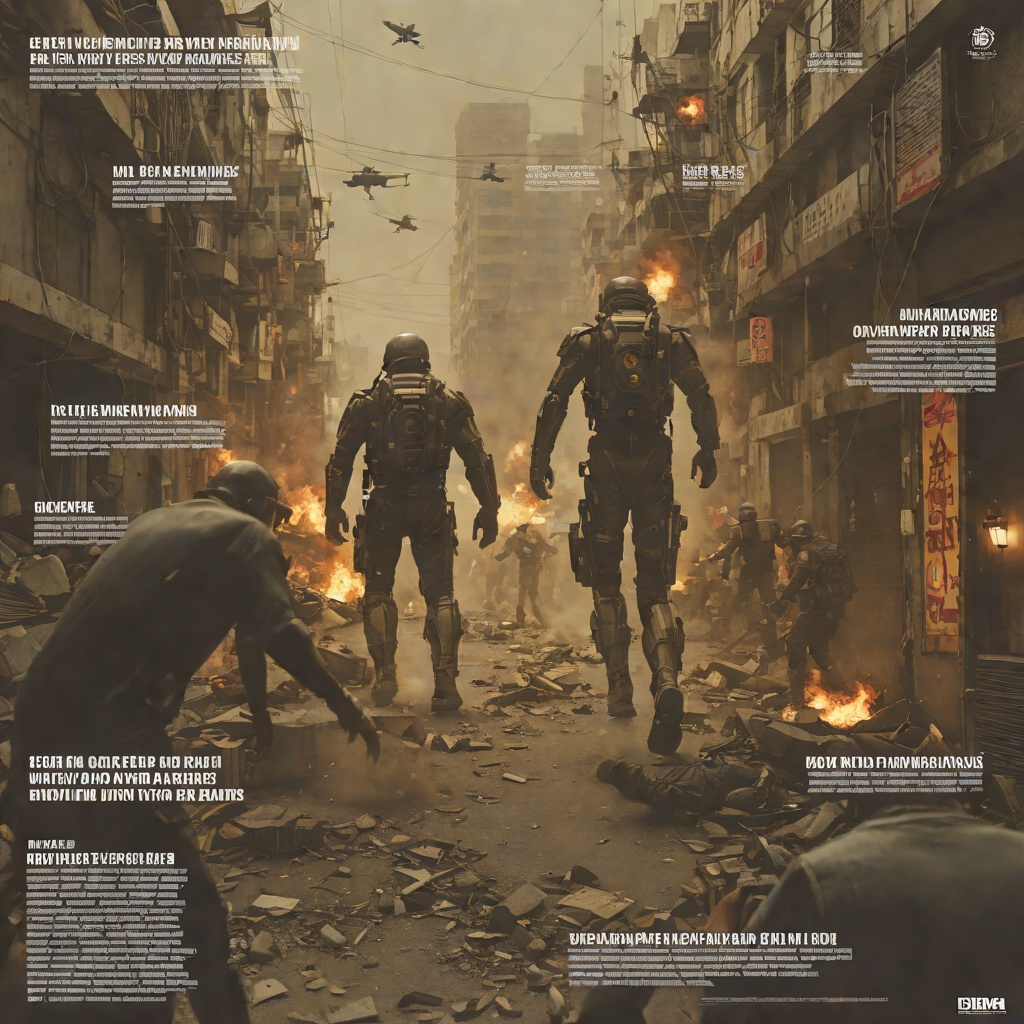
Unemployment structures the geography of New York City. Co-Op City, south of The Canal, contains four million people, “almost all of them” unemployed, while the better-served districts use New Dollars and reserve their cleaner streets, police protection, and consumer amenities for employed people. The division is visible in ordinary movement: Ben Richards walks for miles because he cannot afford a transit token, having already spent his week’s twenty-dollar unemployment allotment. The streets he crosses contain stripped cars, broken lights, garbage, rats, and abandoned infrastructure, while the skyline of the Network Games Building rises cleanly beyond the social boundary.
The currency system makes joblessness materially legible. The unemployed survive on oldbucks, whereas the dream machine of Free-Vee and the profitable world beyond The Canal run on New Dollars. Free-Vee is therefore both universal and unequal: every Development apartment must contain one, but its entertainment is offered as consolation to people excluded from the economic system that sustains it. The device fills the apartment with news, games, and compulsive spectacle while the family remains unable to pay for the medical treatment that might save Catherine Sarah Richards.
Family Consequences
For Ben Richards, unemployment becomes urgent when Catherine Sarah Richards falls ill. Sheila Richards tells him that their daughter is “Not so bad,” but the child’s flu-hoarsened wailing continues behind the shrieking television broadcast. Ben has watched the Free-Vee for weeks, abandoning his usual hatred of it because the big-money giveaways seem to offer a possible remedy. His fixed attention is not entertainment but fear translated into calculation: the program displays money precisely when his family has none.
The family’s poverty limits medical choice as sharply as it limits employment. Ben rejects the prospect of relying on a block midwife with dirty hands and whiskey breath and insists that Catherine Sarah Richards needs a real doctor and modern equipment. Sheila Richards resists the means by which he hopes to obtain it, arguing that she would rather sell herself to a government collector than accept what she regards as blood money for Ben’s disappearance or death. Their argument shows unemployment entering the most intimate relationship in the household: it turns medical care into a gamble, marital loyalty into a financial question, and parental responsibility into an accusation that neither spouse can escape.
The same deprivation appears in the family’s diet. Ben thinks of help pills and fake milk for the baby while eating the applicants’ breakfast, and wonders when the promised money will begin. The Games’ meal provides brute nutrients but no meaningful security; even food associated with employment or opportunity is bland and provisional. Unemployment thus operates through accumulated shortages rather than one dramatic deprivation, making every ordinary need—food, transport, medicine, and communication—part of the pressure toward submission.
Work, Exclusion, and Industrial Harm
Ben’s unemployment has a documented history. He quit General Atomics in 2018 after deciding that repeated shifts behind leaking old-style lead shields were reducing his chances of ever having children. When the foreman challenged him, Ben answered with open contempt for the company and ended the confrontation by physically overpowering him. General Atomics blackballed him as dangerous; in its language, he had “Shown Red.” The label converted a workplace dispute and a refusal to accept radiation risk into a durable employment stigma.
After that exclusion, Ben spent five years loading newsies and taking intermittent day labor. The work diminished and then disappeared as Free-Vee destroyed the printed word. He searched for employment, was repeatedly driven away, and accepted jobs cleaning slime from beneath piers and from sump ditches while others who claimed to be seeking work did nothing. The contrast matters: his joblessness is not presented as unwillingness to labor. He works whenever work appears, but the economic order produces fewer jobs while treating his survival as evidence against him.
A later encounter makes the humiliation of this system explicit. After a fruitless day, a wealthy drunk offers Ben ten New Dollars to expose himself for inspection. Ben knocks the man down and runs. The incident shows how unemployment subjects a worker not only to material want but also to the conversion of his body into a purchasable spectacle. His refusal preserves a fragment of dignity, but it also confirms that conventional employment and lawful income have become nearly inaccessible.
From Welfare to the Games
The state’s support does not restore meaningful freedom. Sheila Richards identifies the possibility of a small allotment for a fatherless household, yet she sees that payment as a bounty on Ben. The language of benefit conceals a coercive exchange: the family may receive money only after the state has taken the husband, and the household’s poverty is used to make that sacrifice appear voluntary.
The Games intensify the same structure. Dan Killian presents The Running Man as the largest program on Free-Vee, complete with viewer participation and the promise of one hundred New Dollars for every hour that Ben remains free. The program supplies forty-eight hundred New Dollars as running money on the assumption that he will survive forty-eight hours, while a thirty-day survival would yield one billion New Dollars. The arithmetic transforms unemployment into a contract in which the contestant’s labor is flight, concealment, and endurance, and the employer’s principal asset is the spectacle of his possible death.
The supposed consent is therefore constrained by economic necessity. Ben enters because his daughter needs treatment, not because the Games offer an ordinary opportunity among freely comparable alternatives. Dan Killian openly describes the program as a way for the Network to eliminate “embryo troublemakers,” and admits that after six years it has had no survivors. The recruitment interview exposes the legal and commercial fiction beneath the arrangement: the unemployed person is called a contestant, the hunt is called entertainment, and a fatal pursuit is presented as a chance to win.
Pollution, Health, and Slow Deprivation
Unemployment is also linked to the environmental conditions imposed on poor communities. Bradley Throckmorton explains that Boston’s pollution count reaches twenty on a good day and forty-two on a bad one, a level he compares to smoking four packs of cigarettes a day simply by breathing. The consequences are distributed unevenly: old people die, asthma appears on death certificates, and the industrial system continues operating around the clock for the benefit of powerful interests.
The poor are denied effective protection as well as clean air. General Atomics sells the only useful nose filters at prices ordinary people cannot pay; the cheapest such filter costs six thousand New Dollars. Bradley Throckmorton and his companions improvise one for Stacey from instructions in a library book and an atomic nugget taken from a hearing aid bought in a pawnshop. Their ingenuity is real, but it is also an indictment of the economy: survival technology is available in principle, yet priced beyond the reach of those most exposed to the hazard.
The illness of Cassie, who has cancer in both lungs at the age of five, makes the connection between poverty, labor, pollution, and unemployment personal. Bradley Throckmorton expects the authorities to record asthma rather than lung cancer, because an accurate diagnosis might reveal that lung cancer has risen seven hundred percent since 2015 and provoke public fear. Unemployment therefore exists within a wider system of concealed harm. The same society that removes work, withholds medical access, and prices protective equipment beyond reach also controls the language used to describe the resulting deaths.
Narrative and Political Significance
The novel’s most severe irony is that unemployment creates the audience for the Games while Free-Vee hides the conditions that make the Games attractive. Viewers watch Fun Guns with dreadful fascination because next week the participants might be them. News of war, riots, and social crisis competes with contests and giveaways, turning collective insecurity into consumable programming. The Network profits from the unemployed twice: first by excluding them from stable economic life, and then by selling their desperation back to the public as entertainment.
The condition also explains why Ben Richards’s personal decision acquires political force. His refusal to accept unsafe labor, degrading charity, and a humiliating purchase of his body is repeatedly treated as deviance. Yet the evidence surrounding him shows that the supposed troublemaker is responding to institutions that offer no dignified route to provide for his family. Unemployment has stripped away ordinary protections while preserving the appearance of individual choice.
That structure reaches its final expression when Ben Richards turns the economic spectacle against its owners. After enduring the hunt and taking control of a Lockheed TriStar, he uses the aircraft to strike the Network Games Building. The plane hits the building three quarters of the way up at slightly more than five hundred miles per hour, with more than a quarter of its fuel remaining; the resulting explosion lights the night and rains fire twenty blocks away. The ending does not solve unemployment or restore the victims of the system, but it completes the condition’s transformation of a jobless father into an enemy produced by the institutions that claimed merely to offer him work.