Voigt Airfield
The Running ManVoigt Airfield is the airport at which Ben Richards’s flight from the Games reaches its most consequential threshold. Known in conversation as Voigt Field, it first appears as a distant destination in Derry and then becomes a heavily fortified complex where police, tanks, airline personnel, passengers, reporters, and television viewers converge. The airfield’s decisive significance lies in its transformation from a route of escape into a controlled public arena: Ben Richards must pass through the state’s security system, seize the attention of the crowd, and demand an aircraft capable of carrying his rebellion beyond the immediate geography of the manhunt.
Location and Spatial Context
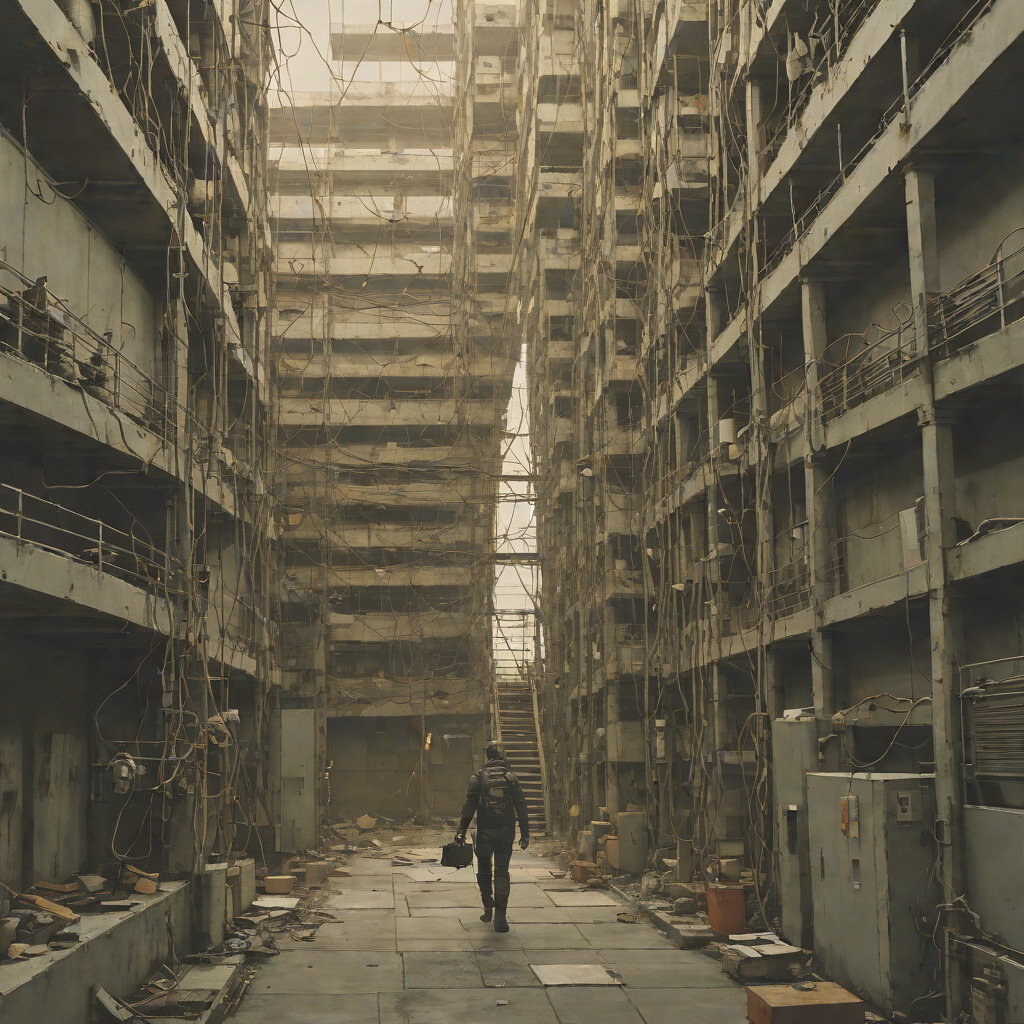
Voigt Airfield lies more than one hundred miles from Ben Richards’s position, in Derry, making it a destination that is difficult to reach even before the pursuit surrounding him is considered. The route toward it passes through a landscape of industrial waste and abandoned development. At the Super Pine Tree Mall, construction had stopped at least two years earlier, leaving miles of half-built stores, foundation holes, rusted steel, discarded pipe, cinderblock, boards, shacks, and overgrown vegetation. That unfinished commercial maze forms the airfield’s immediate spatial prelude: a failed promise of consumer development gives way to an operating transportation complex whose infrastructure is still intact and aggressively defended.
The wider journey also establishes the social geography that Voigt Airfield temporarily interrupts. South of the Canal, Co-Op City is described as a rat-filled district of deserted shops, parking lots, Urban Centers, and paved playgrounds, where cycle gangs have replaced dependable civic authority. Free-Vee cables remain protected because entertainment is treated as essential, while access to New Dollars, transportation tokens, effective nose filters, and secure employment is sharply restricted. Ben Richards crosses the Canal on foot and approaches the Games Building through a zone of increasing surveillance and police density. Voigt Airfield therefore stands at the far end of a class-divided city: movement from the neglected southern district into privileged, guarded infrastructure is itself a passage through unequal space.
Fortification and Control
When Ben Richards and Amelia Williams approach, the airfield is not an open field but a layered security system. A tank blocks the main gate, its cannon capable of firing quarter-megaton shells. An electrified cyclone fence crosses the marshy field on both sides of the access road, while an information booth and check-in point occupy a traffic island before the gate. Police vehicles line the four-lane approach, and employees and passengers have been pushed into a parking area and held back by additional police. The airport’s ordinary functions—checking in, boarding, working, and traveling—have been suspended beneath the logic of containment.
The authorities nevertheless convert the confrontation into an apparently orderly procedure. A loudspeaker directs Richards to proceed to Lot 16, where Airline Police will take him into custody. The instruction is bureaucratic in tone but coercive in substance: the state attempts to make arrest appear like routine airport traffic management. Richards answers by imposing his own terms. He tells the authorities that he will come out, but only after requiring a fully fueled jet, a skeleton crew, and a range of at least two thousand miles, with ninety minutes allowed for preparation. The fortified airport thus becomes a bargaining chamber in which the hunted man’s physical vulnerability is countered by the danger of a public spectacle and the explosive threat he claims to possess.
The Airfield as Public Stage
Voigt Airfield is saturated with spectatorship. A crowd screams and babbles along the access road; cameras reel and crank; flashbulbs pop; reporters watch uneasily; and the imagined pressure of five hundred million viewers weighs on every official decision. The airport is consequently both a transport facility and a broadcast set. Its signs, lots, gates, loudspeakers, armored vehicles, and aircraft create a visible sequence of marks through which the Network can attempt to organize the story of Richards’s capture.
That media architecture produces an unstable value shift. At first, the airport’s power appears absolute: the gate is blocked, the tank is armed, the fence is electrified, and police surround the road. Yet the same concentration of witnesses that makes the site secure also makes it politically dangerous for the authorities. Richards’s demands are heard rather than silently erased, and his confrontation with official power becomes part of the event the Network must manage. Voigt Airfield therefore exposes the contradiction of a regime that relies on public spectacle: visibility supports surveillance, but it can also give the fugitive a platform.
Aircraft and the Threshold of Escape
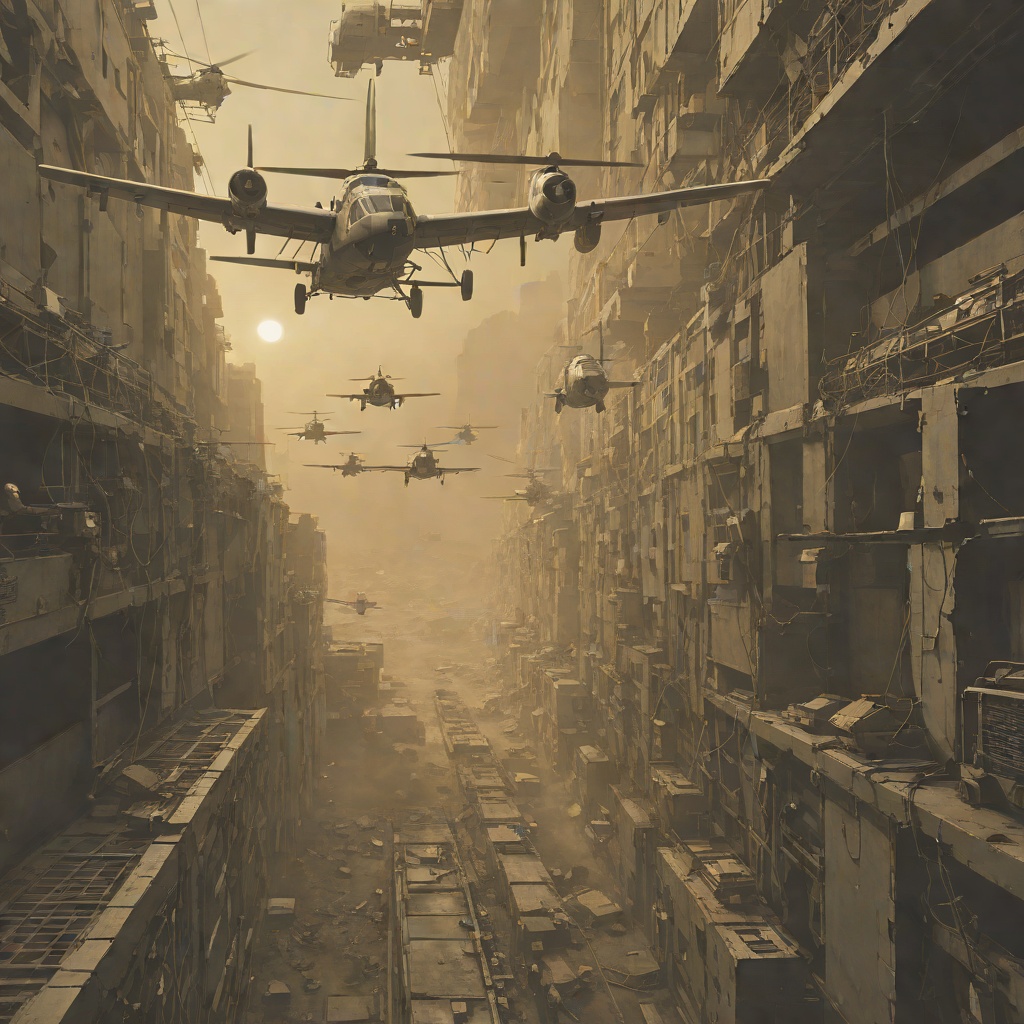
Beyond the gate lies a service area marked for employees only and prohibiting smoking and unauthorized entry. Richards drives through it past high-octane tanker trucks and small private planes until he reaches a taxiway of oil-blackened cement. The runway infrastructure extends straight toward the horizon, while the control tower rises above the terminal complex like an ominous technological structure. A white jumbo jet waits with twelve turbine engines softly grumbling, its roll-up stairway being positioned by four workers in coveralls. To Richards, the stairs resemble those leading to a scaffold, preserving the double meaning of the aircraft: it promises escape, but it is also the setting for a possible execution.
The aircraft’s technical requirements reveal the scale of Richards’s objective. He does not merely ask for transportation away from the immediate search. He demands a Lockheed/GA or Delta supersonic jet with enough fuel and range to travel at least two thousand miles. The demand turns the airport’s own industrial capacity against the authorities. Fuel, specialized aircraft, trained crew, service ramps, terminals, and runways—normally instruments of regulated mobility—become the materials of a forced escape.
Confrontation and Narrative Significance
The airfield is where institutional control and individual desperation meet without the protective distance of the television screen. The police are equipped for escalating violence, but the encounter remains suspended between arrest and negotiation. Richards drives slowly among police cars and heavy weapons, then enters the restricted service area with deliberate calm. At the aircraft, Evan McCone steps from the shadows beneath the jet’s huge belly, appearing first as a celebrity image made real and then as the executioner associated with that image. The airport’s machinery of movement therefore delivers Richards directly to the human embodiment of the Games’ violence.
In spatial terms, Voigt Airfield condenses the book’s central divisions. The streets south of the Canal represent abandonment, poverty, pollution, and informal violence; the Games Building represents centralized media power; and the airfield joins that power to the state’s police and military infrastructure. Yet the airport is not simply the final fortress. Because it is designed to move people and machines across borders, it also contains the possibility of rupture. Its gates can admit the fugitive, its loudspeakers can carry his terms, its cameras can preserve his challenge, and its aircraft can become the means by which the spectacle exceeds the authorities’ intended script. Voigt Airfield is thus both a prison of surveillance and a threshold toward freedom, with the conflict between those functions driving its narrative force.