Braunton Burrows
The Salt PathBraunton Burrows is a sprawling dune ecosystem beside the Taw estuary, where Ray and Moth’s attempt to follow the coast path brings them into contact with both a distinctive natural landscape and a military exercise that abruptly closes their way forward. The Burrows are more than a scenic stretch: their shell-rich ground, insect life and vegetation shape the physical experience of walking, while restricted access forces the pair to exchange their chosen pace and route for a ride in a soldiers’ truck and onward travel by bus.
Landscape and setting
The dunes roll towards the Taw estuary as pale, granular ground that Ray likens to shifting gravel and ground coral rather than ordinary sand. Windblown shells give the landscape its unusual texture. It seems to stretch almost without end and is described as one of the country’s largest sand dune ecosystems, its surface covered with vegetation and alive with insects. The scale and ecology are registered from the walkers’ position on the trail: this is not simply a bare expanse to cross, but a broad, changing habitat.
That sense of scale is filtered through bodily discomfort. Ray has been sunburned, and for more than a mile her attention is fixed on the skin peeling from her nose as she tries to pull it away. Beside her, Moth shuffles through the shell sand with his eyes on his feet. The view is therefore only partly available to the walkers; the ground demands attention, while pain and fatigue narrow what they can take in. The Burrows’ beauty and immensity coexist with the effort of moving through it.
The walk and its physical limits
Before reaching the dunes, Ray raises the possibility of taking a bus around the estuary and skipping Barnstaple and Bideford. The alternative is attractive in part because they could be days from receiving more money, but the Burrows seem worth seeing. Ray agrees to continue on the understanding that they can take a bus if Moth’s pain, leg trouble or tiredness becomes too much. Beneath his sunburn, dark rings are spreading under his eyes, a visible sign of strain that makes the agreement more than a casual precaution.
The decision captures the practical choices governing the pair’s movement. They are drawn to the landscape, but their progress depends on Moth’s condition and the limited money available to them. Their walk is neither an uninterrupted test of endurance nor a carefree excursion: they weigh curiosity against pain, fatigue and the cost of detours. Even before the soldiers appear, the route is conditional on what their bodies can manage and what their remaining funds allow.
Military closure and an unexpected crossing
In the dunes, Ray and Moth suddenly encounter a camouflage-clad soldier carrying a gun. He tells them that they cannot go farther that day and must turn back. Moth appears unfazed, but Ray answers that they cannot return: Moth is unwell, and they are trying to reach Braunton to catch a bus. When the soldier asks whether they saw the sign stating that the dunes were closed, Ray says they did not. Their planned crossing has run into a boundary they had not known was there.
The soldiers tell the pair to stay where they are and promise to take them out when they leave. They bring water, load their equipment into a truck and add Ray’s pack to the pile. The soldiers joke about the lightness of the walkers’ bags, then lift Moth’s pack as well. The pair are bundled into the back of the vehicle, the canvas is rolled down, and the truck bumps away. A landscape that had demanded slow, effortful walking becomes, for a time, a route controlled by the military and covered by vehicle.
Inside the hot truck, Ray sees the soldiers as young men enjoying themselves together, despite their disciplined appearance and heavy equipment. She also considers how soon any of them might be sent to a war zone, and how easily they could be injured or killed. Her response shifts the encounter beyond the inconvenience of being turned back: the soldiers’ good humour and youth sit beside the prospect of military danger. When the truck stops, they let Ray and Moth out without telling them where they are going; the vehicle disappears around a bend, and Ray hopes its passengers remain as full of life as they seemed during the ride.
Detour and narrative significance
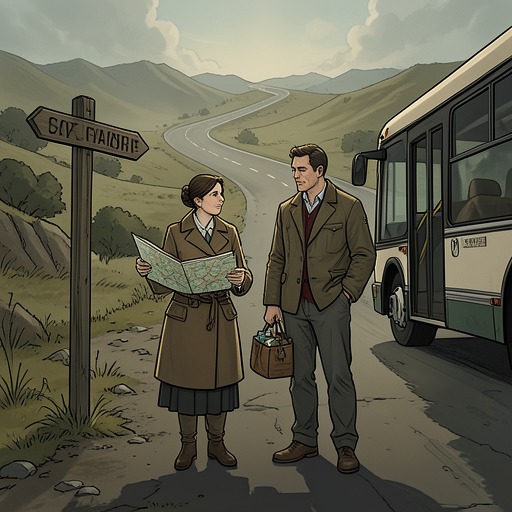
After leaving the Burrows, Ray and Moth take a bus to Barnstaple and change to another bus for Westward Ho!. Ray feels that this break in the trail amounts to cheating, although she does not understand why. The detour leaves them disconnected from the walk and slightly lost. The interruption is consequential not because it ends their journey, but because it alters its texture: the continuous route they had been trying to follow is replaced by an enforced removal and a series of bus rides.
Braunton Burrows thus brings together the freedom of walking and its limits. Ray and Moth choose to enter the dunes because they want to see them, and they negotiate the possibility of abandoning the route if Moth’s condition worsens. Yet access is also governed by a closure they did not know about, and their exit depends on the soldiers who take them away. The episode makes the coastal path something other than a line they can simply follow at will: its ecosystems invite movement, while physical vulnerability, money and restricted access determine where that movement can go.