Brixham
The Salt PathBrixham is a waypoint rather than a destination in Ray and Moth’s account of the South West Coast Path. They reach it by public transport after weighing the cost of continuing through a built-up stretch, then resume walking at Sharkham Point. The arrival marks a return to the coastal route, but also sharpens the practical choices governing their journey: how far to walk, how much to spend, and how to avoid being left without money for food or a place to sleep.
A stop shaped by limited choices
The significance of Brixham is clearest against the financial insecurity that accompanies the walk. In Taunton, Ray describes the moment the couple became truly homeless: their packs stood beside them on the roadside, and there was no door to return to. The walk gave them a reason to keep moving, but it did not make movement entirely voluntary. They had limited money, no secure home, and needed to keep finding places where they could sleep without depending indefinitely on other people’s goodwill.
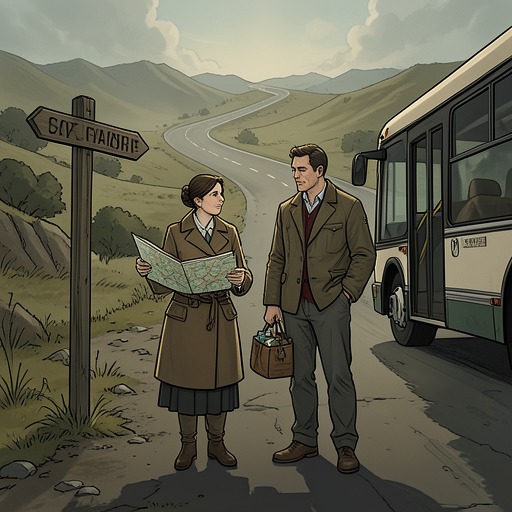
By the time they are considering Brixham, the route ahead appears especially difficult to manage on foot. Looking at the map, Moth counts roughly thirty more miles of built-up areas, railway line and seafront, with little prospect of finding somewhere to camp. He proposes spending their remaining cash on a train and then a bus to Brixham, so that they can rejoin the coast in open countryside. The alternative is not simply a slower version of the same walk: they fear that continuing could leave them sleeping in a doorway, a situation they do not need to enter.
The decision has an immediate cost. After taking the train, Ray and Moth cannot afford anything beyond ferry tickets for the coming week. Brixham therefore represents neither an easy escape from hardship nor a comfortable pause. It is a chosen change of route made under constraint, exchanging one difficult stretch of walking for a tighter budget and a new set of costs.
Arrival and return to the coast
The couple get off the bus in Brixham and wind their way back to the coast at Sharkham Point. Ray presents the moment as a return to the ordinary rhythm of their journey: their rucksacks are again full of rice and noodles, they have thirty pounds between them, and the sun has left her nose red and peeling. It is August, and people crowd this popular section of coast. The scene gives Brixham a particular narrative function: it is where a detour by public transport ends and the physical work of the coastal walk begins again.
That return does not remove the logistical pressure. The route towards Plymouth will take them through busy towns and seafronts and require at least five ferry crossings. Since the train has reduced their available money, the ferries now represent a week of unavoidable spending before they can buy anything else. A place on the map becomes a point in a tightly managed budget: reaching Brixham restores access to the path, while the journey beyond it threatens to consume the money needed to sustain the walk.
Setting a faster pace
After resuming the coastal route, Ray and Moth reconsider the pace at which they have been travelling. Moth proposes that they move faster through the section and get the remaining ferry crossings behind them, because they do not know what those crossings will cost. Once the fares are paid, they will know how much money remains for food. His suggestion turns the journey into a sequence of practical calculations rather than a test of walking purity: speed may reduce uncertainty even when it makes the day harder.
Ray questions whether she can manage the proposed long day, pointing out that Moth is the one who is ill. Moth argues that delaying the ferries would only reproduce the same uncertainty in the following week, when they might be afraid to spend money because they still would not know the total cost. He offers the possibility of resting on a beach after Plymouth once the crossings are behind them. The couple thus make a plan around both bodily limits and money, with Brixham serving as the starting point for a more urgent effort to reach a place where they can pause.
During this exchange, Ray notices that Moth seems stronger, with rising energy and a clearer mind. The change surprises her, but she does not treat it as proof that his illness has passed; she expects that his condition may become apparent again when he reaches a limit. The renewed pace therefore carries hope and apprehension together. Brixham’s role in the narrative is not to resolve the uncertainty surrounding Moth’s health, but to place the couple back on the path at a moment when they must decide how much his improved energy can be asked to bear.
What Brixham represents in the journey
The couple’s route repeatedly mixes walking with transport. Earlier, a bus takes them from Barnstaple to Westward Ho!, and later they consider whether to leave difficult sections behind rather than treat uninterrupted walking as an absolute rule. At Brixham, that flexibility becomes a direct response to the risk of having nowhere safe to camp. Their detour shows the difference between choosing a route in the abstract and choosing one with limited cash, exhaustion and shelter in view.
The location also belongs to a wider shift in what walking means to Ray. On the coast, the path provides a recurring structure: pack the tent, take the next step, and know that the following day will bring another stretch to walk. As the route approaches Plymouth, she fears the end of that structure and the unknown life beyond it. Brixham falls within the effort to preserve forward movement, but its importance is concrete rather than symbolic alone: it is the place reached after a costly change of transport, from which Ray and Moth try to put the ferries behind them and retain enough money to continue.