Chesil Beach
The Salt PathChesil Beach is a long bank of pebbles rather than a conventional sandy shore, running between the Isle of Portland and the coast beyond West Bay. In Ray and Moth’s journey, it is not merely a landmark to pass: its stones and adjoining Fleet Lagoon shape the pace and sights of their walk, while camping beside the water gives the landscape an intimate, temporary dimension. The place joins geological change to the couple’s precarious but chosen life on the path.
A barrier shaped by movement
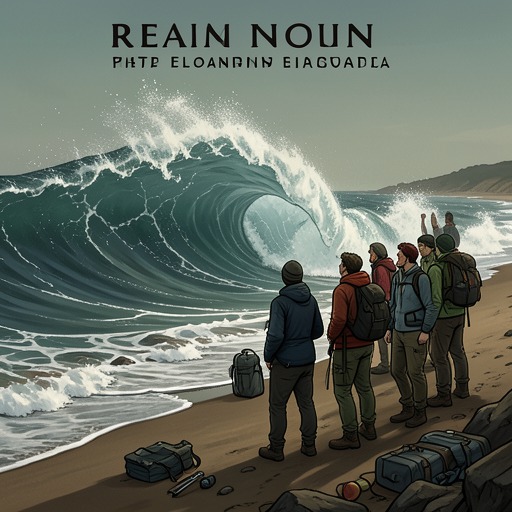
The bank rises to fifteen metres and stretches for eighteen miles. The account describes it as a barrier beach, or tombolo, believed to have formed as sea levels rose. Its pebbles have been rounded by millennia of movement under the force of the sea. Their size changes markedly along the shore: near the Isle of Portland they are about the size of a fist, while towards West Bay they are as small as grapes. The difference may indicate that the stones came from two separate pebble beds before rising water deposited them at the breaking waves.
Behind the shingle lies the Fleet Lagoon, cut off from the open sea but still subject to its ebb and flow. Its water also changes from one end to the other. Near Ferrybridge, where the sea pushes in, it is saline; at the western end, streams of fresh water reduce the salinity by half. The beach and lagoon therefore form more than adjacent features. They are a connected system in which sea, freshwater, stones and land continually meet and alter one another. The account presents their relationship as reciprocal: neither is independent of the other, and each loses and gains through their continuing exchange.
The route beside the lagoon
After John drove away, Ray and Moth considered bypassing the Isle of Portland and taking a slow few days along Chesil Beach. Moth was drained, and the decision was practical rather than ceremonial: the couple did not regard the route as a purist test that required them to walk every section. Their choice put the lagoon and pebble bank at the centre of the next stage, allowing fatigue, distance and the available path to shape how they travelled.
The walking beside the lagoon is described as easy, though the day feels dreamlike in hazy sunlight and in the lingering weakness after sickness. Small huts stand along the landward side of the shingle, with rowing boats drawn up nearby. A fence borders an arable field, its edge lined with more than fifty crows, each perched about a metre from the next. Ray and Moth hesitate rather than pass through the unusual line of birds. The account briefly recalls beliefs in Wales’s Mabinogion, where the crow can bring death or take the form of someone with magical powers, and other traditions in which it foretells change. It then sets those meanings against the possibility that the birds are simply oddly arranged. When the walkers take two more steps, the crows rise together in a black, calling cloud.
Evening and camp on the shingle
As the still evening settles, the landscape changes almost by degrees. The low sun turns the sky a gentle southern colour; the land ahead darkens to blue, and the lagoon falls silent as its water recedes. Channels of moving water remain in the muddy sand. A small boat returns to shore, its dark shape winding through the reflective shallows before disappearing as mud, stones and fading light merge. Mist lifts as the air turns silver and the night blue. Ray and Moth pitch their tents among the marsh grasses, with the calls of wading birds and the rustle of seed heads for company.
The following day they continue together and camp near West Bexington, on the beach’s shingle ridge. Mackerel fishermen are scattered along the shore. At night, their lanterns swing in the darkness, while the continually shifting pebbles make a rattle that punctuates the quiet. By first light, the fishermen have packed up and gone, leaving buckets full of fish. These details place human work within a landscape that remains in motion: the campers shelter for a night, fishermen follow their own timetable, and the stones keep moving under the sea’s force.
A temporary home on a changing coast
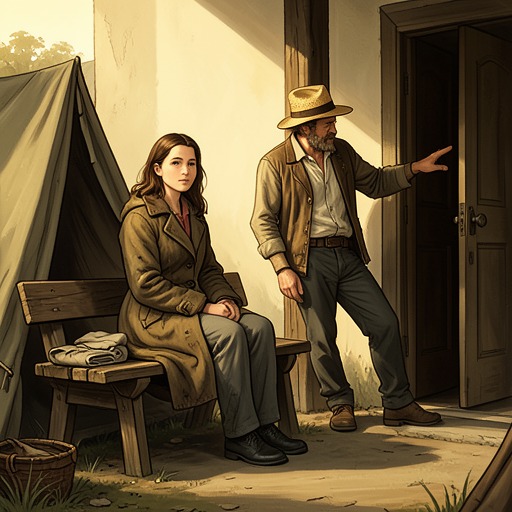
Chesil Beach’s significance in the narrative comes from the conjunction of physical exposure and chosen movement. Before reaching it, Ray and Moth have lost their home and become homeless; on the path, walking gives them a form of control over whether to continue or stop. The shingle ridge and the marsh grasses offer places to pitch a tent, not permanent shelter. Their nights beside the lagoon are therefore both vivid encounters with a particular coast and practical episodes in a life without a fixed address.
The account’s attention to changing pebble sizes, tidal channels, salinity and birds makes the landscape something encountered through movement rather than a static view. The walkers learn its distinctions as they pass along it, while fatigue and weather remain part of that knowledge. At Chesil, the idea of partnership between sea and lagoon also resonates with the couple’s own dependence on one another as they travel: the parallel is grounded not in an abstract symbol but in a description of two connected systems that change through contact. The coast offers no promise that the journey will be easy or lasting. It provides a route, a place to pause and camp, and a moment of shelter within a landscape whose defining condition is continued motion.