Colin
The Salt PathColin is a homeless man whom Ray and Moth encounter during a night in the city. He first appears as a stranger watching them from the opposite bench, then becomes their guide to the unwritten rules of finding a place to sleep and a fellow traveller whose life, like theirs, has been overturned. His brief appearances turn the book’s discussion of homelessness from a disputed category or public statistic into an encounter between people who recognize how readily a life can fall apart.
First encounter and appearance
Colin sits opposite Ray and Moth and stares at them. The narrator estimates that he is in his late forties or fifties, while noting that life on the streets seems to age people. His clothes are worn: cargo trousers, generic trainers, and a ripped fleece over a hoodie. A brand-new Carhartt baseball cap, conspicuous beside the rest of his outfit, gives Ray pause. Its significance becomes clear when Colin explains that his daughter visited that day and gave it to him for his birthday, along with the beers he is carrying.
Colin eventually crosses the paving and asks what Ray and Moth are doing there. He suspects they are hikers but senses that there is more to their situation. When Moth explains that they are homeless hikers staying only for the night, Colin takes up the description approvingly. He tells them that several other homeless people are nearby and cautions them not to crowd anyone’s sleeping spot, since people can be touchy about it. His welcome is practical rather than sentimental: he offers local knowledge, then offers them a beer despite their having no money.
Family and loss
The cap and beer open onto a larger loss. When Ray asks whether Colin has family he does not live with, Colin says that he once had a wife, children, and a house, but that everything fell apart and he is now an embarrassment to them. The book gives no further account of what happened to his family or home. The restraint leaves his brief answer stark: the life he describes is not an abstract past but a contrast with his present place on the pavement.
Colin’s story echoes the circumstances around Ray and Moth without making their experiences identical. They, too, have lost their home and are trying to find somewhere to sleep; Moth does not appear threatened by Colin, while Ray admits to feeling some fear at being approached. Their conversation instead settles into recognition. The narrator reflects that Colin does not need to explain how easily a life can fall apart. In a book that challenges the familiar image of homelessness as only a person bedding down in a doorway, Colin is presented as someone with a family history, birthday gifts, and a past that once included a house.
A later meeting
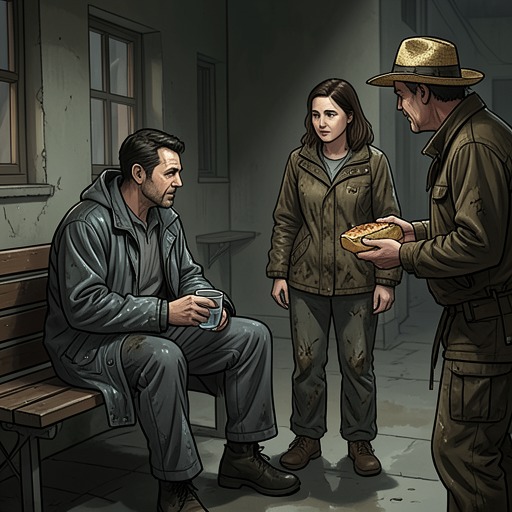
Ray and Moth encounter Colin again as they are leaving to catch a ferry. Ray calls to him; Colin stops and says he had stayed away from that end of the street the previous night to get out of Dean’s way, describing Dean as agitated. Ray notices that Colin looks unwell and offers him a sandwich. Colin is surprised by the gesture, then discovers that it is sausage, his favourite. The exchange reverses the earlier offer of a beer: Colin had welcomed the two newcomers when they had nothing to give, and now Ray gives him food as they part.
The scene ends with Ray and Moth leaving to catch the ferry and telling Colin to take care. Colin is not given a resolved future or a fuller account of how he became homeless. Instead, the episodes establish the terms of his presence in the narrative: he can offer hospitality and advice, speak plainly about the life he has lost, and receive a small kindness in return. His encounters make homelessness visible through specific relations and gestures rather than through a single stereotype.