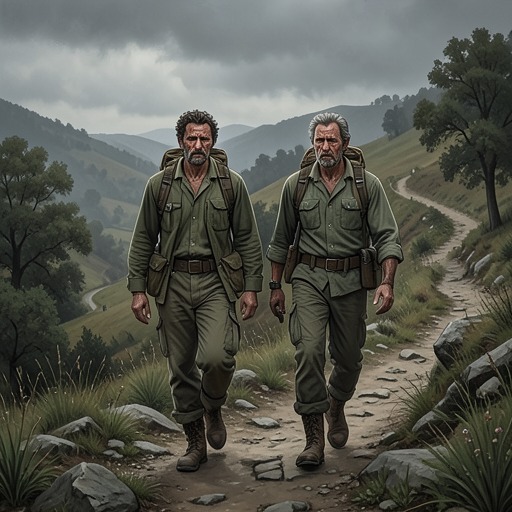
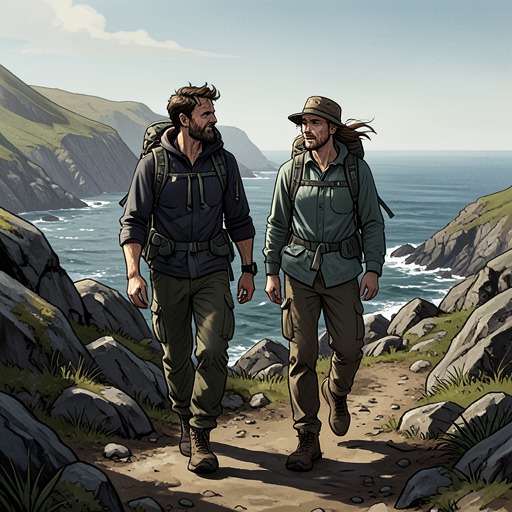
Continuing along the coast path beyond Land’s End
The Salt PathRay and Moth’s continuation along the South West Coast Path beyond Land's End turns a journey begun in homelessness into a way of making decisions, enduring illness and weather, and finding a provisional sense of home in movement. The coast path offers purpose and a measure of control, but it cannot resolve the losses that set them walking or answer what will happen when they have to stop.
From homelessness to a route
In early August, after leaving a temporary stay in Taunton, Ray and Moth stand with their rucksacks beside them and recognize that they are homeless in a way they have never been before. Travel and life in a van had still allowed for the idea of a door to return to; now, Ray feels that there is no door. The place where they stand, exposed and uncertain, seems safer than the prospect of moving on. Yet moving is precisely what they have come to do: a bus to Minehead costs ten pounds each, and their remaining fifty pounds must stretch alongside a small weekly income. The walk is not a leisurely escape from settled life but a response to having no secure home to return to.
At the monument marking the start of the path, they delay among the crowds, taking photographs and adjusting their packs before setting out at half past three on a Thursday afternoon. They are excited and afraid, and Ray names the condition plainly: they are homeless, exhausted by their circumstances, but the first step gives them somewhere to go. The walk’s 630-mile scale is at once daunting and practical: it supplies a purpose and a next direction when their wider future has none.
The path immediately contests the abstractions of a guidebook. Above Minehead, an excruciatingly steep zigzag through the woods makes Paddy Dillon’s description of the route as drifting inland and uphill seem absurdly mild. They stop on a bench, catch their breath, and reread the directions. The mismatch between the printed route and the actual climb establishes a pattern: the journey is learned through aching bodies and difficult terrain, not simply followed on a page.
The body, the weather, and the story of the walk
As they continue, physical exertion becomes part of how Ray reads the landscape. On a steep ascent, pain in the legs, hips, and shoulders gives way to the exposed height above the sea. Heat bounces off the rock, the wind lifts beneath Ray’s rucksack, and the view toward Wales seems to recede. Moth walks leaning away from the sea, while Ray describes feeling carried by the height, heather, salt air, and gulls. The path makes freedom palpable, but that feeling is inseparable from fatigue and exposure.
The account of walking also changes in response to other people. When strangers ask why the couple can walk for so long, the truthful answer—that they lost their home and are following the path—often ends the conversation. Ray and Moth begin saying instead that they sold their home to pursue a midlife adventure. The alteration is only one word, but it transforms how others receive them: homelessness following a sale can be treated as inspirational, while homelessness following loss invites recoil. Repeating the more acceptable story dulls their grief, Ray observes, even as the walk becomes less a space for making plans than a meditation in which each step, climb, and survived day gives the next one meaning. That account is not merely a cover for strangers; its repetition may also help them endure what has happened.
Their movement is not uninterrupted. A bus carries them to Barnstaple and then on to Westward Ho!, a break in the trail that leaves them feeling disconnected and slightly lost. Ray feels as though the ride is cheating, while the town’s grey appearance disappoints the expectation raised by its emphatic name. In a dismal bar overlooking the sea wall, Moth drinks beer in silence as Ray presses a glass of iced water to their head. The interruption reveals how walking has become more than transport: when the route is broken, even briefly, their sense of connection falters.
Land's End and the decision to continue
At Land's End, the apparent culmination of the walk is deliberately unspectacular. The tourist development is deserted in the rain; the photographer has locked up, the shops and exhibition centre are closed, and Ray and Moth jump the barriers to take photographs on a phone beside the signpost. They stand alone, wet and clinging to a post, with no welcome or celebration. After more than 250 miles of pain, exhaustion, hunger, wild nights, and wild weather, they could board a bus and return to the familiarity of Wales, seek a council-house waiting list, and find a cheap campsite for winter.
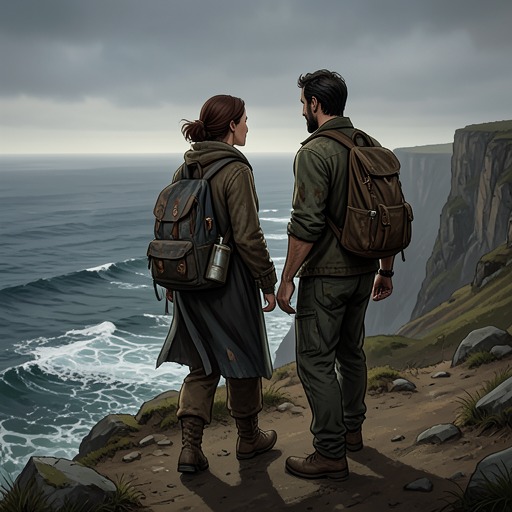
Moth holds Ray’s hand as the bus doors close. They do not board. From the shelter of the visitor-centre archway, they watch it pull away, then choose to put their packs back on. Ray describes their freedom not as comfort— they remain hungry, tired, cold, and battered by the elements—but as the ability to decide whether to walk or stop without turning friends’ hospitality into a burden or wearing friendship down into mere tolerance. That choice leads them back into the exposed landscape. Near the Armed Knight Rock Arch, they face enormous plumes of sea driven through the offshore opening, then camp among rocks with little food and only a tent between them and the weather. The physical hardship makes their decision tangible: continuing is neither a triumphant finish nor proof that their problems have vanished, but an exercise of agency under stark limits.
Turning north, and facing the end of walking
At the mainland’s southernmost point, the direction of the journey changes: from there, any further progress is northward. Ray reflects that the old home and its familiar routines are gone, and that the country ahead can feel like an empty space. Against that uncertainty, the narrow track offers a dependable action—put one foot in front of another—and has become a kind of home. The change is not a recovery of property or a return to the life they knew. Ray describes instead a growing acceptance, shaped by sun and storms, of being part of the elements without needing to own land in order to belong. Moth stands stiffly as Ray holds his pack for him, and together they turn north.
On a later stretch of the path, the return to open coast brings relief after months of inland confinement. At Old Harry Rocks, the route opens along the Jurassic Coast; Ray recognizes again the sun, wind, salt, and familiar pull of the trail. They camp on Ballard Down above Swanage. Moth, having taken four painkillers, asks whether they have done the right thing while Ray rubs his shoulders with a pain-relief gel that does not work. Ray’s answer is practical as well as hopeful: they intend to pay for a room with money they have earned, Moth plans to retrain, and Ray expects to find work or retrain too. The aspiration is not simply to keep moving, but to use the journey as a bridge toward housing and a different livelihood.
That bridge remains uncertain as they approach Plymouth. Rain and silence accompany the thought that only a few days separate them from the end of the trail, and the path’s familiar sequence—packing the tent and walking again—has become a source of security. Ray fears not only the practical work of starting over but what may happen to Moth once walking stops. Later, standing on the road between the Isle of Portland and the mainland, they are tired enough to consider missing Portland and taking a slow few days along Chesil Beach; Moth readily agrees that they are not pursuing a purist mission. Near Plymouth, a plan goes wrong and panic rises; their joking suggestion of a tour of the city does not remove the worry that they may have to sleep there. The walk has given them choices and a rhythm they can trust, but its approach to an ending makes clear that forward motion cannot indefinitely stand in for a home or a future.