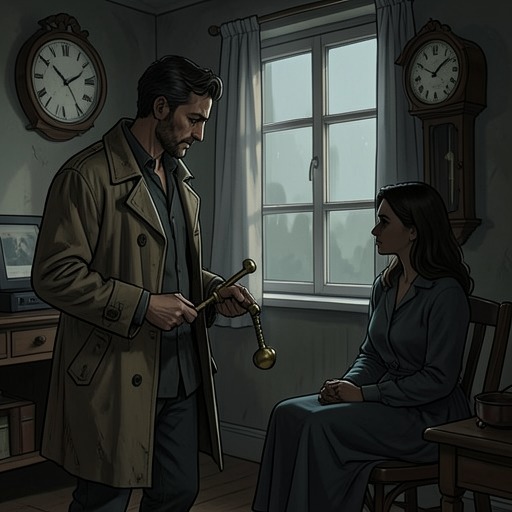
Cooper case ruling and repossession of the Welsh farm
The Salt PathThe Cooper case ruling and repossession of the Welsh farm turns a years-long financial dispute into the loss of Ray and Moth’s home, livelihood, and place in their community. Its decisive blow is procedural: after three years of trying to prove they were not liable for debts from a failed investment, they arrive in court with evidence they believe settles the matter, only to have it excluded because they did not submit it through the required process. The judgment makes a private betrayal into an immediate eviction, with seven days to leave the farm they had rebuilt around their family life.
Origins of the dispute
Moth and Cooper had been close friends since childhood. They had grown up together, ridden tricycles, played football, and remained in contact as their adult lives diverged. Cooper moved into financial circles unfamiliar to Ray and Moth, but Moth continued to trust him. When an opportunity arose to invest in one of Cooper’s companies, they put in a substantial sum. The company later failed, leaving debts unpaid.
The claim against them arose from the structure of that investment. Cooper maintained that Ray and Moth were liable for part of the company’s debts; they believed the agreement’s wording did not make them responsible. At first they ignored the suggestion that they owed money. As Cooper pressed the claim, Moth was hurt more by the collapse of the friendship than by the financial demand, and he continued to hope they could settle the disagreement between themselves. That hope ended when a court summons demanding payment arrived.
Three years of litigation
The dispute consumed the couple’s savings in solicitors’ fees. Once their money ran out, they represented themselves, among thousands of people left without legal aid by reforms that classified their case as too complex to qualify. The book connects this predicament to a policy that saved an estimated £350 million a year while leaving people like them without free representation. Without a barrister, they struggled to keep pace with the opposing side and repeatedly sought time while contacting lawyers and accountants for written proof of their interpretation of the agreement.
The legal pressure reached beyond the debt itself. A charge was registered against the farm as security for Cooper’s claim, followed by a claim for possession of the house and land. For Ray, the threatened loss was not an abstract property dispute: it meant the stones the couple had carefully placed, the tree where their children had played, blue tits nesting in a hole in the wall, and bats living beside the chimney. The farm had been their home, business, and sanctuary; its holiday-rental income was also their livelihood.
After three years and ten court appearances, they found a document they believed proved Cooper had no right to claim the money. They sent copies to the judge and the claimant’s barrister and came to court expecting it to save the farm. Ray wore the leather jacket her children had bought for her fiftieth birthday and felt confident. Moth, by contrast, stared ahead. The strain had thinned his hair and left his skin ashen; pain in his shoulder and arm further depleted his strength. The judgment would land on a couple already worn down by the case and by the physical changes Ray hoped would improve once ordinary life resumed.
The ruling
The judge asked whether the document was new evidence. Ray explained that they had received it only four days earlier. The judge refused it: “New evidence cannot be proffered at this late stage. I cannot accept it.” Ray protested that the document proved their position and that they owed the claimant nothing, but the judge said the correct judicial procedure had not been followed and proceeded to judgment.
Possession was awarded to Cooper. Ray and Moth were ordered to leave the property within seven days, by nine in the morning on the specified day. The judge dismissed Cooper’s claim for costs after Ray said they had no money left and were already losing their home, business, and income. That limited concession did not alter the central result. Ray asked for permission to appeal; the judge denied it, reasoning that the case had gone on too long and that they had had ample opportunities to provide evidence.
The document’s significance makes the procedural failure especially devastating. Ray had believed that finding proof would reverse the course of the case; instead, not having made the necessary request to submit further evidence meant the proof could not be considered. She understood the mistake as basic, but had not known the requirement. The loss therefore came not from a finding in this passage that the document was false, but from its exclusion and the judgment that followed. The couple left the courtroom stiff and silent. Moth went into a side room and offered the barrister his hand, telling him he understood that the barrister was doing his job while insisting the decision was wrong.
Eviction and homelessness
The couple had to close the farm and put their few belongings in a friend’s barn while trying to work out what came next. Their children were students in shared accommodation and had little money to help. Moth’s brother could house them temporarily, but only until he returned from holiday with his family; the brother’s home was just twenty miles from the farm, yet they could not go back. The upheaval coincided with the couple trying to absorb a doctor’s diagnosis and the prospect that Moth’s health might decline. Ray feared that taking a job would cost them precious time together while he was still in relatively good health.
Finding somewhere permanent was not a straightforward alternative. Their credit rating had collapsed with the repossession, making it nearly impossible to rent. A campsite quoted them £80 a week, more than they could afford, and housing benefit did not cover campsite fees. The council could place them on a waiting list, but they were low priority; the immediate option was a bed-and-breakfast room in accommodation used mainly by people with drug and alcohol problems. A council worker questioned whether Moth was ill enough to qualify as a priority because he was not expected to die within the year. The couple concluded they would rather live in a tent than accept that option.
Later help offered shelter but did not restore the security of the farm. Friends and acquaintances invited them to camp, sometimes providing food as well as a place to stay. On Polly’s farm, they could live in a disused meat-processing shed without paying rent in exchange for helping with the building and farm work. Much later, Anna offered them the chance to rent her flat in Polruan, where the coastal path passed the front door. These different arrangements show the importance of personal generosity while also marking the precariousness of a life dependent on temporary places and other people’s willingness to make room.
Homelessness in the wider frame
The memoir places the couple’s sudden displacement against the distance between homelessness as lived and homelessness as publicly imagined. It challenges the common picture of a rough sleeper alone in a doorway and notes that 280,000 UK households had claimed to be homeless or at risk of homelessness in 2013, while officials accepted 52,000 as statutorily homeless. The figures counted households, not individuals, and different counting methods produced sharply different estimates of rough sleeping: for London in 2013, one measure recorded 6,508 people and the government’s one-night snapshot recorded 543. Those outside official lists—including people staying with others or sleeping in less visible places—were harder to count.
The account also traces the history of laws used to police people without homes or visible means of support, from earlier anti-begging measures to the Vagrancy Act 1824, which remains partly in force. The later Anti-social Behaviour, Crime and Policing Act 2014 enabled Public Space Protection Orders that councils could use against activities associated with homelessness, including rough sleeping and begging. The book challenges the assumption that homelessness is simply the result of addiction or mental illness, observing that such problems can follow homelessness as well as precede it. Against those categories and statistics, the court’s order is the hinge between losing a particular home and becoming one of the people the public and authorities may overlook or move on. By the summer of 2013, Ray and Moth were among them.