Cornwall
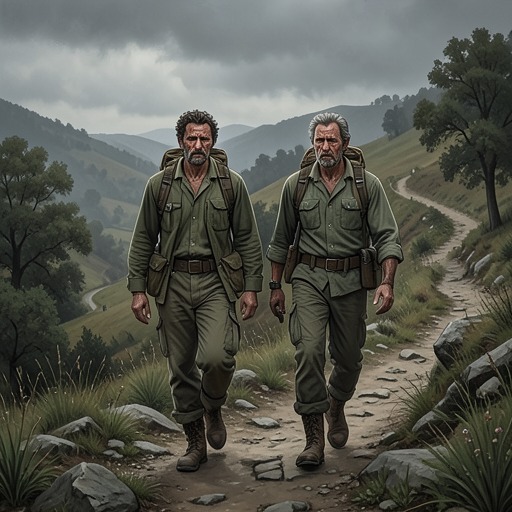
The Salt PathCornwall enters Ray and Moth’s story as a county crossed on foot, but becomes more than a segment of their route: its weather, cliffs, working histories and wildlife shape how they understand both the land and their own displacement. The journey carries them from an exhausting climb above Minehead to the mining country of the far west and the southern tip of the peninsula. Along the way, the coastline is at once a place to endure, a landscape to examine, and a form of home that possession cannot take away.
Entering Cornwall on foot
The transition into Cornwall comes unexpectedly during an evening’s slow progress. After descending into a shaded combe and crossing a wooden footbridge, Ray and Moth see a sign welcoming them to Kernow, the local name for Cornwall. North Devon has passed beneath their feet; a new county extends westward towards the horizon. The moment is less a formal arrival than a change registered through walking, with the boundary appearing in the middle of a tiring day rather than as a planned destination.
The physical scale of the route is set early by the guidebook’s understated description of the path above Minehead. Halfway up an exceptionally steep zigzag through the woods, Ray and Moth stop on a bench, catch a glimpse of the sea through the branches and reread the route instructions. Their exchange about whether this counts as drifting uphill makes the gap between a mapped description and the body’s experience of the ground an immediate feature of the journey. Cornwall will be encountered through that same bodily measure: effort, pace, weather and the next rise or descent.
Cliffs, weather and the walking body
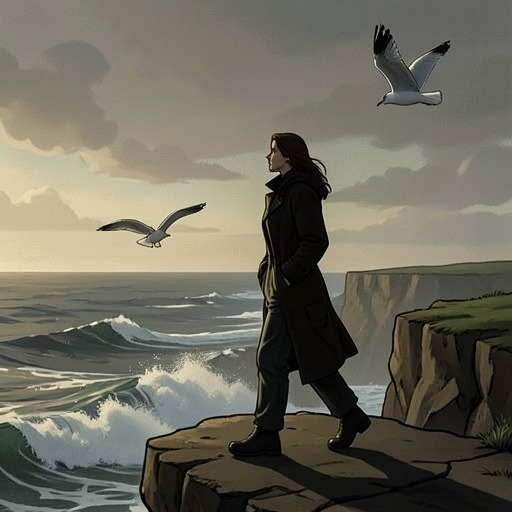
Cornwall’s coast offers physical strain alongside sudden release. After climbing across a valley, Ray and Moth reach a hot rock path above the sea. Their legs, hips and shoulders ache, and heat reflected from the rock burns their faces. Yet the height and wind produce a contrary sensation of freedom for Ray: with her arms outstretched, she feels able to fly, while the distant coast of Wales seems farther away. Moth walks leaning away from the sea and towards the cliff; Ray responds instead to the heather and salt air. The same exposed place therefore registers differently in their bodies, combining exhilaration with the danger and discomfort of the route.
The landscape also provides necessities that make the walk possible. After crossing from Devon into Cornwall, the pair pitch their tent beside running water when a steep climb at the end of the day proves too much. Ray follows the stream to a waterfall and washes there, having gone eleven days without clean water. Dust, salt and the accumulated grime of the trail come off as she stands beneath the falling water. The scene makes the coast’s beauty inseparable from the practical conditions of life outdoors: water is a resource, a means of washing, and a brief reprieve for bodies worn down by walking.
The wider weather can be both shelter and force. In a storm, wind races in from the west and drives clouds eastward over Devon. Ray stands outside the tent and experiences the wildness not as something to fear, but as a cycle in which she can feel herself included. Her memories of farm work—penning sheep, trimming hooves and preparing the land for winter—make the season especially present. Having been cut off from that agricultural rhythm, she feels unrooted, yet the storm gives her a renewed sense of connection. Cornwall’s exposure does not restore the farm or the home they lost; it helps her recognize that her bond with the living world has survived their loss.
A landscape carrying human histories
The western peninsula bears visible traces of work and extraction. Geevor Tin Mine operated until 1991, when the pumps were switched off and its shafts flooded to sea level. Ray notes that former miners dispersed, including to Australia, while others found work on the Channel Tunnel. The closure marks the end of an industry that had lasted for centuries, but not the end of the site’s public life: Geevor later became part of the Cornish Mining World Heritage Site. Its purpose has shifted from producing ore to attracting visitors, a change Ray describes with a dry contrast between mining metal and mining visitors’ pockets.
On the day Ray and Moth pass, the mine is closed and deserted, though the site remains in good repair. Beyond it, ruined engine houses and broken chimneys make the surrounding country appear devastated by the long struggle between people and rock. The contrast between preserved heritage and visible industrial damage resists a simple picture of the past as either prosperity or picturesque ruin. Mining has ended, but its marks remain in the landscape and its history continues to be presented to visitors.
At Bedruthan Steps, another argument over the coast becomes visible. The sea and small offshore rocks lead towards the famous rock stacks, associated with the legend of the giant Bedruthan. Ray reflects on uncertainty about the legend’s origins and on the National Trust’s ownership of much of the Devon and Cornwall coastline. The Trust’s Project Neptune sought to protect the coast from development, while local people, in the comments Ray has heard, object to restrictions that they feel overlook the need to earn a living. Ray recognizes that making a living from the land is difficult and believes the coast should be protected from the kind of development she has seen at Mother Ivey’s Bay. But the packed car park, paved paths and tills at Bedruthan make her aware of a contradiction: protection and tourism are not outside the economic pressures shaping the place.
Protected nature and changing pace
On the Lizard peninsula, the Lizard National Nature Reserve protects a large area of land. Ray and Moth walk across level clifftop through rare Cornish heath, and the plants delight Moth. Their pace is strikingly unlike the competitive measures used by other walkers on the South West Coast Path, who discuss distances, records and targets. The couple may cover only three miles in a day, spending an hour examining an Autumn Lady’s-tresses orchid, an afternoon trying to photograph a butterfly and an evening watching seals at Kynance Cove. The route’s progress is measured not only in distance but in the attention the landscape invites.
That attention puts fragile or seasonal life alongside the pressures of visitors and weather. Before reaching Kynance Cove, Ray watches choughs moving between the cliffs and Bellows islet, skylarks rising and descending, and kittiwakes on the ledges. She wonders whether the unusually warm weather has confused the birds whose season seems to be ending. At Kynance, the rocks change from the grey, blocky granite encountered elsewhere to serpentine in dark green and red; turquoise water and white sand make the cove appear calm. By mid-morning, however, people stream down the paths and gullies, filling the spaces by the rocks and the tideline. The cove’s beauty is also a destination claimed by crowds, and the human tide changes the experience of the place within hours.
From lost home to chosen belonging
Cornwall’s significance is inseparable from the circumstances in which Ray and Moth walk it. In Taunton, after leaving a temporary stay, Ray realizes that they are truly homeless: unlike travel with a place to return to, this has no door at the end of it. They have fifty pounds left and take a bus to Minehead to begin a 630-mile walk that gives their immediate future a direction. Later, being driven by bus to Barnstaple and then on to Westward Ho! leaves them feeling that they have cheated and become disconnected from the trail. Their movement is therefore never simply freedom to travel; it is also shaped by having lost a stable home and by the limited money available to them.
By the time they reach the far west, the distance already covered represents pain, exhaustion, hunger and nights spent outdoors. At Land’s End they could take a bus back towards the familiarity of Wales, but instead choose to continue walking. In the rain, sitting beneath the visitor-centre archway, they understand the choice as a form of control: they can decide to walk on or stop, rather than risk wearing away the goodwill of friends or family on whom they might otherwise depend. Soon beyond the visitor attraction, they are again on exposed cliffs, with little food, a damp tent ahead and the Atlantic breaking against the granite. The contrast between the commercial site and the returning wilderness accompanies a decision made under material constraint, not a claim that hardship has disappeared.
At the southernmost point, Ray’s relationship to home has changed. She knows they will not return to the old house, with its slate floor, cats, garden and familiar view of the Plough above the mountains. The country once known to her now feels like an empty space, while the narrow path beneath her feet has become home through repeated use. She describes a new acceptance: she no longer needs to own a patch of land in order to belong to the earth, sky, water and wind. Moth stands stiffly while Ray holds his pack for him, and together they turn north. Cornwall is thus not a substitute house or a simple cure for homelessness; it is the landscape through which Ray begins to separate belonging from property, and to find a steadier self in the act of moving through the world.