Culbone Church
The Salt PathCulbone Church is an ancient church in a secluded valley on the South West Coast Path, described as the smallest church in England and once the site of a leper colony. In Ray and Moth’s account, it becomes a pause within a punishing walk: a place where physical exhaustion gives way, briefly, to human spirituality, and where an encounter on the path offers a prophecy that will accompany their journey. Its significance lies not in a planned pilgrimage or a formal religious experience, but in the way landscape, fatigue, and an unexpected meeting alter the meaning of a day on foot.
Setting and Approach
The church comes into view after Ray and Moth climb away from Porlock Weir and into the woods. By the late afternoon of their second day, the pace has already become difficult. Moth struggles with every step; Ray feels leaden and achy. Their fatigue might come from poor fitness, emotional exhaustion, Moth’s corticobasal degeneration, or simply the chips they have eaten. The route is taking longer than their guidebook suggests: what was expected by the end of the first day has not yet been reached.
The path broadens into a clearing, where a tall, gaunt man stands apparently practising yoga, facing a wooded valley. He repeatedly bends, reaches towards the valley, and draws something invisible back through his body. Ray and Moth wait rather than interrupt. When they eventually pass him, he remains absorbed in his movements and seems not to notice them. The trail then leads down into the valley and to Culbone Church. The transition from wooded path to churchyard gives the stop a distinct stillness after the exertion and uncertainty of the walk.
The Churchyard and the Encounter
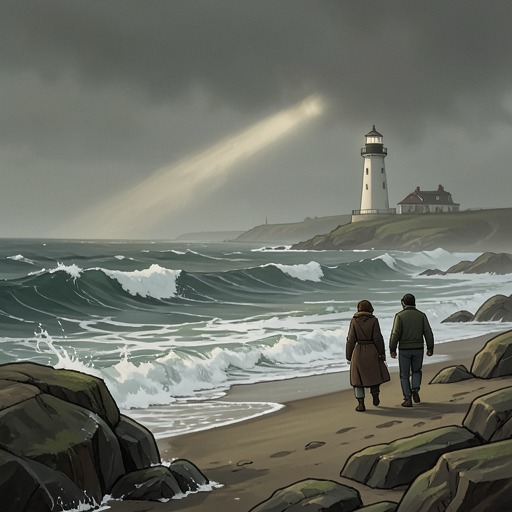
Ray sits in the graveyard and lets the peacefulness of the place settle over her. The response is spiritual, but not religious: she describes it as something deeply human, and feels that a knot she has been carrying begins to loosen. The church’s ancient setting and its past as the site of a leper colony are part of its history, but the scene does not turn that history into an explanation for what Ray feels. Instead, the churchyard matters through the immediate contrast it offers to aching bodies and the strain of continuing along the path.
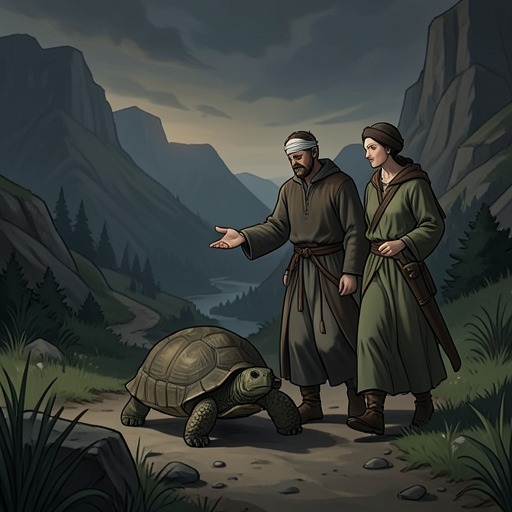
When the man comes slowly and precisely down the hill, Ray and Moth wonder whether they should leave. He stops without looking at them. Ray tells him they have visited the church and found it peaceful; he answers that they passed him on the path. They had assumed he had not seen them because he had seemed unaware of their presence. He clarifies, “I didn’t see you; I don’t see anything. I heard you.” His blindness changes the meaning of the earlier encounter: what had looked like absorption in a private practice was also an encounter shaped by listening and by the limits of what the walkers had noticed.
A Prophecy on the Path
The conversation turns from the church to the journey. When Ray says they are walking the path, the man tells them they will travel many miles and see many things. He also predicts setbacks and problems they will think they cannot overcome. Reaching forward, he puts his hand on Moth and says, “But you will overcome them, you’ll survive, and it will make you strong.” Ray and Moth exchange a wide-eyed look, unsure how to respond. The prediction is not offered as an explanation of Moth’s illness or as a practical plan; it is an unexpected assurance spoken during a chance meeting on the route.
The final prediction is stranger and more memorable: “And you’ll walk with a tortoise.” Ray and Moth carry the words away with them, and the following exchange makes their uncertainty explicit: they remark that tortoises do not often run wild in the south-west. The prophecy links the church encounter to the continuing journey without resolving its meaning at the time. Its force comes from the combination of a concrete prediction, the blind man’s assurance that the walkers will endure, and their inability to know what the tortoise might signify.
Place in the Journey
Culbone Church is one small stop within a much longer walk, but its scene brings together several recurring pressures of that journey. The guidebook offers an abstract account of distance and progress; the walkers’ experience is measured instead in painful steps, fatigue, and the effort required to reach the next place. At Culbone, the route’s wooded terrain, the quiet churchyard, and the man’s words all become part of what the walk teaches them. The landscape is not simply scenery along a predetermined course: it provides the conditions for an encounter that changes what the walkers carry forward.
Ray’s brief sense of release at the churchyard also anticipates the way she later understands walking as a practice of surviving one day at a time. She describes the walk as a meditation in which each step has its own force, each climbed valley a victory, and each day endured a reason to continue. Later, after losing the home they had expected to return to, she comes to find a different kind of belonging in the elements and in the path itself. These later reflections do not make Culbone Church the cause of that change. Rather, the churchyard scene is an early, specific moment in which the surroundings briefly loosen her distress and make room for another way of experiencing the journey. The blind man’s words add a second kind of meaning: not certainty about what lies ahead, but a promise of endurance made at a point when every step already feels difficult.