Duckpool
The Salt PathDuckpool is the destination Ray and Moth choose when heat and thirst overtake the other demands of walking, but the map’s hopeful blue line proves no guarantee of water. At the end of a punishing descent, they find a dry stream and locked toilets. The place becomes a test of how little a route guide can promise on the ground—and how suddenly a stranger’s welcome can alter what the landscape offers.
A destination chosen for water
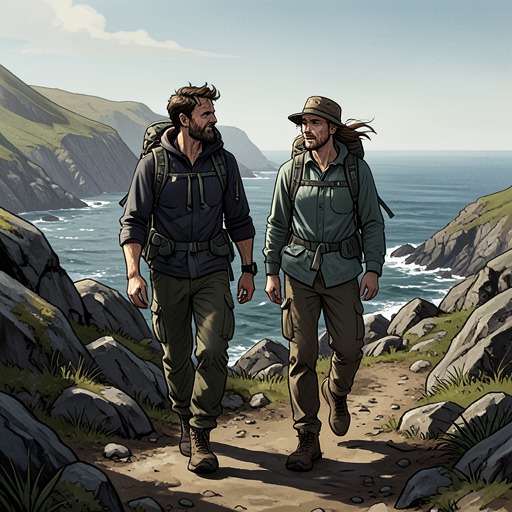
The approach to Duckpool comes during a stretch in which heat has made the walkers’ ordinary discomforts recede behind one urgent need. Their joints hurt, their feet are battered and blistered, and their skin is sunburnt, cut, and bruised; now, Ray records, nothing else matters but finding water. Moth drops his pack and insists they must reach Duckpool. Ray questions the detour, but Moth has read the map: its blue line looks larger, so the water may not have dried up. If it has, he reasons, houses lie half a mile inland, where they might ask for water. The guidebook offers another practical inducement: toilets.
That calculation gives Duckpool a particular importance before they reach it. It is not chosen as a scenic pause or as a destination for its own sake, but as a possible answer to bodily need. The walkers are reasoning from small signs—a thicker mark on a map, homes inland, facilities mentioned in a guide—because their choices have narrowed to whatever might relieve thirst. Ray resents having to concede that Moth has read the map better, but the urgency of the walk gives his judgment weight.
The descent and the failed promise
Before reaching the hoped-for supplies, the walkers encounter the steep coastal terrain around Steeple Point. The path follows the exposed edge and then seems to disappear; from the point, the route drops down a hillside so steep that the track below appears almost vertical. They inch along, gripping handfuls of grass as loose stones roll beneath their feet. Each step demands care, and the descent leaves their thighs trembling and their knees and toes aching. The journey to Duckpool is thus not a simple walk to a convenient water source: it requires negotiating a hazardous slope while already weakened by heat and thirst.
At the bottom, the expectations that brought them there fail together. The toilet block is locked, and the stream has dried up. Ray’s response is a blunt self-reproach, and the pair drop their packs onto the dusty ground. Duckpool’s blue line had stood for the possibility of water; here, the actual stream offers none. The detail is small but decisive: a mapped feature and a listed facility cannot substitute for what is available at the moment of need. The stop exposes the gap between the route as represented and the route as lived, where heat, distance, and a closed door decide what a place means.
An offer beside the dry stream
A gravelly voice then offers what sounds at first like another frustration: there is no water, but an ice cream may be available. Moth, exhausted, answers skeptically and asks where the ice creams are. The exchange catches the walkers at their lowest point in the scene: they have reached the place selected for water and found none, and even the unexpected offer is hard to trust. It does not solve their immediate need in the way the map had promised, but it opens a conversation rather than leaving them alone with the failed search.
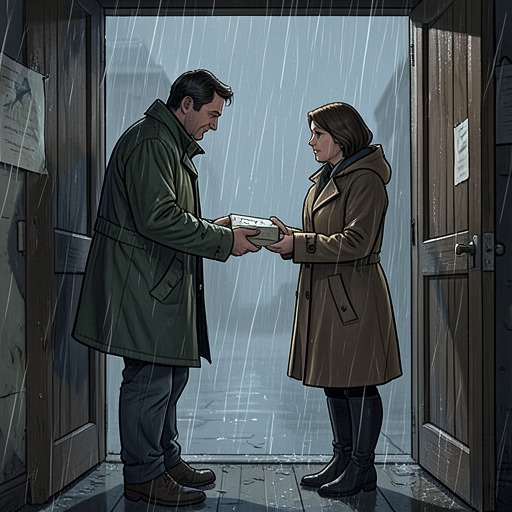
That encounter leads to a more substantial offer. Grant asks whether they have arranged somewhere to stay; Ray explains that they are camping and will not make Bude, so they need somewhere between there and their destination. Grant says that he is renting a farmhouse about twenty minutes away and invites them to camp in its orchard. The invitation turns the episode away from Duckpool’s empty stream and toward shelter supplied through personal hospitality. The farmhouse stands in striking contrast to the dry coastal stop: it has a stream beside it, and the orchard’s mown grass provides a place to pitch their tent beneath apple trees. A shower and beer are offered as well as a camping place.
The place in the journey
Duckpool’s significance lies in this sharp movement from expectation to failure, and from failure to unexpected help. The map and guidebook give Ray and Moth reasons to keep going toward the stop, but neither can guarantee that its facilities will work or its water remain. The landscape is not a dependable refuge simply because it is open or coastal; the walkers must read it, endure it, and adjust when the resources they counted on are absent.
The nearby farmhouse also makes the episode more than a story of deprivation. The walkers’ need is plain, but their next possibility arrives through an offer from someone they have just encountered, not from the amenities they sought. Duckpool therefore marks both the limits of route information and the contingency of their daily life on foot: a dry stream and locked toilets can defeat a plan, while an orchard and its flowing stream can appear through human kindness. The stop’s importance is not that it provides the water Ray and Moth hoped to find, but that its failure leads them toward a place where they can rest, wash, eat, and camp.