Edgelanders
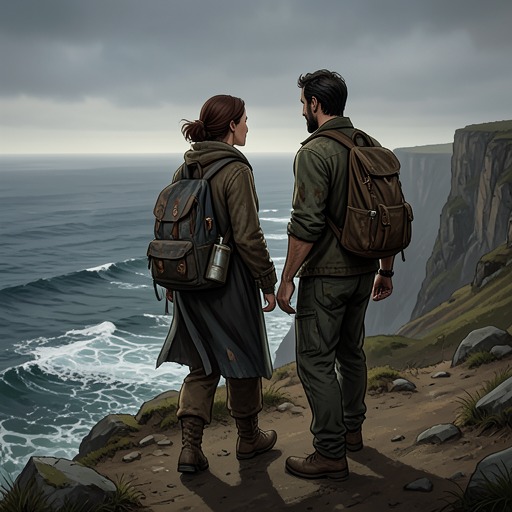
The Salt PathEdgelanders is the name Ray gives to a way of life shaped by the narrow margin between land and sea, where homelessness becomes both a material condition and a vantage point from which to reconsider belonging. The word holds together the contradictions of Ray and Moth’s journey: they are without a home, yet find purpose and a measure of freedom on the path; they keep moving by choice, but began because there was no door to return to.
From homelessness to the path
In early August, in Taunton, the distinction between travel and homelessness became unmistakable to Ray. Travelling had once meant knowing there was a point of return, somewhere to put down a bag even if it was also the place she was escaping. Now the couple stood beside their rucksacks with no door to go back through. The pavement felt like the safest place they had, and Ray did not want to move. That stillness captures the pressure behind the Edgelander identity: movement is not simply an adventure when no stable home waits at its end.
The journey towards Minehead gave that movement a direction. At the monument marking the start of the South West Coast Path, the couple delayed among photographs and adjustments to their packs, excited and afraid, homeless and aware of Moth’s illness. Starting a 630-mile walk supplied a purpose when they had little else to do. The purpose did not make the circumstances voluntary, but it made the next step possible. Early on, the terrain resisted the guidebook’s mild description: above Minehead, a steep zigzag climb forced them onto a bench to catch their breath and reread Paddy Dillon’s South West Coast Path guidebook. The route they had chosen was already teaching them that an abstract line on a page would be measured in bodily effort.
A border made through walking
The path’s edge is geographical, but Ray describes it through bodily sensation. On a hot cliff path, the rock returned heat to their faces; a gust lifted beneath her rucksack, and height brought a sudden feeling of flight. Moth leaned away from the sea while Ray felt drawn towards it. Their different responses make the landscape more than scenery: the same exposed boundary produces exhilaration for one walker and unease for the other.
Walking also remakes time into a rhythm of manageable demands. Ray recalls pain and hunger mellowing into ache and thirst, then softening into a steady beat beneath the sound of the sea. At Port Quin, the former fishing settlement seemed to have become a collection of weekend homes; local rumour held that its fishermen had gone to Canada in pursuit of better catches, leaving lobster pots to weather as garden ornaments. The walkers’ views behind registered the miles already passed, while those ahead narrowed towards another corner and another turn south. The route repeatedly put departure and continuation beside each other: places left behind, stories of people who had gone elsewhere, and a path that kept drawing them onward.
That repetition did not produce a settled destination so much as a practice of staying with the next step. Ray says the walk had become a meditation, a mental space filled by salt wind, dust and light rather than by plans. Each climb out of a combe could count as a victory, each survived day as a reason to face the next. In this account, the edge is not an escape from difficulty; it is where difficulty is broken down into a sequence that can be endured.
The social edge and the name
The couple’s homelessness also places them at the edge of other people’s understanding. When they explained that they had lost their home and were walking because they had nowhere else to go, conversations often ended in discomfort and the other person withdrew. They began saying instead that they had sold their home for a midlife adventure. That small change made their story more acceptable: homelessness following a sale could be treated as inspirational, while homelessness following loss invited stigma. The invented account was a form of self-protection, for their listeners as well as for themselves.
Repeating the more palatable story seemed to soften their grief, though Ray wonders whether the same habit of denial affected how she faced Moth’s illness. This uncertainty gives the idea of living at the edge a psychological dimension: the couple are caught between what they can say publicly and what they can bear to acknowledge privately. Their walk may have begun as a way to shape a future, but it also becomes a space in which memory and loss are worn down gradually, through exertion and attention to the immediate world.
Ray later asks whether people on the path are all searching for something missing, drawn to a strip of wilderness where they might accept their lives or find another way of being. She imagines Edgelanders as suspended between worlds: tame and wild, lost and found, life and death. Moth teases her for becoming another Cornish sage, and Ray wonders whether that might be the answer; he reminds her that they had said they were walking because they had nothing better to do. The exchange keeps the term open rather than turning it into a settled philosophy. Edgelander is at once an insight drawn from the journey and a name the walkers can laugh at.
Choosing movement, fearing its end
At Land’s End, the couple could have taken a bus away and returned to the relative familiarity of Wales, where they might seek council housing and a winter campsite. Moth held Ray’s hand as the bus doors closed. Later, watching another bus leave, they sat dripping beneath the visitor-centre archway. They were cold, tired and hungry, but chose to continue because walking left them in control of whether to go on or stop. Staying with friends or family risked becoming a burden and wearing welcome down into mere tolerance. On the path, their freedom was real, but conditional: it existed within homelessness, weather, exhaustion and the need to keep finding somewhere to sleep.
When they resumed the route from Poole, they were still homeless, though now with a possible end date. They had arrived at South Haven Point, the path’s eastern endpoint, and turned back west towards Polruan, where their earlier journey had broken off almost a year before. The marker recorded 630 miles between South Haven Point and Minehead; for Ray and Moth, the familiar finishing marker became a new beginning, with about 250 miles left. Moth’s confusion and the decline associated with corticobasal degeneration sharpened the stakes of continuing. The path remained a source of familiarity precisely because it was unknown: Ray felt its pull and judged the decision right, even as Moth sat with pain and she rubbed his shoulders with an ineffective pain-relief gel.
The possibility of an end to homelessness did not remove the fear of what would follow. As Plymouth approached, Ray saw the city as a doorway into an unknown future. The routine of packing the tent and walking had given them certainty; stopping would mean confronting money, practical arrangements, unfamiliar people and the question of what would happen to Moth. Their anxiety surfaced again in a frustrated exchange about why they had never made plans, followed by the prospect of a tour of Plymouth and the fear of sleeping in a town. Edgelanders therefore names no completed arrival. It describes a provisional belonging made on the move, powerful enough to carry them forward but unable to guarantee what lies beyond the path.