Fetch as a metaphor for life
The Salt PathFetch as a metaphor for life names both a physical measure and a way of understanding momentum: the distance wind travels over water helps determine the wave it creates, while life’s direction and strength depend on forces that may still be gathering. The metaphor shifts from explanation to encouragement, then becomes a way to read the walkers’ changing relationship with the wild coast.
The wave and its making
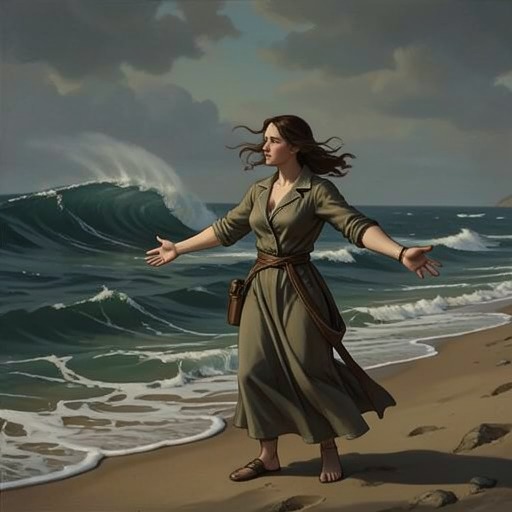
A man explains that a wave begins when wind blows across the sea. Its force depends not only on the strength of the wind, but on how long it blows and how far it travels over the water—the fetch. Strong wind, long fetch, and a suitable stretch of coastline can build a large, clean, powerful wave. He applies that process to his companion: the gale has already risen, but the fetch is still running, so the wave has not yet reached its full force. The image makes difficulty part of an unfinished process rather than a final condition.
Encouragement to keep going
The same idea becomes practical advice when the man learns that the walkers have travelled at least as far as Land's End. He says he has always wanted to walk for days and days; the reply is to pack a rucksack and begin, since nobody knows how long their fetch will be. The metaphor carries urgency as well as possibility: a life’s available distance cannot be known in advance, so desire is a reason to start rather than wait for certainty.
The coast as a changing measure
As the walkers continue, the image moves from speech into their surroundings. Between land-slipped cliffs and breaking waves, they feel both confined and free, on the edge yet part of the scene; their strength, like a wave’s, is still building. Near Zacry's Island, they gather mussels from blue-covered rocks and boil them in a pan, using a penknife to pick out the flesh. Passing people recede as the walkers become observers rather than participants, and the boundaries of their world seem to fade into sea, sky, and rock. The salt path itself comes to redefine their fetch: the metaphor no longer describes only a force acting upon them, but the distance and experience their journey is making. Later, exposed to the Atlantic on the fort at Trevelgue, they endure rising wind and torrential rain before sleeping for twelve hours under their waterproofs. The coastal journey gives the metaphor its double edge: exposure to the elements and a growing capacity to continue through them.